Showing posts with label intercultural communication. Show all posts

Monday, August 14, 2017

Holidays in Canada

Canadian taking our picture
I just returned from a vacation in West Canada. It was not my own idea to go there, my husband and daughter really wanted to go. I did not really know Canada except maybe the remote farm of Riks from Farmers wants a wife. It is a very special country! I found the scenery and the colors very beautiful and also so much space compared to the Netherlands. Occasionally we drove 2 hours by car without encountering a real village. People are very nice, too, quick to chat with you. For example, I wanted to make a picture of my daughter when a passerby thought we had to be in the picture together and the camera was already out of my hands. I enjoy the cultural differences on holidays, even though Canada is also a 'Western' country and traveling is different from living/working in a country.

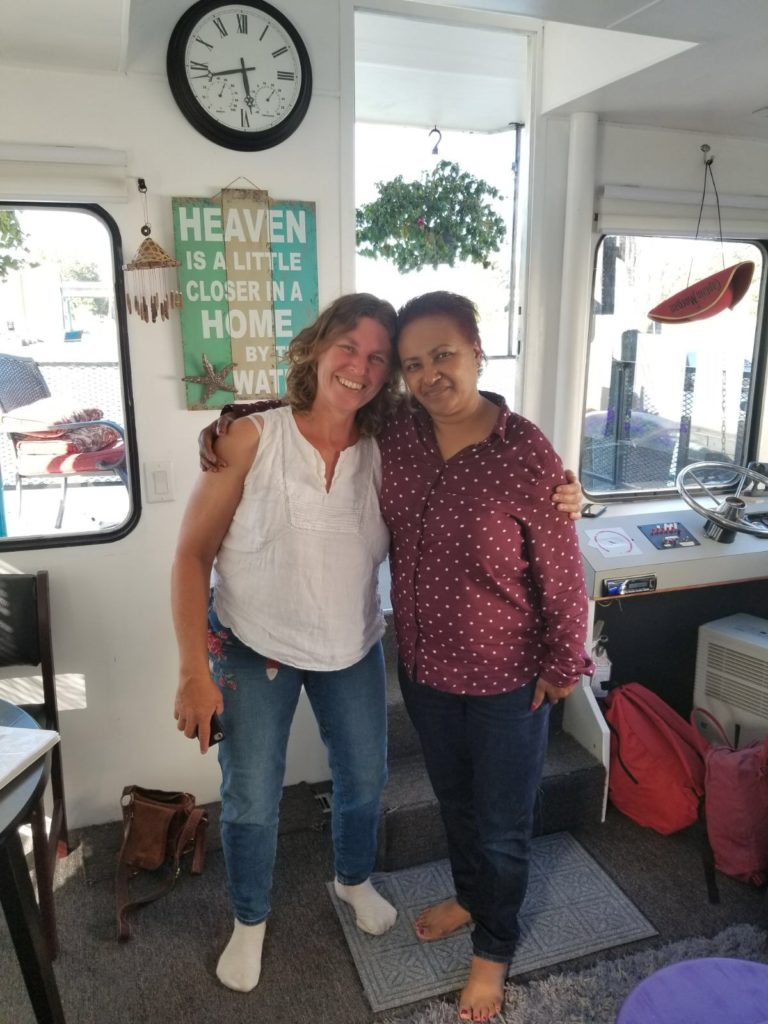
With my friend Kidist
It was also a reunion with three Ethiopian friends (two living in Canada and one in the USA). It turns out that the relationship does not change at all, even though many years pass: it was as much fun to see them as in Ethiopia. This way you can see Canada again through Ethiopian eyes. For example, what was funny was that the ladies' toilet was occupied and so I just went to the man's toilet. But my Ethiopian friend was totally shocked: that is highly offensive! She therefore preferred to wait another 10 minutes rather than to follow my bolt step. Their children had become truely Canadians, and knew much more in many ways than the parents, were fluent in English. That seems to me weird as a parent. Nice was the response of our friend who was rather enthousiastic about it: "I learn a lot from my son and daughter".

 And life with bears ... Bears are in Canada just like the weather in the Netherlands I imagine. People often know where bears or other wildlife are signaled and pass this information. It is normal that when there is a bunch of cars along the way, you know there is something to see, a bear or a moose. They also know how to deal with bears, eg do not leave any trash left. A lot of ads on television could not be transported to the Netherlands because there are jokes with a bear, wolf or cougar.

Bear along the roadside
When using the internet, I noticed that we depend every year more heavily on internet also for planning the vacation. For instance we used Google maps for the directions and you can search for petrol along the chosen route. And we have waived visiting the Columbia Icefield gletscher for instance, because you can read from the reviews it is highly touristic and almost a tourist trap. It also made me wonder what business I would have on a gletscher. Actually I have read a lot less in the Lonely Planet and more on the internet. On the other hand, I noticed that I assume there is phone and internet coverage everywhere, but that is certainly not the case in Canada! We had bought a Canadian sim card, but you could not call in many places because there was no coverage Then you see how lucky and spoilt we are in the Netherlands. By the way, there was also a funny ad on the radio about dating stating: "if you tired of internet dating, join the BC dating club (British Columbia) with our organized events for singles, so that you can actually see and meet your dates and get to know them face-to-face".

I also liked to occasionally share pictures or updates via Facebook and Whatsapp and see what others are doing on vacation. Thus I discovered that 3 acquaintances had also been on Vancouver Island and were equally enthusiastic. You hear more often that people try to stay offline during the holidays, but I also found the internet super handy during the holidays, so no #offline for me! 

Monday, March 03, 2014

Solving collaboration issues with technology is a myth

Yvonne van der PolThis interview is also posted on our Dutch blog Ennuonline. Yvonne van der Pol has her own company called Luz azul trainingen, advies & coaching and works within the domain of intercultural 'craftsmanship' (not sure how it translates in English but the Dutch term vakmanschap is wonderful). She did our learning trajectory on learning with new media Leren en veranderen met sociale media where she designed a blended trajectory about intercultural effectivity, in-company as well as a course for open inscription. The core of her work is to improve working relationships from people with different cultural backgrounds. We live in a ‘global village’ because of internet - every country is one click away. I interviewed her because I am interested in learning more about working interculturally online... which I do a lot by the way.

Where is the source of your interest in intercultural 'craftsmanship'?
I've studied Sociology of non-Western societies and worked in international cooperation for 10 years. When I was 18 years old I went to the United States, I experienced that you enter into a different culture and you have to adapt. On the surface there appear many similarities, but beneath the surface there are major differences. When I was in Costa Rica for research later, I encountered other intercultural challenges. For example, I gave a presentation which contained criticism.. The next day the director refused to greet me. That made me think about the importance of communication and intercultural skills. In another culture there are very different assumptions and methods to decipher and interpret the world.

Is collaborating interculturally a skill which is more strongly developed because of all the developments triggered by internet (eg. large gaming communities)?
DeepCultureModel
Indeed, it seems that we now live in a global village, the Internet connects the entire planet. However, that is only on the surface. There is a difference between surface and deep culture (see Deep culture model of intercultural adjustment of Joseph Shaules). Regarding surface culture: we are indeed coming closer. An online gamer may experience for example an American or Chinese situation in the game. Young people experience more different things and different cultures than before. However, the deeper understanding and skills you develop to work interculturally are not developed. It is an illusion to think that with globalization, intercultural skills come naturally. I'd say on the contrary, sometimes prejudices only increase. At the same time it is true that the development of intercultural skills is increasingly important as more work is international, from horticulture to retail, from science to education everything is becoming more internationally oriented. The question is: "how are you going to understand each other better?" Take for instance the cooperation to build wikipedia. That communication is very multilingual - but native speakers have an advantage over non- native speakers.  Native speakers may sometimes empathize less with people who can not express themselves with nuances. Another example is: the open data movement. There is much to do about improving transparency and making data accessible. This conviction also stems from a cultural belief. If you are born in a country where you're not safe, there can be a lot of anxiety around online sharing of information and experiences. If you do not take this undercurrent in your approach to open data serious, then the project is perhaps less effective than hoped ... If you want to read more, go to Yvonne’s blog.

Do you think new technologies make collaboration internationally easier or harder? Why? 
The new technologies make communication easier and cheaper for sure, you can work with Skype, webinars, email, Yammer, and other tools. This makes collaboration internationally more practical than 20 years ago. But you have organize this collaboration specifically. It is a myth that technology will resolve collaboration across borders and across cultures. Technology can also obscure the difficulties: everyone continues to work from personal and cultural assumptions. Importantly, it is always about creating confidence to effectively work together. The new technology is fantastic but you have to learn to use it effectively to work together. That's the same as always: you have to stay alert to human interaction, pay attention to non-verbal communication in virtual teams. Is there no answer because the technology does not work or because someone is disengaged for other reasons? And then how do you solve this?


Can we learn something from the field of intercultural effectivity for learning to work with new media? Is there a parallel between learning to work in a new culture and learning to work with new technology? 
There are definitely parallels that can be drawn between the use of new media and moving into a new culture. In both cases you enter a new situation where you do not know the codes- how to behave. You crave for knowledge about how it works. Knowing yourself and how you react in situations like this is important – how open-minded, curious, flexible, persistent, tolerant are you? Schermafbeelding 2014-02-24 om 21.26.23

I work with an online assessment tool, the Intercultural Readiness Check, which is based on three areas: Connect, Perform and Enjoy. In the intercultural competencies (see diagram) you can see the parallels with dealing with new media such as how to deal with uncertainty? Some people enjoy jumping into something new, others much less so. How do you connect with each other online, and how to effectively work together?  So you could easily say that Connect, Perform and Enjoy are true both for personal intercultural skills as for dealing with new media.

Friday, February 05, 2010

Understanding intercultural misunderstandings

This is a funny video with a strong message. I found it through the blog of Raf Stevens. Watch it first if you have the time (2,5 minutes). It shows what a mental framework or 'schema' is and how it can lead to misunderstandings.


If you can't relate a conversation to your own experiences, it often makes no sense at all. When people talk from different mental frameworks, it is easy to misinterpret what is being said. Did you think it was about washing cloth or did you already have another interpretation?

This type of misinterpretation happens a lot in intercultural communications (intercultural communications can be between people from different nationalities, but also from different neighbourhoods or disciplines..). So any conversation where the mental framework is very different you have to be aware of this possible misunderstanding which is always around the corner. An example (but after 10 years in different countries I have many ofcourse..): I have a close Ethiopian friend who lives in the united states. When we visited her she locked herself out of the house. The way you deal with it, the decisions you make are very much tight to your framework. We prefered to pay a locksmith to allow us to enter the house. She prefered to call a friend and stay there. Only if you are aware of the fact that your reference frames differ so much, you can work through your differences (though you may still get conflicts...) It happened to us too when we did an assignment for a research program. We didn't know the schema from the research program and what we wrote down was misinterpreted, leading to frustrations on both sides. In this case neither party invested in resolving the misunderstandings.

What to do? When you are talking or presenting, assess how different the framework of the others might be.. A management view can also be very different from an employee's view. Try to make your own framework clear, by using stories that illustrate your own experiences. Try to talk about practical examples and try to avoid jargon...

Monday, April 20, 2009

Every question can be misinterpreted (communication is hard!)

"Would you rather have lived in Leidschendam?" that sounds like a pretty straightforward question to someone who knows that Leidschendam is a town in the Netherlands, isn't it? (and when you see the picture here of the center of this town the answer would Yes!) But even to this question there are two interpretations!

I'm doing a series of interviews with neighbours in our (young) area. This was one of my questions. I always think I have been trained on the job by living in Mali, Ghana and Ethiopia to formulate my questions as clear and unambiguous as possible, so I was surprised that this question was interpreted in a way that escaped my observations. I thought the interviewee answered it the way I intended it: whether she would rather live in the town called Leidschendam than in the Hague. I didn't realize that this part of the Hague where we live used to be part of Leidschendam. So she interpreted it as 'Would you have liked this area to be called Leidschendam rather than the Hague"? Fortunately we were two doing the interviews and the other person knowing the history better than I understood this different interpretation. Confusion, confusion...

This is even a small confusion compared to the misunderstandings we have around concepts related to knowledge management for our paper on impact assessment of knowledge management strategies. It shows communication between people from different backgrounds, frames of mind or mindsets can easily be distorted. It shows the importance of a common framework for easy communication. After all, old couples really only need half a sentence.. But where that framework is absent, we have to be careful.

So how to work with this? If you are aware of this distortion, you can try and work in tandem with people who know more about the background (in this case, the co-interviewer). It really calls for teaming up, because working in two's makes this easier. And you can build in sufficient checks. When a common understanding is crucial, you write it down, or paraphrase it in a conversation. That allows you to see the misunderstanding. When you have a skype conversation, you can type your understanding at the same time while you talk, that also help for clarification.

Nancy Dixon has a good blogpost on perspective taking and how you can learn something new by opening your perspective to other people's perspectives. She argues that this already starts by using inviting language.

Monday, February 16, 2009

Do wikis change development work?

Friday 13th was well and safely spent in Utrecht where ICCO organised a session with David Weekly, the founder of Pbwiki. I wrote a somehow faithful summary for the icollaboration weblog (which is starting to look more like my blog than a teamblog...but never mind since I believe in making what's happening in the group accessible online!).

I will use this space to elaborate more on my own thinking and my sceptism. Though I'm a social media adopter, I also have my reservations. For one thing, it was interesting to understand from David Weekly what the online wiki niche is. Large companies have their own online packages and stuff (like sharepoint) but that wikis like pbwiki come in handy for cross company collaboration. People in large companies are setting up wikis because the other applications run behind firewalls that are not accessible to partners in other companies. In development, this is a different case. Large organisations may have applications, but smaller development organisations in the north or organisations in the south may not have invested in any systems. Wikis (free or for a small sum of money) are then a good solution that empower people to set up wikis to collaborate with others online. If you know how to work with wikis and have a certain level of access to the internet that it. Easy and free= empowering?

However, I have the impression that so few people like working with wikis and are comfortable working with wikis that the real revolution that Shirky promised, worldwide collaboration at scales we have never seen, is still very far ahead for development. The wiki examples are more online libraries build by a few enthousiastic persons than representing a new way of collaborating. It looks cool to put a conference online is a wiki, but how does it support learning and decision making? Maybe I'm putting my expectations of wikis too high in a way. And we may not have investigated it enough.

My worry is that if development organisations set up wikis to do the same work they used to do- it might not change anything substantially in the distribution of powers in the current development process. I guess that needs more, a vision of what to build or collaborate on (like wikipedia had ofcourse a great vision of becoming an online encyclopedia), and a process to bring stakeholders together around that vision in a new manner. Or the other way around, having a spontaneous collaboration. But maybe a much larger group needs to be comfortable working with wikis and other collaborative tools before that happens. Being overoptimistic may be counterproductive.

Ofcourse a wiki is only a tool, like a hammer, and anyone is free to use it as he/she wishes. But somehow the tools seems really powerful in the hands of a community. Like the km4dev wiki is a growing resource and dynamic repository. But it's not easy to stimulate people to make their hands dirty. And many may learn more from the verbal interactions than looking at the wiki so we should not overestimate the importance. It's a gut feeling that we should not measure change by the number of wikis, but by how the wikis changed the participation in the processes, and the truth is that we might exclude people too. I'm fearing too that partners organisation may start wikis because they have the feeling some donors are suddenly into wikis. But that may be diverting attention from what we should really focus on. Any ideas? Do you share my concerns?

Monday, October 06, 2008

Clash of generations

Via Steve Bridger I found this cartoon on the clash of generations on the Geek and Poke blog. On my Dutch blog I wrote the story about the train where a girl was looking for the women's toilet. I told her the toilet in front of her was for everyone. She answered that it was written that it was for 'men'. That was true, but 'men' in Dutch is a rather old-fashioned way of talking about men and women jointly!

Wednesday, October 01, 2008

Secrets and lies

If a conference is well blogged, and video-ed, you can probably learn as much from it as when attending.. At Picnic I heard people talk about the fact that men lie about 70% of the time on internet and women about 30% of the time... it made me curious how this was measured. And it may be reflective of face-to-face communication?

Anyhow, I just found a post by Ethan Zuckerman blogging Genevieve Bell's presentation on secrets and lies.
"Men and women lie differently. Men lie more, and we’re not as good at it. Men lie about their jobs and cars. Women lie about their weight, age and what they’ve purchased.
Why does this happen? We probably need to understand that lies aren’t always opposed to truth. They are often a form of self deception, a way of coping with the world. “Lies are not always opposed to truth - they are opposed to reality.” Children lie to test boundaries, to discover what is and isn’t an appropriate response in conversation. Is it okay to say that you’re seven when you’re actually three?"

She also point to the cultural determination of secrets and lies:
"Secrets are different than lies. Genevieve grew up in indigenous communities in Australia, and there secrets are a big part of life. Not everyone gets to know everything - there’s knowledge held only by women, only by men, only by the old or the initiated. She tells a story about indigenous women wondering at white women’s honesty with their husbands. “The white men asks, ‘What did you do today, dear?’ And the women answer! And the women I spent time with were howling with laughter over this.”

I recognise this as in Ghana there was definitely a different perception about what is allowed as secret or lies. Some lies are publicly known as lies to insiders, it is only the outsider that may be confused... Back to the internet: I have the feeling that the more you are online, the more you have to be honest, since everything gets connected. The more people you add on twitter, the more likely it is they know it when you are lying. But that sounds a bit contrary to her findings about lying?

Sunday, August 31, 2008

Employees Must Wash Hands

I am back home from a one month holiday in the eastern part of the USA - my first time to visit the US which was very inspiring and revealing! I thought I would blog on the way; but I didn't get to it because I did not spend many hours on computers. Somehow I thought you need to blog regularly to prevent that your readership will drop drastically. It is nice to see that isn't the case. I don't see any noticeable drop after 4 weeks at least.

Visiting the US was interesting because seeing part of the US made me understand a lot of the movies I have seen, and world politics, economy, etc. in a different way. The US is not a new country you don't know anything about, but seeing it with your own eyes makes a huge difference. When you work in an African country, people from the US and Europoe are often seen as 'Westerners'. It was impressive to see the cultural differences between the Netherlands and the US, but also to experience that as a newbie you don't know about many things and don't understand them. At first we didn't know how to fuel our car ('lift the lever') for instance. One of the signs in the bathroom struck me as utterly weird- the sign you see in the picture reading "Employees Must Wash Hands Before Returning to Work". At the end of the trip it felt normal seeing the signs (you see them in virtually all the bathrooms in restaurants-called restrooms by the way). I still wonder whether the reminder is seriously intended for the employees - which seems quite paternalistic to me to be told to wash your hands! Or rather for the customers to show the company cares about hygiene. Anyhow, this is just one example of how a newcomers looks around with fresh eyes.

To make the link to knowledge management in organisations: I guess organisations could make more systematic use of this phenomenon by asking explicit feedback from their new employees after a certain period on job. I heard of an organisation that did a 100- days feedback. Seems that can give very good insights and would allow the managers in the organisation to see the organisation with fresh eyes.

Monday, May 26, 2008

Bridging and bonding in communities of practice

I read in the newspaper that ethnically mixed neighbourhoods have lower levels of trust in general. This was already proven by a research by Putnam in 2007. Dronkers and Lancee repeated the research in the Netherlands and reached the same conclusion. BUT the inter-ethnical level of trust in heterogeneous neighbourhoods is higher than in the others. Which is kind-of logical: when you meet people from other ethnic groups you are likely to see that they can be kind and friendly too. In the homogeneous neighbourhoods, the social trust is higher, but the image of different ethnic groups can be very negative.


It sounds like a description of my old and new neighbourhood! I moved last year from a homogeneous village to a mix area of the Hague.


What really triggered me to blog about it was the coining of two terms: bonding social capital and bridging social capital. I recently attended a ecollaboration meeting where the people with developer skills were in the lead because of the topic chosen for the meeting: open source. As non-developer I could see how interesting it was for them to connect. On the other hand, if you don't pay attention, you get a reinforcing loop towards the developers side of the domain of ecollaboration. It was suddenly very obvious to me that the role of a facilitator of a community of multidisciplinary practice includes balancing the bonding and bridging social capital. Try to make sure that there is enough space for bonding between the disciplines, but include sufficient bridging capital. That sounds quite abstract, but I think it means being aware of the member who play a bridging role and enabling them to continue to play the bridging role. At times this may not need any intervention, at times, this may need some attention.

Secondly, since we facilitated the community of practice with a group of four non-developers, it might have been easy to overlook the needs of developers to connect and discuss at their level of interest. So whenever possible, try to have a balanced core group too.

Saturday, April 05, 2008

'Can you repeat yourself?'

I love working in intercultural settings. So I'm very happy that I find myself in this situation again working in the Netherlands teaching an international class of students. All of us have English as a second or third language. Yesterday I swapped stories with colleagues. I shared that there are times when you simply don't understand what a student is saying. Depending on the situation, you decide whether you ask him/her to repeat it. At times, you think it's best to nod in agreement and really hope that it wasn't a question! Others shared how it works for them to fill in the empty spaces in what you hear with some empathy. And try to summary and check whether your understanding is right.

A pitfall in these situations is that you may confuse intellectual/analytical skills with skills to express oneself. Being aware of this pitfall hopefully helps. As a teacher, I try to work with as many signals about the students performance as possible (it's an experiential course without test exam). Therefore I attended some team meetings too. That really gave a different view as compared to the class situation. Furthermore, I stimulate students to communicate online by using e-mail or our google group. The google group has helped in two or three confusing situations to clarify the situation. In that way, the multiple channels seem to contribute to improve 'regular' communication in class and clarity about the work.

Wednesday, April 02, 2008

The Italian man who went to Malta

Via Guido Sohne I discovered this video with the Italian man who went to Malta. It's a funny example of miscommunication. At the risk of causing another layer of intercultural miscommunication about Italians ...

Thursday, November 22, 2007

My blog in Arabic

Somebody in Egypt is reading my blogposts in Arabic! I found an Egyptian interested in my Carnaval and Aquasan blogposts; by following a referral link to my blog. It looks really great. So if you ever end up in an Egyptian carnaval you know where they picked up the idea.

We often encounter the question of working across different languages. It depends on the importance of the exchange whether you invest heavily in translations or not - by employing a certified translator.

An alternative could be to offer quick and dirty online translation services like:


Wouter tipped me about two resources explaining how to add translation services to your blog:

Britt Bravo showed me her blogpost explaining the Worldwide Lexicon project. Using open source, this project stimulates readers of website or blogs who are bilangual to translate parts of the website in other languages. It is somewhere in the middle of the machine translations mentioned above (weakness: mechanical translations) and professional translations (weakness: costly).

What's the best tool at the moment?

Thursday, October 18, 2007

How to explain blogging in Ghana

(picture:openingsceremony training web2.0 for journalists, source penplusbytes)

I'm still catching up with my bloglines.. after my summer holidays I could not keep up and have these kind of number (183) behind the blognames, which is extremely discouraging and even stopping me from reading. So I'm trying to reduce the number of blogs on my bloglines too. But going through them, I do like the wide variety of blogs, giving such different views to the world...

From Emmanuel Bensah's blog I got a report by Mr. Abissath about a blogtraining Emmanuel gave in Accra. The write up is so elaborate and different from the other blogposts I was reading that it made me happy and I can just imagine the scene of the training and the atmosphere in the room there.

"As stated in the opening paragraph of this write-up, when Emma was taking
us through the Blogging lesson, he made the subject matter so interesting with
his famous analogy that the learning became fun for us all. Before he started,
he asked the class that all those who were married should show by hand.
Virtually everybody in the class raised up their hands. Initially, nobody knew
what he was driving at some of us even raised up both hands. Then he proclaimed
(and I am paraphrasing him here): As behind every married person there is a
partner - a wife or a husband, so, too, behind every Blog there is a Blogger!
Suddenly the entire computer lab burst into spontaneous and prolonged
laughter. He himself could not help it but to laugh infectiously. Then someone
asked him whether he himself was married and he said capital NO. So it turned
out that all the students in the class were married expect the lecturer rather.
When he was asked why he was not yet married, he responded: "I am studying you people and I want to learn from you first." His answer to the question made the class to laugh even the more. Emma could be in his 30s or so and he is a man of impeccable and fantastic sense of humour."

The name Emma is used for Emmanuel. The full post by Mr. Abissath can be found here. More information about the full training can be found here. The training is a follow-up from the web2.0fordev conference that took place in Rome. (help! another blog with (105) behind its name!)

Saturday, July 21, 2007

The news: no news

In Ghana, the Volta River Authority (VRA)'s main function is to generate and supply electrical energy in Ghana. For some time now, there is an energy crises in Ghana and every other day, you'll be 12 hours off electricity (alternating day and night shifts). This includes ministries and business areas, so you can imagine it affects work seriously, let alone the domestic troubles it gives. Yesterday one of the news items on the Ghanaian television was that there is no news on the energy crises. There was a briefing for journalists by officials of VRA planned on the energy crises yesterday by 9.00. By 12.00 someone came to explain that the briefing would not take place... So this became the news item.

I'm not blogging this to ridiculize the VRA officials, but I do think it shows how they continue to think and act according to a pre-media model, where officials can arrive as late as they want, and can even cancel meetings after letting people wait for hours. Yet, currently with the new media like television and internet, this will become the news itself. Strikingly, the meeting was called 'briefing for journalists' and not a press conference.

Wednesday, July 04, 2007

Argyris and intercultural settings

Last Friday I attended a the M&O conference 'samenwerking in allianties en netwerken' (=collaboration in alliances and networks). I think it was my first real conference, you're never too old to attend your first conference... and immediately I can join the unconferencing movement. Can't say I was impressed by the general level of presentations and sessions. BUT a real treat was the presentation by Chris Argyris. And it was really cute that he was using a good old overhead projector with slides (see picture). That did not diminish the power of his presentation. It was impressive how he told a story and explained both theory in use versus espoused theory as well as model 1 and model 2 thinking and behaviour, and I felt like he had explained the book I read (knowledge for action) in less than 30 minutes. He stressed that model 1 behaviour is universal behaviour.

One question I have is whether working in intercultural situations helps to move towards model 2 thinking and behaviour. Model 2 is behaviour where you try to make your assumptions explicit, check them and ask for feedback. Unfortunately I didn't dare to ask him (even though I spotted him in the corridor)..

Sunday, May 13, 2007

Happy end of ramadan!

A friend told me the following story. It is funny but a nice example of intercultural communication (and how easy it is to create misunderstandings) too. Fortunately, she allowed me to blog it:


I work in a large, international development organisation with thousands of staff in various countries all over the world. We have a corporate e-mail system whereby it is possible to send a mail to all employees at once. One day, towards the end of ramadan, a person from a country in West Africa send a message to all to wish every one a happy end of ramadan celebration. Others started replying thank you, etc. The IT persons at the headquarters were panicking because a lot of mail traffic may bring the system down, so he sent a message warning people not to send these kind of messages around. But that aroused very bad sentiments within the West African employees, and they started reacting to his message by challenging their right to wish everyone a happy end of ramadan, as they would wish for Christian holidays. So the whole discussion became even more heated on the issue of muslims versus christians (everyone sending mails to thousands of staff) and the IT department panicking even more.


You see how easily the intentions of the IT department staff get misinterpreted. Probably the West African staff may not be aware of the implications of sending messages all over the globe, both for the system as well as for using the staff time. There is a dimension of people from different backgrounds giving different levels of importance to these kind of messages too (they may think this is not wasting time). I can also imagine there may be more general frustrations about unbalanced attention for Christian holidays over Muslim holidays leading to this interpretation by the West African staff...

Wednesday, April 18, 2007

Read my blog in chinese and french language!


Since I couldn't read my own blog in China, I'm happy to discover that some people are reading my blog in Chinese language! I found the french and chinese translations of my blog when I looked through the referals to my blog. Both persons used google translations. I can't say anything about the quality of the chinese translation. The french translation of the heading is quite good, but the quote has become really hard to understand because I used a Dutch text...

Saturday, March 31, 2007

I'm in the field

Last week I met a researcher who asked me about my work. He asked whether I was 'going to the field'. I replied no, but when I dropped the word Accra, while talking about my work the conversation became very confusing. It appeared the researchers considered all work in a research country as 'field'. As an irrigation engineer, I'm raised in the conviction that anything to do with office and not sufficiently muddy, is not 'field'. Hence my firm No-reply. A good example of the fact that crosscultural communication is not only between nationalities, but also between professions.

So in his language I'm now in the field (Accra). See in the picture that being in the field for me now means driving in cars (sometimes while colleagues are all talking to their own mobile phone)... Though I can understand this definition, deep down, I really disagree with this definition and miss the real fieldwork of walking in the rice fields and talking to farmers.

Thursday, February 22, 2007

More oneliners

There is some contradiction in the fact that the busier I get working with communities of practice the less time I find to blog about my experiences. And a blog does not seem the best place for digesting experiences, rather for pointing to new articles, phrases, things you overheard that ring a bell, etc.

So here are two oneliners I heard at the end of a meeting about e-tools and communication, worth sharing with you:
'Communiceren is zo dicht mogelijk langs elkaar heen praten'
(seems to be a quote from Seth Gaaikema :)
'Luisteren is wachten tot de ander is uitgepraat'
I discovered the first one is quite famous and even the titel of a book.

Those are hard to translate but let me try: 'communication is trying to talk as closely as possible past each other' (don't know if that's still english). The second one is easier: 'Listening is waiting till the other finished talking'

Saturday, January 27, 2007

Tony Chocolonely talking to cocoa farmers

I've been too busy to blog, but the blogideas do keep coming in my head. So it would be better to allow time to let them out..

I've watched one episode (no. 4) of the 'keuringsdienst van waarde'. Unfortunately, it is not yet online, but it will be available here.

The story line is that Tony Chocolonely buys fair trade chocolate in the Netherlands. With Fair Trade farmers get a higher price for their produce. At least that's the idea. Tony goes to Ghana to find out what's actually happening. There's a dialogue with farmers which made me laugh outloud (out of sheer recognition). The dialogue between Tony and 3 farmers is roughly as follows:

Tony: 'So are you aware that you are Fair Trade farmers?' (something in his voice showing that he will have found something if the answer is no)
Cocoa farmer 1 and 2: 'No, we are not aware'
Cocoa farmer 3 (cooperative): 'I think you are aware'.
Cocoa farmer 1 and 2: 'Yes, we are aware'.

The rest of the dialogues are full of recognition for me too. The thing is that people are trying very hard to please the interviewer, but also try to safeguard their interests. So there are a lot of assumptions going on in their heads, influencing the answers. This makes it very hard to get the actual picture clear. Just a very practical example of intercultural communication in the context of development!