When I met Marc Coenders on Tuesday, who has written a book about communities of practice and has extensive experiences with CoPs in the Netherlands, I decided to pilot my first interview (to be honest I had carried my camera two times before without daring to ask the interviewees for an interview..). I was interested to know more about the dynamics of CoPs within the context of the Dutch culture, as I just realized that each national culture may bring its own specific dynamics to the art of cultivating CoPs, which may be more important to realize and learn to work with than generalizing the dynamics of 'southern' CoPs.
I asked him: 'what are the specific dynamics of CoPs in the Netherlands?' The interview is roughly 3 minutes and he explains partly in Dutch and summarizes in English towards the end. He stresses that every CoP is unique due to the self-organising nature and that it's hence hard to craft general rules. According to Marc, the Netherlands culture has strong positive and negative characteristics that do influence the functioning of CoPs. First there is a drive for results, to be productive, concrete and pragmatic. But with little room for philosophying. He misses sometimes attention for reflection and some long-term perpective in thinking.
(it was easy to do and VERY easy to upload with castpost!! except that you cannot choose the coverphoto. For my next interview I have to think of how to start, with or without the question and should try to avoid laughing)

In my blog I share about learning design with technology, blended learning & knowmad learning. I started with a focus on communities of practice. I share personal experiences, articles and cases.
Wednesday, November 30, 2005

Culture: sinterklaas goes digital
 For everyone who is not in the Netherlands: you can also put your digital shoe. Between 17.00 and 20.00 hours Dutch time you click on 'zet je schoen', click on 'nee', choose a shoe, put your name and address, choose a room to put your shoe, put your shoe in the room, add water and/or a carrot if you like, click on 'schoen zetten'. The next day between 7.30 and 16.00 you can see what's in your shoe. For the real sinterklaas feeling.
At work, we celebrate it the traditional way where you draw a paper with the name of one person for whom you have to buy a small present. But what's more important you make a poem about the good and bad characteristics of the person....
Tuesday, November 29, 2005
Communities of practice: reification
Dorine asked: Do Wenger et al. also outline some ideas on HOW to bring balance to situations where there is too much emphasis on reification?
I'm very scared that I interpret the theory differently as intended summarizing it so much :), so her question gives me the opportunity to explain more as I read it. Wenger writes in communities of practice, meaning, learning and identity:
Reification can take a great variety of forms: a fellting smoke signal or an age-old pyramid, an abstract formula or a concrete truck, a small logo or a huge information-processing system, a simple word jotted on a page or a long silence, a private knot on a handkerchief or a controversial statue on a public square, an impressionist painting of a butterfly or a scientific specimen in an entomological collection. What is important about all these objects is that they are only the tip of an iceberg......
An an evocative shortcut, the process of reification can be very powerful...
But the power of reification- its succinctness, its portability, its potential physical persistence, its focusing effect - is also its danger. The politician's slogan can become a substitute for a deep understanding of and a commitment to what it stands for. The tool can ossify activities around its inertness.
I find this part very important because I have seen it happening so many times that a tool (eg. PRA tools) start leading their own life and the whole idea behind the tools and methodology is not understood. For people who do not possess sufficient knowledge and skills about a topic, tools are very appealing and gives them something to hold onto. But the danger is that they do not understand the deeper levels of practice. So tools can never replace a thorough understanding and knowledge of a subject. And the development arena seems to be particularly fond of tools and toolbooks. (what a great opportunity to get this out!!). To answer the question: so reification is never a substitute for connecting people in practice and this may often mean working together or allowing people to come in an observe and observe.
Another example: at my posting about my daughter's school exercise there was a comment to add it as a good reason for homeschooling. Whereas I'm a big fan of the Dutch schoolsystem and would never be in favour of homeschooling!
I'm very scared that I interpret the theory differently as intended summarizing it so much :), so her question gives me the opportunity to explain more as I read it. Wenger writes in communities of practice, meaning, learning and identity:
Reification can take a great variety of forms: a fellting smoke signal or an age-old pyramid, an abstract formula or a concrete truck, a small logo or a huge information-processing system, a simple word jotted on a page or a long silence, a private knot on a handkerchief or a controversial statue on a public square, an impressionist painting of a butterfly or a scientific specimen in an entomological collection. What is important about all these objects is that they are only the tip of an iceberg......
An an evocative shortcut, the process of reification can be very powerful...
But the power of reification- its succinctness, its portability, its potential physical persistence, its focusing effect - is also its danger. The politician's slogan can become a substitute for a deep understanding of and a commitment to what it stands for. The tool can ossify activities around its inertness.
I find this part very important because I have seen it happening so many times that a tool (eg. PRA tools) start leading their own life and the whole idea behind the tools and methodology is not understood. For people who do not possess sufficient knowledge and skills about a topic, tools are very appealing and gives them something to hold onto. But the danger is that they do not understand the deeper levels of practice. So tools can never replace a thorough understanding and knowledge of a subject. And the development arena seems to be particularly fond of tools and toolbooks. (what a great opportunity to get this out!!). To answer the question: so reification is never a substitute for connecting people in practice and this may often mean working together or allowing people to come in an observe and observe.
Another example: at my posting about my daughter's school exercise there was a comment to add it as a good reason for homeschooling. Whereas I'm a big fan of the Dutch schoolsystem and would never be in favour of homeschooling!
Monday, November 28, 2005
Practical example: using technology to work with ICT4DJamaica
 I'm working with ict4djamaica; a network of organisations working in the field of ICT for development in Jamaica to assist them in the development of a sustainability strategy. I'm doing this from the Netherlands, without traveling to Jamaica. It a bit of an experiment and I'm surprised how easy things seem to flow and fit together so far. I had discussions by mail and telephone (skype did not work, probably due to the speed of their connection) to co-construct the questions, process and expected results. When my colleague travelled there, I drafted a session plan for a face-to-face meeting for the board and a few members to kick-start the process which was facilitated by another consultant in Jamaica, and was apparently a very lively and energizing session. Now we continue with an online discussion in Dgroups, a discussion space they are all familiar with. I'm just surprised how comfortable everyone seems to be with working with a person at such distance. I asked them to introduce themselves with their name, organisation, what they like about their work and someone they would like to send an email and there are some great replies which make me laugh.
Not too long ago I discussed with someone the possibility of working with some organisations abroad and the person responded that she did not want to travel. Through her response, I realised I had assumed a collaboration at distance using various technologies. My participation in the Foundations of communities of practice workshop and the Online facilitation course have changed my perception about what is possible working at distance (not just online, also using teleconferences), I think you have to experience this once to believe it. Apparently for the people of ICT4DJamaica it not too hard to be at ease with the option of working at distance with trust. But OK, we just started, will tell you more in February when we will have finished the process :).
Saturday, November 26, 2005
Culture and snow
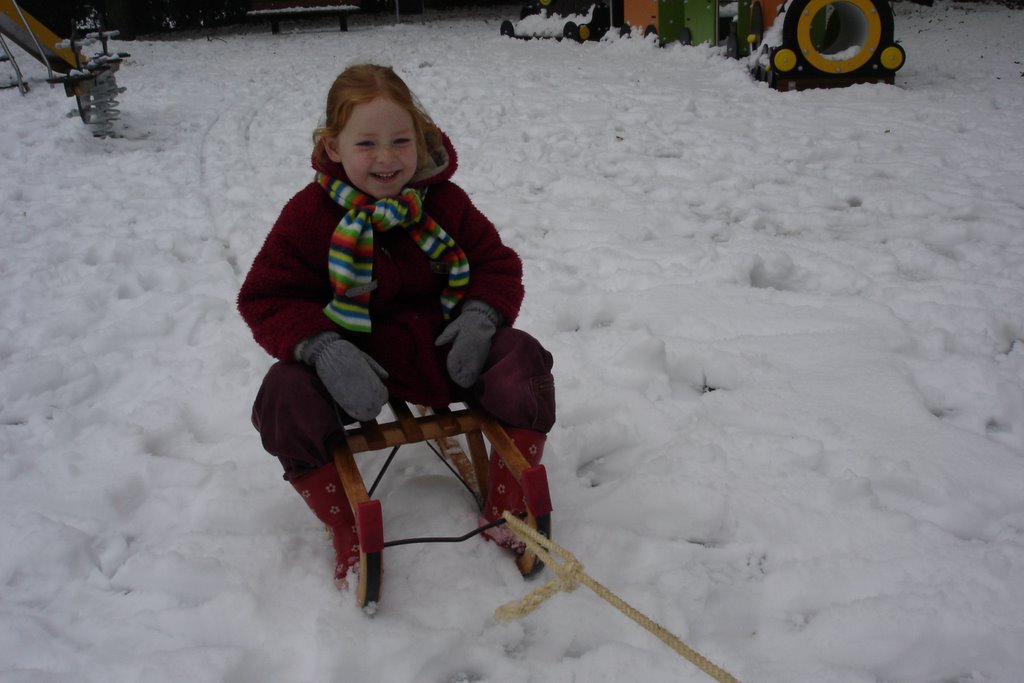 So countries with snow score lower on the power distance dimension than countries which do not have snow.. (probably shuffling the snow requires self-managed teams).
Culture and how it will influence CoPs
 The last onion: how might national cultural dimensions influence the functioning of a CoP in that country?
Hofstede lists countries with a high uncertainty avoidance and explains that in these countries it might be harder for people with opposing convictions to be friends. So in CoPs in countries with high uncertainty avoidance (Guatamala, Uruguay, Portugal, Greece, France, Belgium, etc) it may be more difficult (in general, in can imagine there are professional sub-cultures!) to get people to explore their diverging views on practice and get a healthy level of diversity. Hence, CoPs in these countries may tend to go for more formalisation than in countries with low uncertainty avoidance where CoPs may remain more informal and organic?
I'm wondering how a high collectivist dimension would influence the functioning of a CoP. People of highly collectivist national cultures tend to find their identity in their social network, so would easily identify with a CoP but keep their other strong social identities. These cultures tend to go for harmony and avoid direct confrontation. So this might make it harder to stimulate diversity of views and as a result the innovative capacities of the CoP.
One interesting point on organisations is that organisational cultures are not determined by values of its employees but rather by shared practices. Factors like nationality, age, education, etc. are more important to determine a person's values rather than the organisation they work in. Yet values of the founders do play a role in determining the practices within the organisation.
Tough to think this through, hope to find more practical examples!
Friday, November 25, 2005
Culture: cow, grass and chicken
 At anecdote there was a great post about the chicken, cow and grass, an exercise from professor Nisbett. Apparently westerners tend to put the cow and the chicken together (they are both animals) and Asians put the cow with the grass or the chicken with the grass (cows and chickens eat grass). The explanation is that westerners are more obsessed with categorisation while Asians are more in tune to relationships. I put the cow with the grass, but that could be logical Dutch way of connecting I hope. I may try to do some tests with it with colleagues and in Ghana.
It reminds me of the exercise whereby you ask people to indicate with their hands how large they see the moon. Women tend to indicate a larger moon than men. (forgot the explanation of this phenomenon but try it!)
Culture: Hofstede on culture embedded in management theories
 From the same book by Hofstede as in the previous post (lots of onions today): people who think up theories are products of their countries, families, schools and employers as well and hence bring their own cultural dimensions to theory. For instance Fayol was a french engineer whose theory about authority distinguishes formal and personal authority. The importance he attaches to authority in organisations matches the higher power distance dimension of France. Apparently the matrix organisation has never become popular in France.
The communities of practice theory (he calls it rather a social learning theory) has been developed by Etienne Wenger (and others?) (by the way I just saw a new picture of him on his website so I'll have to readjust my mental image of him abruptly, I always knew the picture with the moustache :)). He is Swiss, but lives in the US. I don't feel in a position to point out the cultural dimension in the theory because it would also imply rating his individual cultural dimensions somehow. Switzerland scores low on the power distance scale (34 out of 100), higher on individualism (68 out of 100), very high on the masculinity scale (70 out of 100) and average on uncertainty avoidance (58 out of 100). So in how far is does the theory reflect the cultural dimensions of Switzerland and/or the US? And for which countries would that fit more/less easily?
What is very interesting is that in development work we often talked about Western cultures versus Southern cultures, but the research of Hofstede shows there are huge differences between countries like Germany and the UK for instance. Germany scores very high on uncertainty avoidance, and the UK rather low. Uncertainty avoidance is the level to which people feel threatened by uncertain situations, which translates in tensions and a need for formal or informal rules to increase predictability. Similarly, there are huge differences between for instance Brasil which score very high on uncertainty avoidance and Jamaica which scores very low on uncertainty avoidance. So if communities of practice work in eg. India, it does not mean it may also work in for instance, Mali, because the national cultural dimension may be very different. Or they may work in a very different manner.
Culture: Hofstede and intercultural sensitivity
 Another onion. This time I read Culture and organisations, software of the mind by Geert Hofstede (I read the Dutch version: Allemaal andersdenkenden). I understand his ideas and research much better reading a full book rather than all kind of short articles. I had some questions about the fact that his research included only IBM employees, but the reason is that all other (non-cultural) factors are equalised as far as possible.
One thing I drew from the book is that the intercultural sensitivity starts with understanding your own cultural values, followed by understanding the other cultures. And that cultural integration like in international collaborations (think of mergers also) should be carefully guided, it will not be something happening automatic and if not guided can lead to lots of difficulties.
I was very happy with his warning against stereotypes, as I felt his work on national cultures could lead to stereotyping. He explains that the dimensions of national cultures are averages and can not be applied to individuals or smaller groups. Even though Japanese on average are less individualistic than American, Mr. Suzuki from Japan may be more individualistic than Mr. Jones from the USA. Also, power distance varies according to the level of education. Lower educated people had a significantly higher score on the dimension of power distance (power distance is the degree to which people expect and accept that power is unevenly distributed). Funny is also that he found a relations between power distance and geographical place (higher latitudes less power distance). Now I can see the advantage of knowing the general dimensions of a culture, so that some differences can be anticipated.
He is not of the opinion that cultures will grow closer (though with globalisation and coca cola all around it would seem easy to think so), but does think intercultural collaboration is more and more important. Since the main research took place between 1968-1972 it would be interesting to know more about how cultures evolve. (over the 4 years he did not see any evidence of converging of cultural dimensions, rather diverging).
Thursday, November 24, 2005
Practical example: UNDP in India
Steve Glovinsky from UNDP reported in com-prac about the communities of practice for development practitioners in India. The communities are across organisations. Even though he anticipated cultural resistance this did not occur. The UN platform lends the site impartiality and network moderators who are respected in their own fields and provide lots of encouragement. Some explicit design parameters have been put in place like the absence of titles in the names. The site where the community 'meets' can be visited here. Let me try to interview him by e-mail to get more information!
Technology: blog, vlog and visual learners
Powered by Castpost
In the video you see how my daughter (and a friend) have learned how to read and write the word HUT. In school they use a method which includes a sign for each letter to accomodate for the visual learners amongst the children (I guess). This was not the case when I learned how to read and write (I learned it nevertheless). I can see the use of vlogs or video podcasts to accomodate for visual learners (and even illiterate people?). Just yesterday a colleague mentioned that it makes such a difference in workshops at all levels if you have visual materials (talking about Burkina Faso). I wonder how if there are example of CoPs who used it to support their learning processes?
Tuesday, November 22, 2005
Technology: turning a blog into a vlog test
 I tried to upload a video to turn my blog into a vlog... using the freevlog tutorial. Though the tutorial is fun and every step explained in detail with a video it did not work. The uploading of the video in ourmedia.org for storing purpose did not work (empty screen). After trying all kind of things I gave up (frustrated) and asked Beth who pointed out a list by techcrunch with sites where you can store videos. Then I used castpost which worked like a miracle and with a few clicks.. (see next posting) Where would I be without Beth? (not in blogosphere at least..)
Culture: coffins in Ghana
 In Ghana there are very special coffins in all kind of forms (planes, beer bottles, Nokia cellphones see photo). You can visit them in Teshie amongst others. But you can now order them online as well from eshopafrica. The story of the development of eshopafrica can be found on iconnect-online website.
Communities of practice: the basic theory


 Dorine Ruter mentioned that she liked my blog, but that it covers a wide range of topics (she is interested in learning about CoPs). This made me think that I could add a fourth stream: communities of practice inserting both older articles I liked and new ones.
The basic theory is covered in three books: by Cultivating communities of practice Wenger, McDermott and Snyder which is a very good guide for practitioners, Communities of practice: learning, meaning, identity by Etienne Wenger and Situated learning by Wenger and Lave. I read cultivating communities of practice first and this gives a very practical introduction to all issues around communities in various stages of community development. I later read the other two which helped me amongst others to understand the concept of legitimate peripheral participation (a form of apprenticeship whereby people are learning by participating in the practice of the CoP) and reification and participation. (difficult to explain in short but roughly reification is when practice gets defined in forms, documents, instruments, etc., participation is when people interact.) These two concepts help me to analyse situations where there is no balance between the two (for instance where there is a lot of written materials, but people do not read them or really engage with the content, there is too much reification and too little participation and learning gets obstructed).
Sunday, November 20, 2005
Technology photographed: Bernd and Hilla Becher


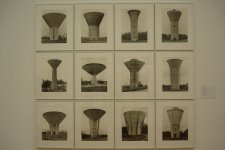

Bernd and Hilla Becher have spent all their lives photographing industrial artifacts like mine shafts and silos all over the world. In an exposition in the Hamburger Bahnhof in Berlin these photographs were displayed according to countries; 9-15 artifacts by function together in a group per country (see pictures, each picture is one country). As you can see, the displayed waterreservoirs have very similar features within one country, but look amazingly different across countries, showing the 'vernacular' in engineering. The question is now whether bringing together the engineers and letting them work jointly would have lead to an enriched device and practice? Or they all serve their purpose well enough within their own context? At least it shows there is not one single way of building a waterreservoir. (as there is no one single technology design to support communities of practice)
Technology and Culture: the introduction of the milktank in the Netherlands
 The story of the Suri in Ethiopia and the introduction of guns reminded me of the introduction of the milktank in the Netherlands, which made a lot of impression on me when I read about it during my studies. Milk used to be collected in milkcontainers, which farmers put by the road side. But when the milktank was introduced (around 1975), the factories stopped to collect the milkcontainers and farmers had to use a milktank on their farms. The farms which had about 5 milkcows and practised mixed farming were forced to specialize: either invest in a milktank and specialize in milkproduction or specialize in agricultural production (wheat, sugarbeets, etc).
An example of how a technological change (the invention of the milktank) can influence practice (need to specialise and scale up milk production to cover the milktank investment). So choices in technologies to support communities of practice may also influence and drive the communications of that community (and culture of the community?)
Culture and technology: The Suri in Ethiopia and guns
 Zapping on television I landed in the middle of a documentary of the BBC: Tribe I had already seen once before. Bruce Parry lives for about a month with isolated tribes and participates in their activities and rituals in a very playful and respectful way. This documentary was about the Suri in Southern Ethiopia (a part of Ethiopia I have never visited). They practise ritualised violence -the men’s have their donga or stick-fighting battles to train themselves in dealing with enemies, and it works as an outlet for aggression. Since I had seen it before I mostly remembered the part where there are gunshots. And that part came. During the ritual, which is a huge party for all involved, with lots of drinking, suddenly there are gunshots. Bruce get scared and runs. Some of the Suri later complain that the ritual has changed since the introduction of guns into this society. Before that conflicts during the ritual were settled easily, but with the introduction of guns, men who are drunk, start to misuse them and levels of violence during the ritual are escalating. More on Bruce's motivation here. In one of his responses to various frequently asked questions he says:
"Change, if not managed, can bring about a complete social upheaval, loss of cultural identity, famine, disease and manipulation by corporations and national authorities including theft of natural resources and traditional environmental knowledge."
"It is human nature to want an easier life and modernization seems to bring this. I like many of the new developments and changes in my own world. I like instant electricity, central heating, mobile phones, good movies…if that’s what they want too then its patronising to deny them that desire? The problem comes when change isn’t managed and the community is not warned of the various pitfalls such as commercial predation (like selling their land), or loss of cultural identity, pride, language, traditional environmental knowledge etc."
"Cultural dominance or intolerance is a very destructive premise in a rapidly shrinking world (e.g US in Iraq). There are plenty of practices that we take for granted as right and acceptable which other cultures find disgusting. Saving the contents of one’s nose in one’s pocket; using paper rather than water to go the loo; putting old people in homes to die alone; owning land which is meant for all; taking trees with little regard for the future. Are we so superior? It can only be a good thing to question one’s own culture before looking down on another."
Friday, November 18, 2005
Uhm.....
 Fortunately I found the text in English and here's the tune you will sing:
'Zie ginds...'
Look there is the steamer
from far-away lands it
brings us Saint Nicholas
he's waving his hands
his horse is a-prancing
on deek up and down
the hamers are waving
in village and town
Black Peter is laughing
and tells everyone
the good kids get candy
the bad ones get none
Oh dearest St. Nicholas
if Pete and you would just
visit our house
for we all have been good
(lost track of how THIS relates to CoP4D but how about seeing it as an experiment in exporting traditions across language areas by means of blogs??)
Practical example: community of practice on e-government
(Picture: One of the ministry buildings in Ghana)
The World Bank has embraced communities of practice as an important strategy for knowledge management. They have a question and answers section on communities of practice. November 15 they organised a videoconference session for a community of practice on e-government. The two-hours webcast where participants from Sri Lanka, Tunisia, Ghana, Rwanda, Kzakhstan, Moldova and the USA exchange experiences on their e-government projects is available online. (Ghana starts at 1:32 minutes :)). I must say I admire the fact that these kind of webcasts make these project very transparent. On the other hand, it is very raw information, and I rather had a good article on their projects and lessons. I did not hear so many interesting things, and tried to read e-mail, the newspaper, cook and pour drinks for the children at the same time. I can imagine a face-to-face meeting would have provided much more opportunities for participants to exchange and dig deeper. I visited the videoconference facility at GIMPA in Accra (also described in the Iconnect story on Ghana) and the manager told me some people regret the fact that videoconferences reduce the opportunities to travel around the globe....
Ghana reported that it is working on an enabling regulatory environment, including policies and a Telecom Act. And it has set up an information and communication agency. To come up with concrete projects and programs they have surveyed the MDAs (goverment bodies) and found a specific interest in revenue mobilisation, business registration and payroll applications. Public-Private Partnerships are seen an important way to implement more projects with less funding.
The World Bank mentioned that they see this group as a community of practice. I'm very curious to know how the community functions beyond this type of videoconferences. I got the impression there is much more communication between the World Bank (weekly teleconferences were mentioned) and the individual country participants than amongst the countries themselves. I haven't found many case descriptions from the World Bank describing the community of practice nurturing process (but haven't dug their whole website).

The World Bank has embraced communities of practice as an important strategy for knowledge management. They have a question and answers section on communities of practice. November 15 they organised a videoconference session for a community of practice on e-government. The two-hours webcast where participants from Sri Lanka, Tunisia, Ghana, Rwanda, Kzakhstan, Moldova and the USA exchange experiences on their e-government projects is available online. (Ghana starts at 1:32 minutes :)). I must say I admire the fact that these kind of webcasts make these project very transparent. On the other hand, it is very raw information, and I rather had a good article on their projects and lessons. I did not hear so many interesting things, and tried to read e-mail, the newspaper, cook and pour drinks for the children at the same time. I can imagine a face-to-face meeting would have provided much more opportunities for participants to exchange and dig deeper. I visited the videoconference facility at GIMPA in Accra (also described in the Iconnect story on Ghana) and the manager told me some people regret the fact that videoconferences reduce the opportunities to travel around the globe....
Ghana reported that it is working on an enabling regulatory environment, including policies and a Telecom Act. And it has set up an information and communication agency. To come up with concrete projects and programs they have surveyed the MDAs (goverment bodies) and found a specific interest in revenue mobilisation, business registration and payroll applications. Public-Private Partnerships are seen an important way to implement more projects with less funding.
The World Bank mentioned that they see this group as a community of practice. I'm very curious to know how the community functions beyond this type of videoconferences. I got the impression there is much more communication between the World Bank (weekly teleconferences were mentioned) and the individual country participants than amongst the countries themselves. I haven't found many case descriptions from the World Bank describing the community of practice nurturing process (but haven't dug their whole website).
Thursday, November 17, 2005
Culture: Again Sinterklaas (even deeply embedded traditions are dynamic)
 In the newspaper, a puppetplayer complained about the sinterklaasjournaal, which is a daily program on television for kids on sinterklaas. Traditionally (read: in my time), sinterklaas would arrive by boat from spain on television mid November to disappear apart from a felt presence through the chocolate sigarettes you would find in your shoe. He would visit your school by December and on the 5th the whole event would peak by the sudden appearance of a bag full of presents. Now, there is a lot of drama added to the event by the daily edition of the sinterklaasjournaal, there is a movie, pop music, etc. The puppetplayer is especially worried about the use of cliffhangers in this program, whereas toddlers need short stories. (don't know about this, my children seem to like it a lot..) Also by seeing sinterklaas daily on television, children tend to notice the difference between the one of television and the one they see face-to-face, taking away part of the mystery around sinterklaas. (I recognise this from nasty questions about the colour of his eyes!).
Anyhow, this shows that even deeply embedded traditions do change to go with overall changes in society (in Den Bosch, see picture, the music played has a carnaval rhythm :)).
The dynamics of tradition reminds me of my visit to a village in Ghana where we met a female chief. Since we were always tracking the numbers of female mayors in Ghana (thinking of the traditional authorities as something static and male), I was curious to know her story. She explained that she had been very involved in development activities in her village, so when the old chief died she was invited to become the new chief (traditionally, one of the eligible men of certain families will be chosen). Everything can change.
Subscribe to:
Posts (Atom)