Showing posts with label personal branding. Show all posts

Tuesday, November 18, 2014

How personal is your online personal branding?

My daughter thinks I'm a complete loser on Instagram. If I put a photo on instagram I have 1 or two likes. She and her friends easily get 100. Many of her pictures are about experimenting with your looks and a like is feedback. Whatever you think about this (it is also more preoccupation with looks) it is clear that presenting yourself online comes more naturally for that generation. I never learned it and I am still struggling with it. I want to make it personal but have some hesistance in showing too much of my private life online.

I share my background working with SNV in Mali, Kenya, Ethiopia and Ghana. This is part of my work and important for my experience. I also share things about my daughters but mostly if it is relevant and illustrative for the use of new media by the younger generation. I don't share my scoliosis as it doesn't affect my work.. I read and reflect quite a bit on personal branding and it is part of our courses with Ennuonline. Here a few guidelines which may help you think through your own strategy.

Be authentic Authenticity has to do with sincerity, show who you are. So it is better to share less but being really engaged deeply in the topics you write about. In that way people get a good picture of who you are. What I struggle with is when my interests shift. For instance I started this blog about communities of practice, but now it is wider about online learning, innovation, social learning, learning as professional.

Don't share everything Being authentic does not mean you have to share everything. You can show who you are by sharing a portion of your work and thoughts. Ultimately, you want people to get to know as a unique professional. You can also share just a part of your professional life and yet enough to be interesting.

Don't share your whole private life You can perfectly share online as a professional without talking about your private life. You have your own vision as a professional in your profession. Of course your professional vision also influenced by experiences private. And it is also part of your identity. So of course you may at times explain how you come to a certain way of thinking.

Distinguish between professional and private accounts (or not) It is possible to create different accounts for different identities, for example, a separate account as a teacher on Facebook, and a private account for friends.  The great thing about social media is however that you get to know the whole person and you miss that when splitting. Besides, an extra account is more work.

Copy-cat A good exercise is to look down at a few of your heroes and copy / imitate. Who has way of sharing that is personal yet professional that appeals to you? Read again what he or she shares and try to write some tweets or messages in the same style. Is it different from your 'normal' style?

Want to read more?
How do you decide on what to share and how personal you want to be?

Tuesday, June 18, 2013

Help! - the professional2.0 is coming...

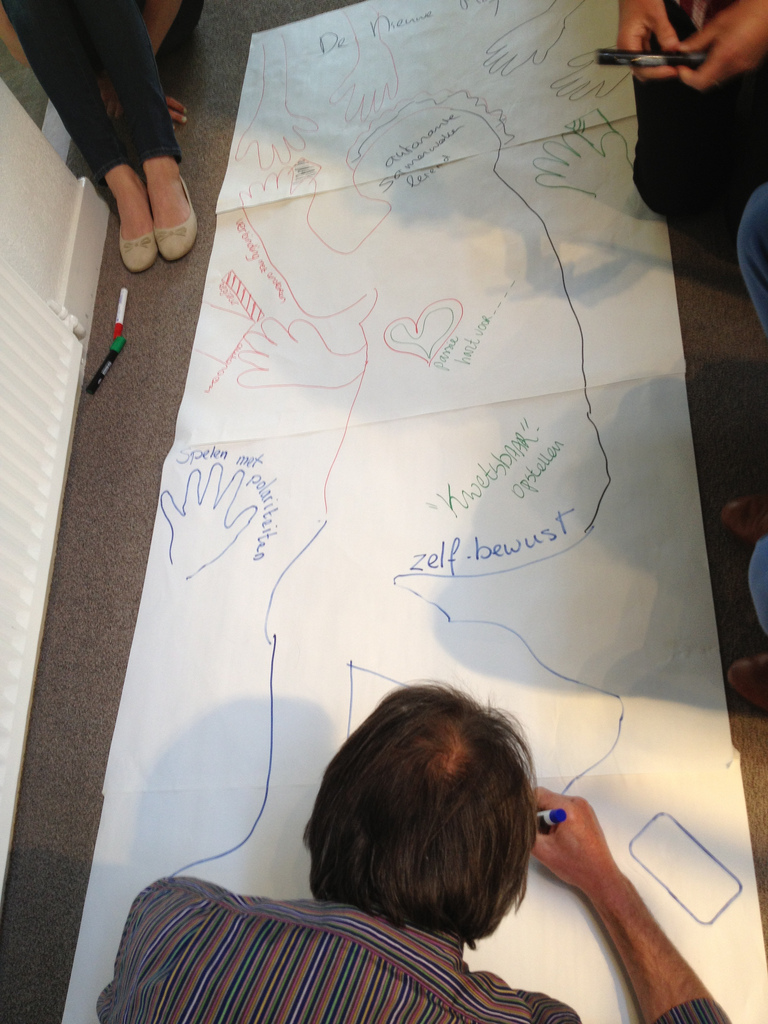
 professional20That professionals can be wilful and opiniated we already knew (only look at house!): several authors have written extensively about this phenomenon (such as the Caluwé, Vermaak and Weggeman). With the recent technological developments such as social media and social intranets, professionals have even more spaces to profile themselves. Who are these new professionals living in our era of social media and what does this process of empowerment of professionals mean for organizations? During the learning trajectory 'learning and change with social media' we made a drawing of the new professional (see picture). She (in this case it was a woman) has at least one smartphone in her hand and apparently on the move (running). She is an independent thinker in her field, she takes initiative and is capable of finding the balance between different polarities, such as online and offline, private and professional, inside and outside the organization. In addition, the basis of her works and passion is from a connection with her own personal experiences, which gives her the drive to excel.

Serial mastery

Lynda Gratton, the well-known professor of management practice at the London Business School, has written a book with the title 'The Shift' about the global changes that are influence the workplace. She marks important changes for professionals: professionals will become what she calls a 'serial master' rather than a generalist. A master is a professional who possesses deep knowledge and skills in a variety of domains. The serial aspect of serial mastery consists in that the relevance of these domains will change and the professional during his / her career will have to venture into new domains, building on old topics, she calls this 'sliding and morphing'. It is therefore important that the professional can quickly learn and is a good networker.

Self-organised learning

Hans de Zwart (Senior Innovation Adviser for Global HR Technologies at Shell) is posing the following question online: can you design a curriculum for the professionals when their work is so dynamic and is changing all the time? Or should there be more focus on self-directed learning (do-it-yourself-learning, self-regulated learning)? There are currently more and more complex problems to be solved by professionals - and complex problems can not be solved with routine answers and best practices. In a complex situation you have an emergent practice, and you should work with trial and error, try things, reflect and adjust. So apart from the fact that professionals need to move into a new domain they must learn to solve complex problems. They do this in daily practice.

Online branding

Online communication is becoming increasingly important in finding the right professional for the job or project. If you a professional and you are not on Twitter and LinkedIn, you have been fairly invisible. Internally channels like Yammer or other social networks are becoming increasingly important to be visible within the organisation, especially in larger companies. Professionals should therefore clearly know what makes them distinctive and unique from other professionals. A professional2.0 will build an online reputation and that reputation is more durable than the job he / she has. The organisation only 'borrow' the reputation of the professional.

Organisations and the professional 2.0

What does this imply for organizations, strong, initiative-taking autonomous professionals? I have spoken several youngsters who are surprised about the slowness of communication in organizations and the lack of adequate resources and support. Professionals are 'serial masters', who design their own online brand, and be young and old. For me, these technological and social developments have the following implications for organizations: 
  • Look for new models of working in collaboration with professionals, not only in fixed employment, but also in networks
  • Develop new '21st century' skills such as dealing with social media, online networks etc.
  • Encourage and social learning within (online) communities instead of organizing training and education 
  • Provide a technological infrastructure within the organisation which works just as easy as social media
  • Support professionals by new and lighter forms of leadership: avoid too much hierarchy, give space and ensure that leaders themselves are professionals too, so avoid 100% managers
Interested in gift, skills and attitudes of the new professional? Read the blogpost on the portrait of a modern knowledge worker by Ewen Le Borgne. 
What impact of the various developments do you see for organizations? And to what extent is your organization already doing what I suggest above?

Wednesday, November 21, 2012

How to mix work and private life on social media: tips for finding the right balance

The picture says: Don't forget to unfriend your boss when the weekend begins... Loesje

If you are a professional engaging in social media you need to find a balance between the sharing of private and professional information and bringing together or separating different networks; networks of friends and colleagues. Inherent in social media is that there is no clear separation between work and private life, because usually you have only one account on eg Facebook or Twitter. On that account you may be followed by friends and family on the one hand, but also by people from various professional networks. When you have a mix of people, what will you post? Pictures of the children? Professional articles? Or a mix? Personally, I don't have a dilemma on Twitter which I mainly use as a professional network about social and informal learning. On Facebook it is more tricky for me. I started on Facebook with mostly people from my international professional communities (eg Km4dev), but now there are more and more friends on Facebook. Do I hence share my vacation or share more about the content of my work? and I do post in Dutch, English or Spanish?. I end up sharing very little. I suspect that for many young people the dilemma will be reverse: they have a private network of friends on social media and beyond may later become active as a professional.

Different identities
As a basis, it is good to also look to see how you're separating - private- worklife in general in life. What are your different identities / caps you are wearing?. Everyone has their own different identities as family member, professional, friend, expert in ICT or enthusiastic music connoisseur, which identity in which you engage online? Do you know who you are and what you stand for? From my past experience working in international cooperation, I am quite used to a blurred boundary between private life and work. You know a lot of about your colleagues private lives in international developmen, from, for instance, driving 5 hours in the car together .... and in your free time you talk again about the work. Josien Kapma told me once that for farmers it is actually quite normal to integration private life and work, and that it is actually a separation which only began with the industrial revolution. If you are used not so strict separation will also be easier online more mixing. On a similar note a new job may bring about a new identity or new focus. That does require you to build a new network online. 

Separating different identities online 
If you clearly have different identities which are hard to mix and would like to separate them online, there are different options:
  1. You can choose to have 2 different accounts. For instance, in primary schools is it often recommended to have a private account and a teacher's account. Eventually you may not want all your students to know about your parties. On the other hand, there is a Dutch professor Mooi who deliberately invites students to his facebook profile and also talks about concerts he has been too and other personal interests. Mooi: "I chose to present myself as a person and to see how students would react. I started posting inspiring images with captions, but soon I noticed that students were open to conversation." Another reason for separate accounts may be language, eg a Dutch and english twitter account. I mix Dutch and English tweets but are still struggling. 
  2. Beside having different accounts you can use some features like lists on Twitter or Google + circles to distinguish networks via one account.  
  3. You could also make a distinction in social networks used for private or professional engagement, such as Facebook for personal and Twitter for professional contacts. 
Here you will find 5 more tips to separate private and professional lives online. And here's also a blogpost with some figures on how people separate their professional and private lives.

Showing your unique professional perspective
Balancing between work and private life in social media is not just about your personal life and sharing your hamster or not but it is also about showing your personal color and unique views as a professional, your unique perspective. Do you share what you feel strongly about as a professional or do you neutrally retweet others without stating your opinion or view? I always try to give my opinion about things I share. I think it is also better for people to make a decision whether to click on something you share. See this tweet about a certain presentation of where I indicate slide 5 is funny.

Being honest and open versus thinking about your personal branding / clients/ people's feelings  What makes social media so compelling are the real stories, and those stories may be both personal and professional. Through social media people share their own stories, which give a different insight into somebody's life compared to eg. scientific articles. The question here is what you like to show. Recently I participated in the blogpraat chat where this was also a question: How can you blog about a sensitive situation at work without it being recognizable to colleagues? This is something I myself am also struggling with. On the one hand, because you do not want people to recognize themselves when the situation is sensitive. On the other hand, because you also want to create a certain professional image. While those 'war stories' about difficulties are often the most powerful stories. How open do you want to be? And it's even harder if you active on behalf of an organization

Balance between online and offline  
Furthermore, of course you also have to find a balance investing in online social media versus face-to-face contacts. When I am too much online I find it boring, when I am too busy I can't find the time to blog.. When you have to meet many deadlines it might be wise to put all social media off ... and yet keep some light engagement. You might need to meet and talk with new contacts on Twitter. Also here you need to find the right balance. 

NB. Input and inspiration for this blogpost gained during our 8 month course de leergang leren en veranderen met sociale media

Friday, March 30, 2012

Four strategies profesionals for personal branding via social media

Why would you be busy and thinking about personal branding?
I always though branding was a horrible word 'become your own brand'. It sounds so much like shallow marketing. In the meantime I changed. I started branding myself online, though not consciously, through this blog, participation in online communities, twitter, commenting on blogs. I have a lot of followers on Google+ even though I hardly post...So branding can also be about sharing you unique view on professional issues and showing what your view and particular interest is. This is actually fun to do. I am now convinced you can use social media very effectively and in a fun way to develop your professional identity. Seeing what type of blogposts trigger a response from you may help you define your own specific interests to pursue.

What is a professional? A professional is someone who work and has autonomy to act. He or she identifies with his field of work. A doctor in a hospital often identifies himself more easily with other medical doctors than with the hospital. As a result he of she will be more energized by a meeting with peer than by a hospital department meeting.

Online personal branding Social media provides a space for professionals to profile themselves as autonomous thinkers and professionals. Much more than for instance within the organisation. This sometimes gives friction if someone is more appreciated online than in the organisation. In social media they are judged for unique content and interesting views whereas in organisation hierarchy and organisational politics come into play. However, in social media there is also group dynamics, but it works differently.

Meet Emile I would like to share a great example of online branding. I was part of a meeting, the Yamtour. The meeting started online. During the gathering some speakers were features from large organisations like Rijkswaterstaat en Capgemini.
They had interesting stories, so my point is not that the selection process was not good, but often the larger organisations are in the spotlight. Small innovators like Emile buurtzorg will not be selected so easily to be on stage. However, Emile used the online space to profile himself succesfully online as an innovator in the health sector. He used the online space to search other health professionals and started a group for them. After the event, he organised an informal meet up.  This is an example of using online space to profile yourself. 

Four strategies to use for personal branding using social media
  1. Become an 'info-mediairy' or 'content curator' if you want. Scan information, search, make sense of it and add your personal view. You can use Google like everybody else, but you need to build your unique learning network to get more interesting information. You can use RSS feeds and other dashboard tools like tweetdeck or hootsuite to help you scan information. Don't forget the sharing part!
  2. Network and learn. The speed of communication through social media and the open culture lends itself for building a personal learning network, a group of people who can help you answer work related questions. As they say: 'it's no longer what you know but who you know'. My tip is to invest in developing some relationships further. Not allow your network to become very shallow. Try to meet new people too.
  3. Share. Menno Lanting -in his Dutch book 'Iedereen CEO'- notes that sharing through social media is an excellent way to work on and develop a professional identity. What are the things you'd like to tweet? What triggers you to write a blog. Maybe your blog categories help you to sharpen your elevator pitch. Everybody is an expert on something on social media...
  4. Collaborate in project. Maybe you are a very practical person and you'd prefer to let your actions speak. You could also use social media to work on real project and collaborate. For instance help build a wiki about a specific topic.
The four strategies are overlapping ofcourse. Nevertheless, I'm convinced they can help you make informed choices on where to start or what kind of activities to intensify. Choose the strategy closest to your preferences and current activities.

I developed a presentation on Prezi on this topic. You might have a look if you are interested. It is in Dutch, but quite visual so it might make sense.