Showing posts with label technology. Show all posts

Tuesday, January 09, 2018

Bookreviews Kevin Kelly: mind artificial intelligence, attention and quantified self


 I read two books by Kevin Kelly about technology, one on my kindle and one on paper (not the same book by the way :). The first was What technology wants; the second the Inevitable. I found both through Twitter. Now that I think about it: I get most of the book tips via my Twitter network.
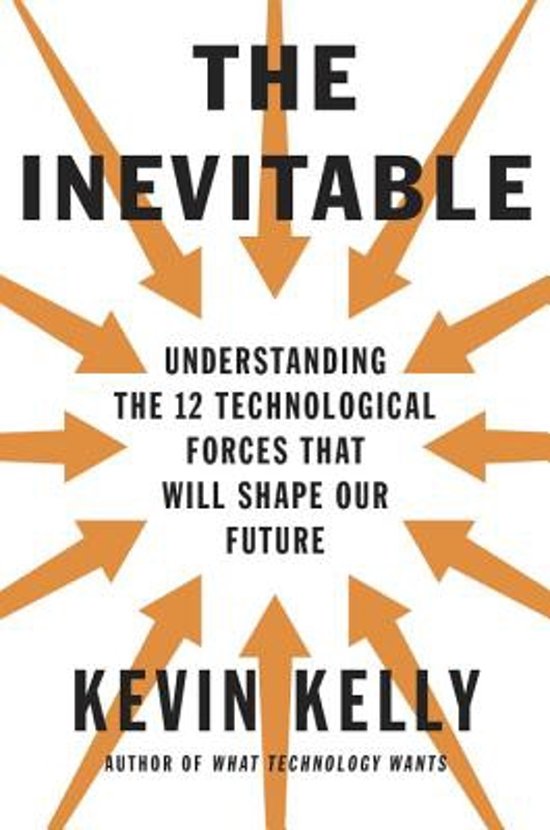
I have read these two books because I want to know how technology is going to influence my field of work: learning and knowledge. I was also curious about what lens he uses to looks at technology. In my study Irrigation Engineering we learnt about various lenses. For example, you had the techno-optimists who thought that technological developments would solve all problems of developing countries, for example agricultural production would go up by invention of artificial fertilizer and pesticides. On the other hand, there are the skeptics. I was more skeptic because I saw how great the influence of culture and the way people react to technology is. At times people do reject technologies. Farmers in Africa did not make massive use of fertilizers and pesticides at all. Are there differences in visions on (learning) technologies? What lens can I use?

Kevin Kelly ends his book The inevitable with a clear position: he sees that we are at the beginning of a new phase, the last chapter is hence called 'the beginning' since he sees that we are at the start of a new phase. In this phase we move towards a collective consciousness that he calls the holos. We can not imagine the holos because it is something unseen yet. Another phase change from the past was the invention of the language. The people before the invention of language could not imagine the world with language either. Through language cooperation and coordination got a boost, but also idea development and fantasy. Ideas and knowledge travels with generations through language. The holos is a connection of all people and machines via artificial intelligence. The holos arises because we increasingly share, track, mix, filter, etc. via the internet. He also mentions two different visions on artificial intelligence: hard and soft singularity. The hard singularity theory is that we make a superintelligence that becomes increasingly smart, solves all problems and bypasses us. The soft singularity's theory is based upon a complex interface between people and artificial intelligence.

Some ideas I take from his books are: 

  • Technology takes an increasingly more central place in our lives. We sleep with the smartphone. My daughter sometimes sits with a laptop on her lap, ipad next to it and a smartphone in her hand. 10,000 years ago, a farmer only ran a few hours a day with a tool in his hand. The rest of the day was technology free. 
  • Apart from an addiction to a smartphone, for example, we may be addicted to what Kelly calls the 'technium', the technological innovation itself. This explains the interest in gadgets. The guild of French scholars has been able to delay the introduction of the printing press in Paris but could not stop it. Hence the general technology advancement seems inevitable?
  • Social changes in history are almost always driven by technology. He clearly recognizes that not all changes due to technology are positive. For instance the large-scale slave trade has become possible because of the sailing ships that could sail across the oceans. A quote from Karl Marx: the hand-mill gives you a society with the feudal lords, the steam-mill society with industrial capitalists.
  • The society and what we are working on is much more about intangibles (services, not tangible things) than about goods. 40% of US exports are intangible.

the picturephone


  • According to Kelly, new technologies are sometimes inevitable, but every technology needs a momentum. He gives the example of the videophone. Already in 1938 there were prototypes at the German post office. Picturephones were installed on the streets in New York in 1964, but were discontinued because there were only 500 subscribers. Now we use Skype, Zoom, Facetime or use video to call Whatsapp. Often similar technologies are invented or tried out simultaneously in different places. Only if the supporting technology is right and matches the social dynamics is it widely accepted. There is often a point where technology seems to be an option to individuals but in fact society has already changed so that people feel compelled to use it, in fact it is no longer an option. I recognize this with Whatsapp and the chip card for public transport. My mother could still buy tickets, but that is becoming increasingly difficult. Also think about how difficult it is if you do not want to use Whatsapp?
  • He summarizes the major changes of our time in the inevitable: Our time is knowledge / information-oriented, flows of information such as in your timeline are increasing. Sharing, linking, tagging are all on the rise. 40% of the web is commercial information, however 60% is voluntarily shared, from a passion. Artificial intelligence is going to have a big impact. The time of huge influence of Artificial intelligence has arrived because we have cheap computing power, big data and better algorithms. These three are the optimal conditions for artificial intelligence.
  • Can you redesign the economy based upon attention rather than material goods? If information is no longer scarce, then attention is. What if I was paid to look at an advertisement? If information is not scarce, and we can work more efficiently through artificial intelligence, people will focus on actual experiences. They will become very expensive and a new industry. 
  • There is a whole movement of quantified self. There is so much data that you can collect and analyze about yourself. Does this really make us a better person?
The books offer a lot of ideas about the influence of technology. It is quite overwhelming to me. On a philosophical level, I recognize the inevitably of technological advancements as in society. Being addicted to technology development in general by humanity would explain the focus on new technology and the 'shiny tool syndrome' that I often encounter. The intrusion of technology also gives me an uneasy feeling, as if you lose control. I am not happy about the inevitability. My own feeling says that we do not always need to get better from all new technology and that we still have to stay connected to nature because we depend on it (just look at black mirror). Nor do I believe that technology can solve all our problems, think of climate change, which is quite scary. 

My question was: what will be the influence of technology on learning and sharing knowledge?. What I will take away from these two books is the increasing importance of information, we have to relate to information in a different way. We drown in information but does it help us further? Dealing with big data and information is becoming increasingly important. Attention is becoming scarce. Artificial intelligence will play a major role in this. The quantified self also comes back. 

A conclusion is to pay attention to: (1) artificial intelligence (2) attention scarcity and focus and (3) learning through feedback about ourselves (quantified self). As far as the hard and soft singularity is concerned, I certainly believe in the soft singularity that we determine how artificial intelligence will support us. 

What kind of feeling do you get from all these developments?

Friday, October 20, 2017

Why you should be interested in artificial intelligence as L&D professional

In our book Leren in tijden van tweets, apps en likes there is a clear call for people working with learning, change and innovation processes to dive into technology. Everyone sees that technology is increasingly taking an important place in our lives- even people who are not into technology. I did intakes with vocational teachers this week and I heard that they experienced daily competition with mobile phones. The attention span of students got shorter. If you compete with technology you might make technology work for you and help you? My advice is be curious about technology and get started. But how deep do you dive into different technologies and tools? and why? There are so many developments, think of blockchain, of which I do not know what it actually is. Sometimes it feels like you are in a tsunami of new developments and you let it flow by. For learning professional e-learning seems a clearer need than knowing about artificial intelligence and blockchain.

the allerhande recipes
Artificial Intelligence- What the heck?

A great example of such a what-the-heck development is artificial intelligence (AI). Artificial intelligence is a collective name for software that manages creative thinking by the computer: the learning computer. I've heard about AI regularly, but a lot of it is at the level of 'HEEE, it's coming'. What can you really do? What's going to change? It doesn't click for me unless I get to work with it and start to apply it. A clear application of AI are chat bots. I have written about chatbots before. Those crazy puppets are everywhere if you have an eye for! Especially in Facebook messenger there are many chat bots to follow. I follow Poncho for the weather and a joke, and the allerhande chatbot with a daily recipe. For Slack users: the Slackbot helps you with all your questions about Slack. By the way, there are also chatbots which are not driven by AI, but those will be less smart in their conversations.

What is the influence of AI on the L&D profession? 

During the L&D unconference in Rotterdam I hence threw the  above question to the group: I thought I would be alone in my group, but there were 8 people with interest in the topic. Additionally, those who did not attend seemed to regret it :). The nice thing was that there were concrete experiences in the group with AI applications. The first was the experience of a bank to have Watson analyze credit applications. You will have to teach Watson how to do this, but then you can save a lot of time. Another application shared: At a factory in Japan, a robot runs around (powered by AI) that connects with employees and coaches workers, for example, to take a break. It's not a big brother, but a very helpful robot. The time saved by the use of AI can be put into more creative tasks. A third example was an application that receives information from the internet to make predictions about the market.

The Calimero effect

The AI group acknowledged that you as L&D-er might be afraid of this type of development or may think it's got nothing to do with your business. The famous Calimero effect: What can we do as advisers / trainers / facilitators? This too big for us and something for the ICTs and decision makers and visionaries in the organization. It's not for us but for others. Perhaps AI will take over L & D's work by doing performance support tasks, for example. There is already one AI online teacher doing a great job. Or people are scared of the smart youth who understand it all. Look at the example of  Tanmay Bakshi a 12-year old programmer of IBM.

You will only see it when you get it

This famous quote by Cruijf applies to AI.  You can only imagine or dream up an application if you have seen enough examples and those examples inspired you. Because I opened my eyes (with a group of colleagues), we see different applications. For example, we will experiment with an online confession box for reflection. We could not have thought of this AI application if we had not followed the developments and many examples. In addition, many applications already use AI, think of your news feed on Facebook (does it?) Or your results in Google search. The danger here is that we are increasingly dealing with filter bubbles, you are getting more and more closed in the same line of thought.  Think of the Netflix bubbles. It might be another role for L&D? Ger Driesen calls this the bubble bursting role.

So what to do as learning and development professional?
  • Read, watch, follow. Read an article, attend a summit or start to follow some chatbots. This is a dutch article by Ger Driesen over de invloed op HRD van AI.
  • Investigate whether there are AI projects in the core business and try and learn from those. 
  • Help people in the organization to prepare for robotization.
  • Brainstorm applications of AI to support your work and make it easier. Think of the selections of CVs, relevant chatbots or analysis of online learning data. You might be able to start an innovative project together with others. 
  • Take up a role in the consciousness about algorithms. Burst the bubbles.
Are you working with AI? I'd be happy to know about it in a reaction. 

Thursday, February 11, 2016

What is really changing in the way we learn as a result of new technologies?

Last week I attended the Learning and Technologies conference in Londen. Like last year, it was great. Inspiring talks and the Dutch delegation (almost 25 people!) offered a nice network to make sense of new ideas. Furthermore we had Friday to explore Londen.

Before the conference I attended a session about storyboarding. I wanted to pilot a video 'beyond the talking head'.  I'm proud of the result. I found out that using the fast forward function is very simple in iMovie! Unfortunately it still has talking heads, but it is already much more dynamic.

What is really changing in the way we learn as a result of new technologies?
That's the main question I took to the conference. Sometimes I feel everything is changing, sometimes when people say they prefer classroom training I feel nothing is changing. As you see in the video I interviewed 4 people in a one phrase interview form and am amazed that their answers differ quite a lot. However, they all talk about the consequences of the fact that information is now freely available on the internet.

"It is not about what you know but what you can find out"
David Kelly stresses "it is not about what you know but what you can find out". That shifts the power from people who have accumulating knowledge to the people who know where to find knowledge (and have networks). This has huge implication for power in organizations and even for which organizations (or networks) will survive. In fact Ger Driesen and Martin Couzins stress the same point - with knowledge flowing around what is the point in learning a subject for 5 years? Will learning disappear and turn into knowing where and how to access information whenever you need it? Mirjam Neelen emphasizes the need to learn how to learn in this world of information overload. Which neatly links back to David kelly stating it is about what you can find out. Ger's idea of learning disappearing probably refers to the rapid advances of artificial intelligence and the 10 things an algorithm can do which a teacher can't where our learning can be taken over by computers too. Should we all become data managers?

I wonder whether learning a profession or studying becomes obsolete as Martin states. What do you think? How to gather the tacit knowledge needed for a profession? When you study you also learn the core values and issues of a profession which goes beyond information. How about developing a unique vision? Yet I agree the focus will increasingly shift from learning as in learning facts to analyzing, synthesizing and searching. The idea that the way we learn can be done faster by artificial intelligence is a scary idea. I will definitely start to follow these developments more closely.

By the way Sibrenne and myself blogged about some of the session on ennuonline.com so check it out if you are interested in particular topic like video for learning, artificial intelligenceusing your enterprise social network for learning (session by Jane Hart) or using heart and mind in online learning. Or check out the session with Rudy de Waele about new upcoming technologies.

Wednesday, October 14, 2015

The influence of social media for learning - technology is more than just a means to a goal

 I often hear: "technology is just a tool and should be the starting point, let's start with the goal and the technology will follow". "The tech does not matter if we achieve our goal." In this blog post, I argue that technology is much more than a means. Social technology is a driving force behind social learning. And even within organizations and networks the choice of (social) technology is extremely important and can be a factor determining success or failure.

Technology is means or a goal?
A known example is Henry Ford who built the first car in 1896. Ford had a vision of "a car that moved forward without horses". If Ford would have asked what people wanted they had probably asked for a faster horse. And if Ford would have started with the goal? The goal is to make sure people get from A to B which would probably lead you to horses ...  In education the Open University in this article argues like I do that technology may well be a target. The examples show that technology is not 'only a means' is to carry out what we want to do. Technology is an important driver for change. As new technologies become available our behavior changes after a period of experimentation.

The contraceptive pill as example of the influence of a new technologyThe pill is an example of a revolutionary technology that has caused changed behavior. Evert Chain shows the pill is an example of the right technology at the right place at the right time. When looking for 500 volunteers to test this contraceptive there were 5000 registrations. 10 years after the introduction of the pill in the Netherlands in 1962 it was already used by two thirds of women. Twenty years later, the use of the pill has become the norm A research in 1988 discovered a 16-year-old girl thought it was impossible to have sex without birth control pills, she did not know the pill prevents pregnancy. The major mindset change introduced by the pill is that sexuality was disconnected from pregnancies. Before the pill, there were already other contraceptives like diaphragms and condoms. However, the pill has become a huge success. One of the reasons is that taking the pill is independent of the sexual activity, and thus was respectable. And of course, the use lies in the hands of women. Finally, it is a more reliable method, so doctors also accepted it.

Social media as driving force for social learning
    Like the pill social media is a technology at the right time in the right place. It fits into a trend of individualization and self-expression. Combined with the widespread use of smartphones and tablets it enables a continuous flow of communication with your networks, sports clubs and friends. It is an important technology-driven change in society. The influence of social media on society is huge because a new way of social learning is enabled by social media, in organization, between organizations and in spontaneous networks. Isaac Newton wrote: "If I can see far, it is because I am standing on the shoulders of giants." By publicly sharing work and ideas, considering the rate at which messages are spread through social media it is possible to stand on the shoulders of a lot of fellow professionals. Social media is a driving force that increasingly influences our daily thinking and actions. That is a huge innovation in learning driven by the technology of social media.

Technology to foster social learning in organizations 
Following our personal communication on social media like Facebook, Twitter and Instagram it will be easier to stimulate social learning in organizations, if supported by the right technology. At Rijkswaterstaat in the Netherlands Yammer was successfully introduced for knowledge sharing between departments. The technology was in line with what people already know (Twitter and Facebook) and there was a vision for the new communication that they wanted to see: faster and more participatory. Thus, a policy was developed with input from everyone on Yammer. KLM Airfrance introduced iShare. The community manager is the one with a strong vision of what is possible when people commit to share more - innovation in the business. He was looking for a platform with a vision of social sharing that corresponded with his own vision. The examples of Ford, but also Rijkswaterstaat and KLM Airfrance show that you need that vision. Someone who imagines the car that moves without horses. Or the bicycle for the team that used to walk. At the same time, technology plays an important role to stimulate and facilitate certain behavior. Hence, technology is not only a means but also major driving force for change.

Thursday, January 22, 2015

How our learning theories shape how we use technology for learning

I read a paper called Perspectives on learning and technology: A review of theoretical perspectives"This paper provides a review of literature pertaining to theoretical references on educational practice and technology from perspectives of learning theories of the 20th and 21st centuries."


A learning theory (or theories) helps understand how people learn, thereby assisting educators, trainers and facilitators reflect on their educational practices. The three major prominent learning theories are known as behaviourist, cognitivist and constructivist, though Siemens later developed the connectivism theory as a learning theory for the digital age. The graph displays more theories and some of the major terms used.

The paper caught my interest because I am a fan of social constructivist theories of learning (think: learning by conversation) and always amazed at how differently people can think about what learning is and what it needs. For me it is obvious that Twitter can be an important learning instrument but if see you learning as acquiring new knowledge it is less obvious. 'Twitter is not about learning. How can you learn from 140 characters?! I blogged about the difference before in: twittering= learning? I know my preferences but more and more I start the see the learning theories as all saying something about realities, in other words as pieces of the same puzzle. Depending on the situation a certain theory (and practice) may fit better. Interestingly the practices of people with different ideas may be pretty close...

 I think the implicit learning theories people use determine how enthousiastic you are about new technologies and shape which application you see. The three theories outlined in the paper with their use of technology are:

1. Behaviourist theory 
The main purpose of the behaviourist learning pedagogy is to accomplish the correct behaviour which focuses on achievable learning objectives. Behaviourist focus on learning objectives in 'to do' in the sense of describing observable behaviour. For instance, "when dealing with a complex problem X will contact relevant colleagues for input." The knowledge skills and attitude distinction is also used within this approach. In the context of online learning based on the behaviourist theory the focus is on delivering learning content with clear intended behavioural objectives, and drill and practice and ’electronic page turning‘. Somehow the traditional e-learning modules.

2. Cognitivism theory
Cognitivist views of learning recognize the importance of the human mind in making sense of the material with which it is presented (Harasim, 2012; Schunk, 2012). Cognitivists sought to understand what was inside the black box of the human mind and tried to emulate it computationally. Cognitivists developed educational technologies such as intelligent tutoring systems (ITS) and artificial intelligent (AI). "In addition, online learning based on a cognitivist approach is focused on a learner’s working memory and sensory system. This is done through utilising different multimedia modality (e.g. audio, visuals, animations, or video), the proper location of information on screen, screen attributes (e.g. colour, size of text, or graphics), the pacing of the information, and information chunks to avoid information overload." The cognitivism use of technology is hence very instructionally oriented, focussing on proper media to convey information. The recent focus on 'brainscience' may help to support the cognitivism practices.

3. Constructivist theory and social-constructism theories.
Constructivist learning theory views learning as a process by which a student constructs knowledge thorough interacting with more knowledgeable others; "learning starts by conversations". it is an umbrella term representing a range of perspectives on learning. Educational practices adopted the constructivist approach including situated and active learning, learning by doing, problem-based learning, inquiry-based learning, cooperative learning, collaborative learning, personalised learning, the learning community, active participatory learning, activity and dialogical processes, anchored instruction, cognitive apprenticeship, discovery learning, and scaffolded learning. The constructivist learning technologies are often associated with learning environments and Learning Management Systems such as BlackBoard, WebCT or Moodle with characteristics including the following:

  • providing multiple representations of reality to prevent oversimplification and represent the natural complexity of the real world; 
  • emphasize knowledge construction and co-creatiom instead of knowledge reproduction
  • provide learning environments such as real-world settings or case-based learning instead of a predetermined sequence of instruction
  • foster reflection on learning experiences; 
  • online learning based on a constructivist approach including learning should be an active process; learners should construct their own knowledge

I was a bit disappointed with the explanation in the paper.. I had expected a deeper explanation. I would like to add social learning (probably part of the social-constructivism group) because this theory is really charmed by social networks rather than learning management systems. See Jane Hart's use your Enterprise Social Network for workplace learning.

What I notice is that in technology/ tools, there is a code in the technology (like DNA!) and the code is determined by the people who developed the technology. Hence it makes it hard for people with a different view to use the technology for a different purpose. This code in the technology is very implicit. For instance, we use Ning, a social network for our learning trajectories whereas we could use a learning management system (LMS). However, most of the LMS we tested are way less focussed on interaction and learners in the driving seat than we like. An example: when I work with Moodle the technology invites me to prepare the course with all sections in advance. In Ning, the technology invites me to start on the fly with new discussions. This stimulates a more flexible role for the facilitator.

Lesson? It is important to know your own convictions when choosing and using technology.. and try to find 'the code in the technology' you want to buy or try.


Thursday, September 18, 2014

Changing with technology: the example of collaborating with slack

I find it fascinating to see how our habits change (or don't change at all!) driven by new technologies.


In the Dutch cartoon Fokke and Sukke are making bookcovers for their ipads on the Steve Jobs school

Yesterday Patricia called and because she is in my phone contacts I took the phone with a "Hi Patricia, this is Joitske, how are you?" the answer was "Hi this is Patricia" What a weird start of the conversation... Apparently you can not easily change your default phrase which which you start a phone conversation. The starting phrase "hi, this is Patricia" comes from the time when there was no contact name on the screen of your phone. A phrase or habit which is apparently quite deeply ingrained in our minds. I think it's a funny example of the influence of technology on our communication and how our habits are sometimes matching older technologies ..

At the Ministry of Foreign Affairs, you had (until about 6 months ago) to pass a scanner as a visitor, so you had to walk counterclockwise. Three months after the scanner was removed I kept the same route walking to the escalator. Until I noticed that everyone in front of me walked to the right to go straight to the escalator which is faster! I felt pretty stupid that I had not noticed this before.

I have blogged earlier about my grandma from the North speaking dialect but who couldn't speak dialect on the phone. On the phone she would speak official Dutch which sounds very formal. One older manager I met did not want to read from the screen and had everything printed. He said he simply couldn't read from screens. It is like some of our habits are one step behind the new technology and can not catch up.

Sometimes it works the other way, and you can also use technology to stimulate a change in habits. In team of five people, we noticed that we mainly seek advice from those you work closely together with on a project and that the threshold for quickly asking advice from the others is quite high. My answer was actually consciously assigning a new role of  'advisor'. However, a colleague suggested to use slack as a teamtool. With slack you can create channels, ask questions and call somebody into a conversation by tagging his name.  We've been slacking a month now and it works! Interestingly, another team had a look at slack and thought it was too chaotic. The reason why it works so well for us is that this colleague already uses it in another project and helped us to get into the tool. Which is not too hard, but there are many small things you need to explore.

Wednesday, March 24, 2010

Interview with Chris Collison about the role of technology in knowledge management

I saw this video twice already on different blogs, but going to post it nevertheless. It is an interview with Chris Collison about the role of social media in knowledge management.

He states that he used to see technology as an enabler or driver for knowledge management. But social media has become more than that: it can be a disruptor in a positive way. He uses the example of Twitter, the connection to new people invites linking and sharing in new ways. It is not enabling more of the same behaviour, but disruptive because it leads to new possibilities.

Nevertheless, the term knowledge management 2.0 frustrates Chris because it seems like KM1.0 is thrown away. Whereas there are useful lessons from KM1.0 that need to be blended with enterprise2.0 tools.

Well, see for yourself if you haven't seen it yet.


Reblog this post [with Zemanta]

Thursday, May 14, 2009

Any tool can do, culture matters


I'm writing blogging tips for a book we're writing and one of the tips is to create a rhythm of posting. I had a good blogging rhythm but now I seem to loose it! So I need tips how to keep your rhythm. All the holidays in the Netherlands starting from queen's day on 30 april are definitely fun, but don't help me to keep into any rhythm. But let's try to stick to a weekly rhythm and blogging about a past experience still lingering in my head.

In a teleconference Davee Evans, active participant in wikipedia organised by CPsquare I was very much struck by the complete unimportance of selecting the right tool for online interaction. What's really important is creating a culture of exchange. Since my consultancies started to include online methods for learning and collaboration a lot of the initial questions I get are about help to select the right tool. Or sometimes people have selected a tool and want to know how to tweek it. Though engagement in an intake conversation, all the other questions about introduction, designing the change process, the facilitation of the online interaction surface rapidly. Nevertheless, most of the time I also do some tool advice because I have the feeling that's part of the expertise asked of me. So both clients and myself seem to be drawn to tool selection.

What was the example? Davee talked about a voting process taking place in wikipedia about combatting vandalism. From the teleconference minutes:
The "flagged revisions project" is an attempt to deal with the enduring problem of vandalism. It's a very slow community process held in a very peculiar local style of discussion. Voting, with the pro's and con's about voting, happens in a free text space that is unique.
You can see the polling process in the picture displayed or by clicking on this link. What's interesting is that the tools used are in my opinion not the most appropriate for the job. The poll is done in the form of an online discussion in a wiki. I'd say you need an online survey tool to conduct a poll. And if you want to discuss an issue, you need a discussion thread function. What the wikipedians do, is use the wiki they are so familiar to and write in a threaded fashion in the wiki page that seems to work for them.

A strong example of the fact that when culture of working together online is very strong, the tool doesn't really matter. (it definitely put my idea about the best tools upside down!).

Friday, September 05, 2008

Here comes everybody: book review

I blogged a video with presentation by Clay Shirky before I read his book 'Here comes Everybody'. I'm happy to blog his book too, since I was very impressed by it, despite some weak parts.

To start with the weaknesses: I don't buy into his idea that social media will make organizations obsolete, because they will bring the power of 'organizing without organizations'. His explanation of the raison d'etre of organizations is very simplistic; when you want to organize something with a group of people, you start an organization. First of all he overlooks the fact that there are many more informal and formal forms of organizing - families, networks, associations, friendship groups etc. Secondly, he does not enter into a description of the different functions of businesses, governmental and civil society organisations. Each have a function to play in society and I don't think this function will disappear because people can organize things without costs by using online tools.

What I'm impressed with is his understanding of the impact of new communication tools. "communication tools don't get socially interesting untill they get technologically boring. The invention of a tools doesn't create change; it has to have been around long enough that most of society is using it". I think that is very well said. The tools don't change us. It is through experimenting with the tools, and becoming at ease with new tools that our behaviour changes. Shirky provides the recognisable example of the cell phone- now with cell phone, we don't make clear appointments, we say- I'll call you later. It's not the cell phone that makes us sloppy, it's the fact that we've become comfortable and used to cell phone that changes our appointment making habits. When anorexia patients meet over the internet, it's not caused by the internet, but it is a latent interest of anorexia patient to connect that gets crystallized into a network because of they make creative use of the new tools. I recall that when the students went on strike, the Dutch newspaper headlines were: MSN calls for strike! But in reality it's the students that called for strike and they were very effective in organizing themselves because they had their MSN networks. Online tools remove the barriers to collective action. He provides a very convincing example of the first groups that used Meetup to connect. They were not the well-established groups you'd expect. On the contrary groups that used Meetup to organize gatherings were groups with a latent desire to meet, but for whom it was difficult to organize it (for whatever reason).

As a result of experimenting, behaviour may change and the balance of power may change too. And that's the exciting - or revolutionary if you wish, part of the story. Clay Shirky: " the most profound effects of social tools lag their inventions by years, because it isn't until they have a critical mass of adopters, adopters who take these tools for granted, that their real effects begin to appear." So this is a stage of intense experimentation. There are definitely chapters of the book I'm going to reread.

By the way, you can find all the weblinks mentioned in the book (often annoying to retyp a paper weblink into your browser) here.

Monday, October 01, 2007

I'm setting up a twitter experiment

I'm preparing an experiment with Twitter for 10 people, most unfamiliar with Twitter. Twitter is: A global community of friends and strangers answering one simple question: What are you doing? Basically you update your information continuously with short messages (max. 140 characters) and you can follow/be followed by others who read those messages.

For some, this seems an 'old tool' but for most of the people I work with it is unknown. On the one hand I encounter people who think that putting your information on internet is quite dangerous and feel that we should reduce the number of emails, on the other hand, there those who don't care whether you reply on facebook, twitter or their blog. How to find the middle ground when a group is a mix of those people?

A nice Twitter guide for beginners is written by Robin Good.

Nancy White is compiling stories how Twitter can foster collaboration. Some examples (but there are lots of other examples- check it out):

  • Using a twitter network - project twitter on screen in face-to-face event. Ask a question out to the network. See the (FAST) response.
  • Find job candidates through Twitter
  • During a power outage, use mobile Twitter to coordinate information about the nature of the outage and the availability of internet cafes in the area with power for the team to reassemble.
  • Using twitter as a virtual water cooler.I work from home, and my colleagues are my collaboration buddies, clients, colleagues. Twitter is a great way to keep up with what is happening, so face-to-face meetings get up to speed much quicker. Blogs work the same way, though they tend to contain a different set of content.

Andy Carvin sees a lot of potential in Twitter, because of the combination with mobile phone. Read his post how Twitter can save lives.

For the real fans: there is the twitterfan wiki.

Monday, July 30, 2007

Handwritten letters are moving again

We are going to move to the Hague soon. I decided to clean the attic and throw away stuff, when I found old letters my husband wrote me when he was in Tanzania and I was in the Netherlands (must have been 1989 or so). It is very funny to read the details of things you have forgotten. He had earpain and went to the hospital where the doctor took one hour to find the key to the cupboard where the ear-inspection-device was stored.

It struck me that I hardly receive letters now, and that I don't keep an archive of my mails (though with gmail you have a large archive, I doubt I will ever go back). And then you hardly write a long and intense mail as you used to write letters.

The letters was number 11 and he mentions that he needs to start keeping a diary with numbered letters, so that we can track the arrival of the letters... He is commenting on a job interview I had and I probably had to wait 3-4 weeks to get an answer, the difference is just so big with internet and mobile phones nowadays! When I started emailing (this started roughly in 1997 for me) I remember for a long time I still used to send hand-written letters to my friends, as emails felt so public, with a letter at least you knew that it would only end up in the hand of the person you write to. When I finally took to mailing girlfriends, we wrote less about our boyfriends, as we were not sure they would read it at some point. So technology does bring its own codes and changes your communication patterns.

Thursday, July 05, 2007

Commoncraft video on social networking

Here's the new video in the series by commoncraft explaining social networking. Ofcourse I'm eagerly waiting for the social bookmarking one after our own attempt.. But you watch it differently after you tried to produce one!


As for social networking site, I've become a member of linkln and facebook, but I don't invest in it and it doesn't work for me. For my case, the video doesn't help in explaining the principle, or do I miss the clue because I'm not looking for a new love neither for a new job?

Thursday, May 24, 2007

Technology finds us a house

We are planning to move to the Hague in summer (no, that's not the capital of the Netherlands). I wonder how people searched for a house 10 years ago (probably using newspapers and brokers), but it's amazing how our search is a seamless experience using on-and offline strategies.

We use housing sites like Funda and Jaap and get e-mail alert about new houses meeting our search criteria. Especially the 360 degrees photos are helpful to get a sense of the area when you don't know these places. After finding a few online, we have gone to the areas physically to get an idea of how it looks and feels like. The physical experience is very important. When we had identified houses that could be interesting we rushed back home to look online for the details of the inside of the houses. Together this would give a fairly good picture of where to make an appointment to see the house inside. I'm sure we are making a really well informed choice, knowing what's available. For prices, you request the price of sales in the same areas or street.

For the mortgage advice we had one webcam advice and several face-to-face advices. Though the technology for the online webcam advice didn't work very well (we couldn't hear him, so had to use the phone), the advantage was that he could show the calculations immediately and share them with us. Another advisor who visited us at home created a lot less trust, so the myth that face-to-face creates trust more easily can be dismantled, at least for our case. For trust in this case, it is more important that the responses to your questions make sense, and the speed of giving solid information does a lot to add to trust too.

Monday, March 26, 2007

Software success in Ghana

The BBC posted an article on software success in Ghana. (I copied the picture from there). What you see in the picture is the way it works. Guido Sohne, a Ghanaian software developer (through his blog I learned he has some German blood somehow) developed the software for this system. If you make a picture of this black and white design with your internet-enabled mobile phone, it will give you all the needed information about the building in the background, linking you to wikipedia.

Guido played a role in developing the semacode necessary for this technology. From the article: However, any example of African-created technology being used in Western cyberspace still proves the exception rather than the rule.
"If the size of Africa's IT industry corresponded to the edge of a wheel," Sohne says, "each turn would show just how far and how fast we are being left behind."


It is a nice example that it is possible to design technical software solutions in Ghana. So I'd love to see more appropriate design for the Ghanaian context, probably by linking development workers and software developpers. But who is going to pay for that?

Tuesday, March 13, 2007

Movable Distance, technology and remoteness

Via Cindy I read a long blogpost on Ideant; Movable distance, technology, nearness and farness. The first heading is: detours on the road to abolishing distance. While technology may facilitate being near things once considered far, more than technology is required to bridge the existential gap between the knower and the known. The essay has distance as its topic and argues that we need to think of more than the old temporal/spatial distance, as information technologies make it irrelevant whether we communicate with our colleagues next room, or someone at the other end of the world.

I really appreciated how ideant describes how a lot of talk about online communication carries an implicit judgment about online communication, with a bias towards face-to-face communication. "What do we lose?" Instead of: "what do we gain?"
The implicit assumption is that mediated conversations introduce impurities, because we use lesser senses. Yet, as the essay points out the mediated communication can provide kinds of knowledge not available through face-to-face communication. An online conversation can be 'near' when ideas are congruent with mine, while a face-to-face conversation can be very 'far'.

Now that I write this down, it sounds all too logical to me, and it seems everyone in the world would agree. On the other hand, I do experience that for a lot of people online is less and a substitute for 'real' communication because it is too expensive to travel and meet. I think that's a different mindset from knowing what various types of communication can be fostered and how it impacts the results. Somehow we need to become smarter as using various means without letting ourselves be driven by mere personal preferences. What's the advantage of talking on a blog rather than face-to-face? How does it shift the conversation? Without being aware of this, we will probably not invest in new types of conversations and continue on the same old roads.

Monday, March 05, 2007

Ning: just what I was looking for?!

Via my husband and Checklist, a Dutch blog, I found Ning. Though I don't even try to keep up with all the new tools that are thrown on the internet, but I must say this looks just like the kind of tool I was waiting for. It gives you the opportunity to build an online platform in a super-user-friendly and easy way! You can choose to add or leave out features like video, blogs, etc. and you can choose whether you want a public or private platform. Erwin Blom created a Dutch one if you want to have a look. If you want a 12 minutes instruction you can watch this video:


Considering my recent experience with customizing a microsoft sharepoint environment for an online workshop (which needs technical expertise etc.) Ning sounds like an amazing innovation. With sharepoint, after all efforts, you get very un-userfriendly features; there is no email alert with content, there is no way to see a whole thread at once without clicking about 10 times, etc... A disadvantage of Ning could be the advertisements, but if you pay some money, it will be removed.

The funny thing is that they call it a social network (build your own social network). Whereas I would call it build an online interface FOR your social network. I may be old fashioned because I see the first useful application of Ning for existing groups. With the public version, you can choose to build a ning around a certain topic that may attract new people, so in that sense it might be a tool to build a social network too. (still can't believe that works well with starting with an existing social group or network)