
I read two books by Kevin Kelly about technology, one on my kindle and one on paper (not the same book by the way :). The first was What technology wants; the second the Inevitable. I found both through Twitter. Now that I think about it: I get most of the book tips via my Twitter network.
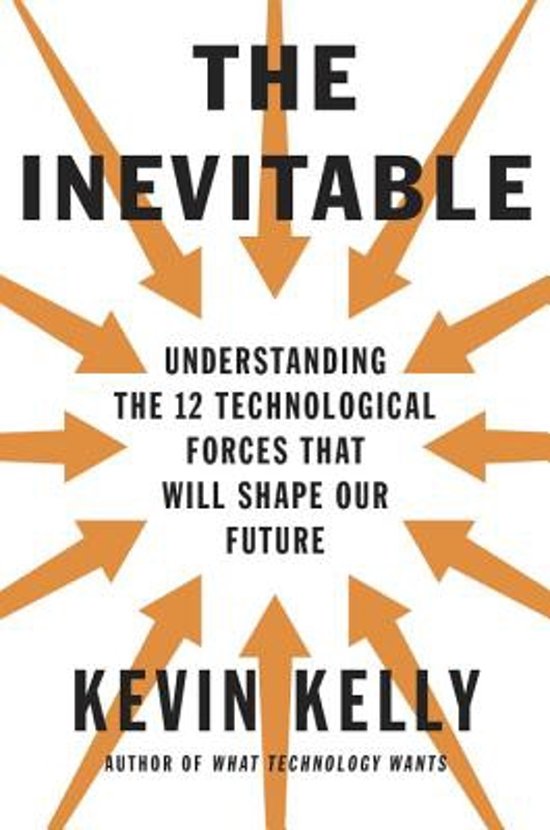
 I have read these two books because I want to know how technology is going to influence my field of work: learning and knowledge. I was also curious about what lens he uses to looks at technology. In my study Irrigation Engineering we learnt about various lenses. For example, you had the techno-optimists who thought that technological developments would solve all problems of developing countries, for example agricultural production would go up by invention of artificial fertilizer and pesticides. On the other hand, there are the skeptics. I was more skeptic because I saw how great the influence of culture and the way people react to technology is. At times people do reject technologies. Farmers in Africa did not make massive use of fertilizers and pesticides at all. Are there differences in visions on (learning) technologies? What lens can I use?
Kevin Kelly ends his book The inevitable with a clear position: he sees that we are at the beginning of a new phase, the last chapter is hence called 'the beginning' since he sees that we are at the start of a new phase. In this phase we move towards a collective consciousness that he calls the holos. We can not imagine the holos because it is something unseen yet. Another phase change from the past was the invention of the language. The people before the invention of language could not imagine the world with language either. Through language cooperation and coordination got a boost, but also idea development and fantasy. Ideas and knowledge travels with generations through language. The holos is a connection of all people and machines via artificial intelligence. The holos arises because we increasingly share, track, mix, filter, etc. via the internet. He also mentions two different visions on artificial intelligence: hard and soft singularity. The hard singularity theory is that we make a superintelligence that becomes increasingly smart, solves all problems and bypasses us. The soft singularity's theory is based upon a complex interface between people and artificial intelligence.
Some ideas I take from his books are:
- Technology takes an increasingly more central place in our lives. We sleep with the smartphone. My daughter sometimes sits with a laptop on her lap, ipad next to it and a smartphone in her hand. 10,000 years ago, a farmer only ran a few hours a day with a tool in his hand. The rest of the day was technology free.
- Apart from an addiction to a smartphone, for example, we may be addicted to what Kelly calls the 'technium', the technological innovation itself. This explains the interest in gadgets. The guild of French scholars has been able to delay the introduction of the printing press in Paris but could not stop it. Hence the general technology advancement seems inevitable?
- Social changes in history are almost always driven by technology. He clearly recognizes that not all changes due to technology are positive. For instance the large-scale slave trade has become possible because of the sailing ships that could sail across the oceans. A quote from Karl Marx: the hand-mill gives you a society with the feudal lords, the steam-mill society with industrial capitalists.
- The society and what we are working on is much more about intangibles (services, not tangible things) than about goods. 40% of US exports are intangible.
 the picturephone
- According to Kelly, new technologies are sometimes inevitable, but every technology needs a momentum. He gives the example of the videophone. Already in 1938 there were prototypes at the German post office. Picturephones were installed on the streets in New York in 1964, but were discontinued because there were only 500 subscribers. Now we use Skype, Zoom, Facetime or use video to call Whatsapp. Often similar technologies are invented or tried out simultaneously in different places. Only if the supporting technology is right and matches the social dynamics is it widely accepted. There is often a point where technology seems to be an option to individuals but in fact society has already changed so that people feel compelled to use it, in fact it is no longer an option. I recognize this with Whatsapp and the chip card for public transport. My mother could still buy tickets, but that is becoming increasingly difficult. Also think about how difficult it is if you do not want to use Whatsapp?
- He summarizes the major changes of our time in the inevitable: Our time is knowledge / information-oriented, flows of information such as in your timeline are increasing. Sharing, linking, tagging are all on the rise. 40% of the web is commercial information, however 60% is voluntarily shared, from a passion. Artificial intelligence is going to have a big impact. The time of huge influence of Artificial intelligence has arrived because we have cheap computing power, big data and better algorithms. These three are the optimal conditions for artificial intelligence.
- Can you redesign the economy based upon attention rather than material goods? If information is no longer scarce, then attention is. What if I was paid to look at an advertisement? If information is not scarce, and we can work more efficiently through artificial intelligence, people will focus on actual experiences. They will become very expensive and a new industry.
- There is a whole movement of quantified self. There is so much data that you can collect and analyze about yourself. Does this really make us a better person?
The books offer a lot of ideas about the influence of technology. It is quite overwhelming to me. On a philosophical level, I recognize the inevitably of technological advancements as in society. Being addicted to technology development in general by humanity would explain the focus on new technology and the 'shiny tool syndrome' that I often encounter. The intrusion of technology also gives me an uneasy feeling, as if you lose control. I am not happy about the inevitability. My own feeling says that we do not always need to get better from all new technology and that we still have to stay connected to nature because we depend on it (just look at black mirror). Nor do I believe that technology can solve all our problems, think of climate change, which is quite scary.
My question was: what will be the influence of technology on learning and sharing knowledge?. What I will take away from these two books is the increasing importance of information, we have to relate to information in a different way. We drown in information but does it help us further? Dealing with big data and information is becoming increasingly important. Attention is becoming scarce. Artificial intelligence will play a major role in this. The quantified self also comes back.
A conclusion is to pay attention to: (1) artificial intelligence (2) attention scarcity and focus and (3) learning through feedback about ourselves (quantified self). As far as the hard and soft singularity is concerned, I certainly believe in the soft singularity that we determine how artificial intelligence will support us.
What kind of feeling do you get from all these developments?


