Showing posts with label professional identity. Show all posts

Friday, January 24, 2020

Do you morph? About professional identity and the importance of doing new things

Judge Willem Korthals Altes (70 years old) is challenging his retirement. He gets an honorable pension because of his age but he doesn't want to stop at all. "My work is part of who I am," he says. The Dutch singer Rob de Nijs (76 years old) has Parkinson but is determined to finish his tour. After this a farewell tour, a CD and a farewell concert and then he intends to stop. Two examples of professionals who, in the words of Jef Staes, are "in sync with their talents". Working no longer feels like working. Suppose you have to give yourself a percentage between 0-100% for being in sync with your talents, what percentage would that be? And many of your colleagues?


The importance of morphing


Photo by Jack Leeder via flickr
Morphing is a gradual transformation into a new version of yourself (see morphing illustrated in the images). A colleague increasingly felt that her work was not important, got a burnout and decided to change the focus of her advisory work. During her burnout period, she has invested in a new direction by, among others. going to conferences. In this way she has found a different focus in her work and is currently capable of making more hours than before her burnout. Your focus and talent is not something you "know" at the end of your studies and work with until you retire. You must take steps in your professional development. Lynda Gratton, a professor of management practice at London Business School, analyzes the future of work. She calls for shaping your craftsmanship yourself: "create the space which will enable you to write a personal career script that can bring you fulfillment and meaning", but not only that: you have to move with the market and developments in your environment. She calls this “sliding and morphing.” The reason for morphing is two-fold: on the one hand the developments in the market, but also changes in your own interests.

How to morph? Keep on doing new things


How to morph as a professional? The Dutch writer Peter Ros gave me a number of ideas with his book Warorde. According to Peter preparedness for change is a learnable skill. Don't wait for a crisis until you change. Stimulate yourself (or colleagues) with new things. Consider for instance:
  • Work in a different place 
  • Change jobs regularly 
  • When self-employed: develop a new service or product 
  • Look for people who think differently (for example, if you work for the government, go and see a school) 
  • Start again from scratch: how should I do it now? 
  • Read blogs from dissenters 
  • Make an appointment with someone that annoys you 
  • Meditate 2 x 20 minutes every day 
  • Provide "fiddle time" 
  • Do something you never dared
  • Listen podcasts 
  • Travel to an unknown destination (sprs.me)

An example of staying prepared are the people in Netflix who developed a
chaos monkey A tool to derail the working of computers. A great way to challenge employees to get everything right again. Another example are de monkey milestones van AFAS. These are creative assignments for new people within AFAS. The name monkey apparently works well for shaking things up :).

Thursday, June 01, 2017

I'm sliding and morphing

You possibly know the book by Lynda Gratton called the Shift? It is about the future of work and she predicts that we will become increasingly serial masters instead of 'shallow generalist'. A master is someone with deep knowledge in a number of domains. The adjective serial points to the fact that you will no longer be active in the same domains throughout your life, but will continue to slide into new domains through personal or technological developments in new areas, building on your older domains and competences. This discovery of new domains is done by sliding and morphing. What is Sliding and Morphing? If you google on image you will see a lot of tinkering. Lynda Gratton says:
"Sliding and morphing happen when you develop deep knowledge, insights and skills in one specialism and then convert this to an adjacent specialism or rediscover a lost competence."
Lynda recommends looking at which subjects and competencies are important and in demand but combine this with your own passions and interests. Often the combination of domains is of great value. In one of the examples, morphing takes place by looking for a new network and new roles. Morphing by doing instead of thinking. When I read the book, I immediately recognized myself in the serial mastership (well, master? but serial sure!). After studying irrigation and soil and water conservation, I started working in the development cooperation sector, in different countries, Kenya, Mali, Ethiopia and Ghana. I only had three years contracts. So half a year before the end of the contract, you thought about what you would like to do in your next job and in which country that could be. And then apply. The good thing of the terminate contracts is that you always think about a next step. I saw that people in the Netherlands stayed longer in the same job because you do not have terminate contracts. From irrigation to consultant learning & Social technology is quite some sliding, isn't it?

Currently I am also sliding and morphing. It feels a bit uncomfortable. I've been working with Sibrenne for many years now in Ennuonline and our slogan is "All About Learning with Social Technology". The slogan still provides direction, however the field of learning and technology develops and expands very quickly. The question is where are you going to focus on within this field? In addition, we each have their own interests and professional identity. A major 3-year assignment aimed at designing and facilitating online courses has ended. That seems a bit like the feeling I had at the end of my contracts. You end something and that gives space to take up new things again. Though, of course, some work continues of course, like our Ennuonline learning activities and some assignments. What I'm struggling with is what direction I want and what I want to specialize in within the learning and technologies field. Blended learning and social learning is already a specialization, I never focused on classical e-learning. I'm very excited to advise on online and blended learning. What I regret in this field is that you are not supporting informal or invisible learning and learning in communities.

I am taking the current space to explore new directions. A number of new lines are:
  • I collaborate with two colleagues to set up a social network analysis (SNA) hub for the Netherlands. I regularly receive emails in response to my blog post about SNA. A concrete question whether we can organize training on SNA led to this brainstorm. Hopefully we can offer advice and training / tailor made support. SNA is one of my loves because it makes the invisible social capital visible. Which helps to develop connections.
  • I teamed up with somebody from our knowmad MOOC to dive into artificial intelligence. We want to do an experiment with eg Watson. There is so much written about artificial intelligence but especially from the point of view of: robots take over our jobs. We want to do a pilot to summarize and improve online exchange using Watson or a similar service. 

  • I visited a VR cinema. Something to explore with the LOSmakers, our network here.  
  • With two new assignments, I helped to find the right platform for learning or a community. I thought it was a good way of diving into tools and I enjoyed that too. 
  • Learning analytics. Two years ago, I was throttled in London because I heard the word XAPI. I then read and learn more about it. I have written a blog and an article about it. But how deep do I want to go in here? Is this not more for data analysts? 
It may seem to divert too much in different directions? A red line in all these subjects may be the use of data and technology (visualization?): for learning in networks and communities. Our knowmad MOOC focussing on the knowmad as professional with strong identity is also an interesting strand, because of the focus on self-directed learning. How wide or how narrow should you be as a serial master? Any thoughts?

Wednesday, May 17, 2017

The influence of technology on professional identity

In january I facilitated a MOOC about knowmads
A knowmad is what I term a nomadic knowledge and innovation worker – that is, a creative, imaginative, and innovative person who can work with almost anybody, anytime, and anywhere. (John Moravec)
The most intriguing element of this concept in my opinion is that professionals need a personal fascination with a subject. There is emotion involved. You can link your work to an experience or strong conviction. For instance I was so pissed in Ghana because I felt I never got any appreciation for my work within the organization. The start of a community or practice was a great relief. Professionals who appreciate each other, give feedback, listen to each other and therefore learn a lot from each other. Finally appreciation! I was so impressed that I decided to do an online course about communities of practice with amongst others Etienne Wenger, became a member of CPsquare and I am still working with the concept of community learning.


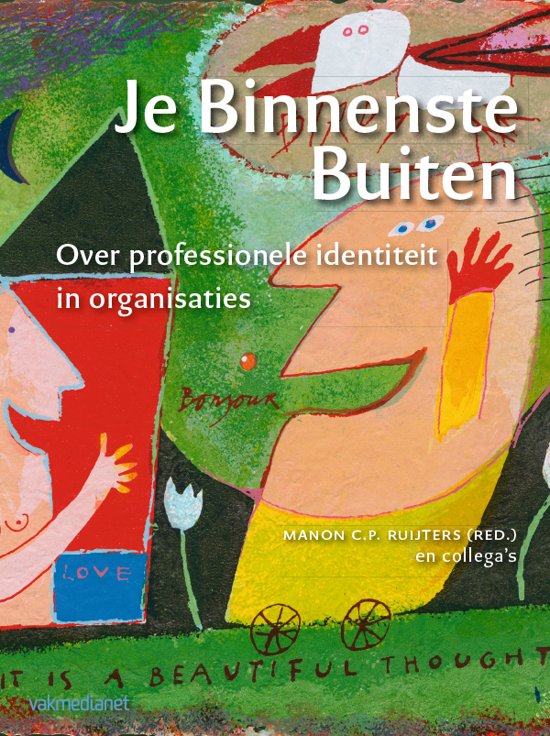
Shortly after the MOOC I bought the book 'Je Binnenste Buiten' by Manon Ruijters and colleagues. I think it's a great subject they explore with the book: professional identity. It is also a central concept in the theory of communities of practice. The book is recommended if you are also interested in developing professionals and knowmads. They argue that more attention is needed for professional identity in case of changes in a domain, career- and cooperation issues. Professional identity is not something that is fixed, but your identity is continuously developing, and therefore requires maintenance and attention. Unfortunately, the book is 'technology blind'. Surprisingly, I often read books & articles which are completely focussed on technology, or they are about other topics, and do not really address technology influences. The interface is still not fully explored. Or do I have a professional deformation?

The knowmad's identity is strong
The definition of professional in the boek is:
A professional is a person who chooses and seeks to be able to serve customers in a competent and comprehensive way, with the help of specialist knowledge and experience. In addition, he uses, and actively contributes to, a community of fellow professionals who continuously develop the subject.
I love this definition, because it clearly describes that a professional wants to develop his or her knowledge and compentencies like the knowmad, and also contributes to a community of peers. The knowmad is by definition someone with a strong identity and self-knowledge. These people prove to be more stress-resistant, to be more successful and to have more self-esteem. A strong lesson I take away from this book is that stimulating knowmads and knowmadic work in organizations means paying attention to professional identity. We do a regular exercise by making an I-cloud with topics of interest to you, but there could be more questions.

Serial masters
Lynda Gratton describes the new professionals as serial masters. A serial master has deep knowledge and competences in a number of domains. So, you need to specialize yourself, and you will be in a new domain for a year, but building on your past experiences and interests. A strong and rapid development in identity. I think the identity of a knowmad meanders more and changes more rapidly than the average professional by curiosity and changing assignments. Identity questions and self-knowledge are therefore more important to stay grounded.

Technology's influence on professional identity: online identity 
An important influence of technology on contributing to professional development is that professionals are increasingly online in (informal) networks: sharing about their work and thoughts in Tweets or other micro-messages. This is a new level of contribution to professional development that previously did not exist. Identity has to do with what makes you unique? In the book, working on your identity is linked to self-knowledge and influence by how others think about us. Social media forces you to work continuously on your professional identity. If you are very active online, this forces you to make choices and think.

Boundary crossing
A second change is that it is becoming easier to look around you and cross borders with other professions, become members of communities you would not normally become members of (eg, like in my case marketing communities). A knowmad not only contribute to developing his profession with fellow professionals, but also innovates by looking across the boundaries of his own domain into other communities- boundary crossing. Online it is incredibly easy to take initiatives with others with different expertise to contribute to new areas. An example? I got to know Jos Maasen and Peter Staal online and we are now writing a blog together about using community principles to design social MOOCs. In other words, there are numerous new ways to work on professional development.

Personal branding
I once wrote a blogpost about personal branding. As a consequence of the need for personal branding, the process of professional identity formation will develop in a substantially different way, and way less linear. You can already build a reputation as a young, starting professional. I think that Erikson's identity creation phases (trust, autonomy, initiative, fidelity, identity, intimacy, care, integrity) do not apply anymore. To give a practical example. The book shows the example of co-assistents who struggle with who they are. Solid feedback during their internships influences their identity. However, the online world offers a whole new space, contacting other co-assistants in an online community, possibly online valuation from unexpected angles. The new space that the online world offers is huge.

Conclusion: A great book that puts the theme of professional identity on the map, but with very little attention for the influence of technology. Huge need for a new chapter about online identity!

Friday, December 13, 2013

The shoemaker and his (own) mould

leest
For years I have been wearing orthopedic shoes. The fun thing is that you may design your own shoes. The first pairs of shoe pairs it was quite frustrating that they do not look out exactly as you designed them... Since years I know that the final shoe will not look exactly like my design and I think it's fine. I'm going to switch from one shoemaker to another shoemaker. So I asked the shoemaker if he could send the mould (do you call it like this?) to the new shoemakers, which seemed logical and efficient. Something about not reinventing the wheel or doing double work ...

The shoemaker did not want to send his mould to his colleague He explained that every shoemaker has his own way of working, there are subtle differences in how you approach it. He would never want to work with a mould made by his colleague, but rather create a new one. His mould of the same foot will be quite different. This surprised me, it seemed so logical to share the mould as an outsider. It got me thinking again about how hard it is to share materials between professionals, and learn from each other's unique way of working. I once taught a course with the curriculum of another teacher, but found myself adjusting many things and almost wished I started from scratch. Although the practice of trainers, for example, looks alike for outsiders, there are many subtle differences that make the work of a professional unique. With a colleague we like to make prezis together and I notice that it is still hard to explain a hard made by a colleague you know really well.

This week I facilitated the third session of a community of practice. One participant told me that he had really connected with two other participants. They share a lot with each other and talk about all their projects. I strongly believe it take a sustained interaction over a longer time frame in order to be able to really learn from each other. This is the only one way to learn how another professional tackles the same challenges. Though I had the impression this shoemaker did not really want to learn something from his colleagues - he knows just how how he wants to work.

Tuesday, June 18, 2013

Help! - the professional2.0 is coming...

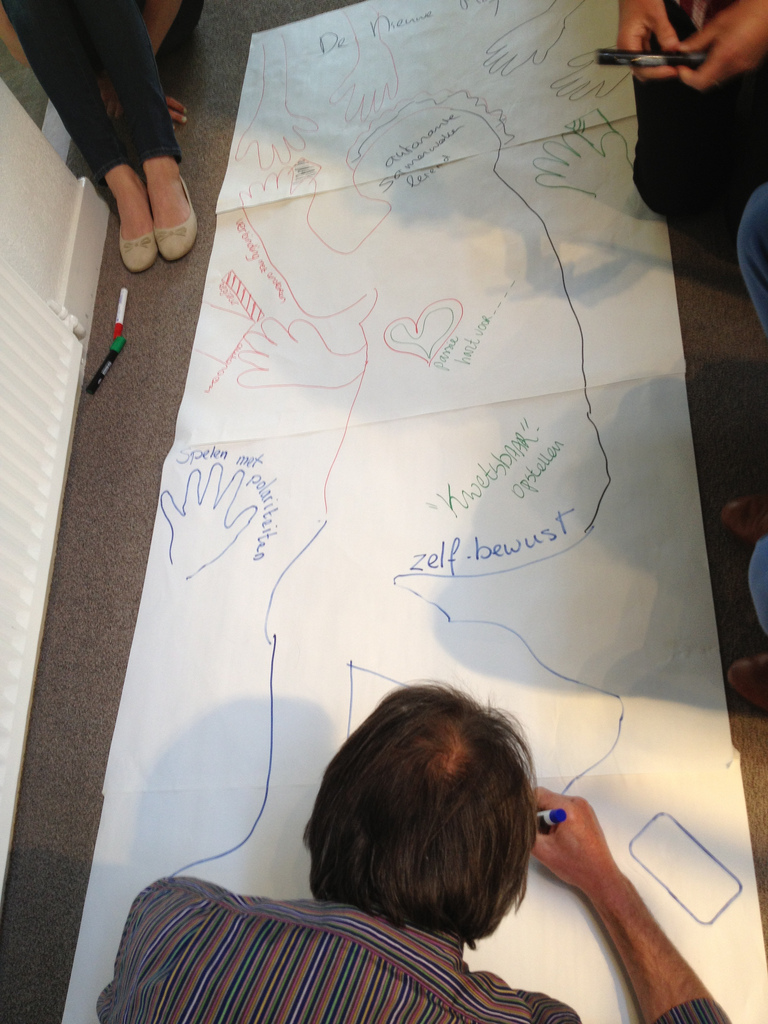
 professional20That professionals can be wilful and opiniated we already knew (only look at house!): several authors have written extensively about this phenomenon (such as the Caluwé, Vermaak and Weggeman). With the recent technological developments such as social media and social intranets, professionals have even more spaces to profile themselves. Who are these new professionals living in our era of social media and what does this process of empowerment of professionals mean for organizations? During the learning trajectory 'learning and change with social media' we made a drawing of the new professional (see picture). She (in this case it was a woman) has at least one smartphone in her hand and apparently on the move (running). She is an independent thinker in her field, she takes initiative and is capable of finding the balance between different polarities, such as online and offline, private and professional, inside and outside the organization. In addition, the basis of her works and passion is from a connection with her own personal experiences, which gives her the drive to excel.

Serial mastery

Lynda Gratton, the well-known professor of management practice at the London Business School, has written a book with the title 'The Shift' about the global changes that are influence the workplace. She marks important changes for professionals: professionals will become what she calls a 'serial master' rather than a generalist. A master is a professional who possesses deep knowledge and skills in a variety of domains. The serial aspect of serial mastery consists in that the relevance of these domains will change and the professional during his / her career will have to venture into new domains, building on old topics, she calls this 'sliding and morphing'. It is therefore important that the professional can quickly learn and is a good networker.

Self-organised learning

Hans de Zwart (Senior Innovation Adviser for Global HR Technologies at Shell) is posing the following question online: can you design a curriculum for the professionals when their work is so dynamic and is changing all the time? Or should there be more focus on self-directed learning (do-it-yourself-learning, self-regulated learning)? There are currently more and more complex problems to be solved by professionals - and complex problems can not be solved with routine answers and best practices. In a complex situation you have an emergent practice, and you should work with trial and error, try things, reflect and adjust. So apart from the fact that professionals need to move into a new domain they must learn to solve complex problems. They do this in daily practice.

Online branding

Online communication is becoming increasingly important in finding the right professional for the job or project. If you a professional and you are not on Twitter and LinkedIn, you have been fairly invisible. Internally channels like Yammer or other social networks are becoming increasingly important to be visible within the organisation, especially in larger companies. Professionals should therefore clearly know what makes them distinctive and unique from other professionals. A professional2.0 will build an online reputation and that reputation is more durable than the job he / she has. The organisation only 'borrow' the reputation of the professional.

Organisations and the professional 2.0

What does this imply for organizations, strong, initiative-taking autonomous professionals? I have spoken several youngsters who are surprised about the slowness of communication in organizations and the lack of adequate resources and support. Professionals are 'serial masters', who design their own online brand, and be young and old. For me, these technological and social developments have the following implications for organizations: 
  • Look for new models of working in collaboration with professionals, not only in fixed employment, but also in networks
  • Develop new '21st century' skills such as dealing with social media, online networks etc.
  • Encourage and social learning within (online) communities instead of organizing training and education 
  • Provide a technological infrastructure within the organisation which works just as easy as social media
  • Support professionals by new and lighter forms of leadership: avoid too much hierarchy, give space and ensure that leaders themselves are professionals too, so avoid 100% managers
Interested in gift, skills and attitudes of the new professional? Read the blogpost on the portrait of a modern knowledge worker by Ewen Le Borgne. 
What impact of the various developments do you see for organizations? And to what extent is your organization already doing what I suggest above?

Friday, March 30, 2012

Four strategies profesionals for personal branding via social media

Why would you be busy and thinking about personal branding?
I always though branding was a horrible word 'become your own brand'. It sounds so much like shallow marketing. In the meantime I changed. I started branding myself online, though not consciously, through this blog, participation in online communities, twitter, commenting on blogs. I have a lot of followers on Google+ even though I hardly post...So branding can also be about sharing you unique view on professional issues and showing what your view and particular interest is. This is actually fun to do. I am now convinced you can use social media very effectively and in a fun way to develop your professional identity. Seeing what type of blogposts trigger a response from you may help you define your own specific interests to pursue.

What is a professional? A professional is someone who work and has autonomy to act. He or she identifies with his field of work. A doctor in a hospital often identifies himself more easily with other medical doctors than with the hospital. As a result he of she will be more energized by a meeting with peer than by a hospital department meeting.

Online personal branding Social media provides a space for professionals to profile themselves as autonomous thinkers and professionals. Much more than for instance within the organisation. This sometimes gives friction if someone is more appreciated online than in the organisation. In social media they are judged for unique content and interesting views whereas in organisation hierarchy and organisational politics come into play. However, in social media there is also group dynamics, but it works differently.

Meet Emile I would like to share a great example of online branding. I was part of a meeting, the Yamtour. The meeting started online. During the gathering some speakers were features from large organisations like Rijkswaterstaat en Capgemini.
They had interesting stories, so my point is not that the selection process was not good, but often the larger organisations are in the spotlight. Small innovators like Emile buurtzorg will not be selected so easily to be on stage. However, Emile used the online space to profile himself succesfully online as an innovator in the health sector. He used the online space to search other health professionals and started a group for them. After the event, he organised an informal meet up.  This is an example of using online space to profile yourself. 

Four strategies to use for personal branding using social media
  1. Become an 'info-mediairy' or 'content curator' if you want. Scan information, search, make sense of it and add your personal view. You can use Google like everybody else, but you need to build your unique learning network to get more interesting information. You can use RSS feeds and other dashboard tools like tweetdeck or hootsuite to help you scan information. Don't forget the sharing part!
  2. Network and learn. The speed of communication through social media and the open culture lends itself for building a personal learning network, a group of people who can help you answer work related questions. As they say: 'it's no longer what you know but who you know'. My tip is to invest in developing some relationships further. Not allow your network to become very shallow. Try to meet new people too.
  3. Share. Menno Lanting -in his Dutch book 'Iedereen CEO'- notes that sharing through social media is an excellent way to work on and develop a professional identity. What are the things you'd like to tweet? What triggers you to write a blog. Maybe your blog categories help you to sharpen your elevator pitch. Everybody is an expert on something on social media...
  4. Collaborate in project. Maybe you are a very practical person and you'd prefer to let your actions speak. You could also use social media to work on real project and collaborate. For instance help build a wiki about a specific topic.
The four strategies are overlapping ofcourse. Nevertheless, I'm convinced they can help you make informed choices on where to start or what kind of activities to intensify. Choose the strategy closest to your preferences and current activities.

I developed a presentation on Prezi on this topic. You might have a look if you are interested. It is in Dutch, but quite visual so it might make sense.