Showing posts with label social media. Show all posts

Monday, September 21, 2015

Social media in organizations: the case of the ambulance services in the Netherlands

Ambulance

With great pleasure, I conducted a field research together with Sibrenne Wagenaar with one of the the ambulance services in the Netherlands. The ambulance service asked us to look for improvement in internal communication; driven by the fact that technological developments offer new opportunities for collaboration and communication within the organization. The initial question was: how can we improve communication within the organization using new media?

We went in search of new forms of internal communication that fit the organization. We did an action research which lasted five months and was conducted by a pioneer group of 17 people, accompanied by us. The action research consisted of internal reflections, research within the organization, visiting other organizations and an experimental phase. Experiences are interesting from the standpoint of how technology influences collaboration within an organization and are likely to be recognizable to other organizations.

Some conclusions
What was especially noticeable is that even if you do not use social media, these media still have an influence on the organization. In this case there was a static intranet, with information from management. At the same time, there were a large amount of Whatapp groups within the organization, often invisible to management. Communication in these groups was often not favorable to the organization in the sense that confusion messages were amplified. If management in an organization does not have an eye for this type of communication via new media, it may strengthen a culture that you do not favour. The outcome was that the organization may benefit from a social intranet, however, a lot of attention should be devoted to stimulate a new way of communication, both face-to-face and online. An experiment showed that people did not like to participate in open groups online, but really need the safety of a small closed group. A social intranet is a big step for this organization and will need a clear vision and several years of implementation.

Download the full article
We wrote an article about our experiences for TVOO in the Netherlands. You may download the article sociale media bij de ambulancedienst  which is in Dutch.

Tuesday, March 17, 2015

Multitasking, Ritalin and online mindfulness


I have watched a documentary about 'our distracted brain'. I hardly dare to say it outloud but in between watching the documentary I was chatting on Skype, answering emails. Nevertheless I enjoyed it and it made me think about singletasking and focus. It is interesting that I still see myself as a very focussed person but I know my habits have changed a lot since I'm working a lot online. I really think that I can multitask at times and that this is very efficient. I will try to improve this by being more aware of when something needs my full attention. However, I am good in focussing I believe because I was always capable of studying with the radio on. When there is a party, I only know what the person I was talking to was saying and missed everything else in the room.

1. Multitasking only works for routine tasks 
A wonderful multitask exercise is to count from 1-10 outloud. Thereafter, say the alphabet from a-j. Then try to combine the two: A1, B2, C3, etc. You'll find that it takes very long to count in the last exercise because combining the two is more complex. With complex tasks, it is not efficient to multitask. Multitasking works especially if one of the tasks can be performed routinely. Therefore, many people think that they can drive and phone. This is also true in itself, however, driving and phone becomes problematic when the driving gets tough, then you should focus all attention on the road. There are many situations where multitasking is OK and can work smoothly, eg driving itself is multitasking - you have to worry about traffic, foot pedals, turning etc. Multitasking works only with more complex tasks if you are a supertasker. However, this is only a small group of people (2% of the population). Furthermore it is a pity, you can not train multitasking.

2. The influence of social media - we get more and more stimuli We now have to deal with much more media stimuli as before. The information that we can swallow (but not digest?) has grown tremendously. In social media, f you've been absent from Facebook or Twitter for a whole day you have the feeling that you are missing something, there are many new messages. You got to go to learn that it is never 'finished'. In the end you have to learn to balance between being distracted and concentrate and focus amidst all those stimuli. I have to say that I am really relaxed. I follow so many people on Twitter that I simply dip in when I have time. I never feel like reading all the messages.

3. How do you force yourself to single-task? With all the social media stimuli, it is much harder to force yourself to single-task. The single-tasking is more difficult nowadays because you have to turn off all distractions. People with lots of dopamine in their brains can concentrate well. The Ritalin / Concerta medicines prescribed for ADD-ers ensure that more dopamine is available in your frontal cortex so that you can focus better. The number of prescribed pills for ADD has lately tripled over the past five years. But other students are already sometimes taking Ritalin pills to study well. A survey of 1,500 students in the Netherlands indicates that approximately 2-3% does take the pills to improve their capacity to concentrate.

4. And if you want single-task without taking Ritalin? For those of us who want to improve single-tasking without Ritalin, there are other possibilities.
  • Mindfulness training and meditation. These are forms to learn to shut your brain or part of your brain down. You learn to concentrate better. What you do with mindfulness is give your brains a rest.
  • Turning all the stimuli in the form of bleeps, pop-ups etc. off. Turn off your phone, email notifications off. Use special programs like MacFreedom to block your internet if you can't control yourself and know yourself.. 
  • Take control over your time back into your own hands. Through better planning you can focus better. Or use the pomodoro technique to concentrate. 
  • Read from paper (this advice will not be a fun one for organizations that just introduced the paperless office :). The advantage of reading from paper read is that there is no distraction. You may choose to read a paper book or article so you can focus more easily. I sometimes go downstairs with a printed article to read as a sort of mental break in my work. 
  • Unplug. Make sure you find a balance in your offline life. Go into a digital detox. Or like Clay Shirky- unplug your students while you are lecturing. 
5. Does our brain change as a result of all the media stimuli? Our brain is overloaded with daily whatsapp, emails and tweets. We get a lot of information and often we respond quickly. What does this do to us and with our brains? Does it changes our brain and will our children's ability to read a longer text suffer? "I am convinced that our brain is changing" said Roshan Cools in the documentary. Our brain is plastic, flexible. Think for example of what happens with addiction to drugs; as a result of heroin or cocaine entering our body, the brains change. The brains learn to cope with drugs. This demonstrates the plasticity of your brains of an individual. We adapt to our environment. Everything we learn is changing our brains. Whether and how this influences ithe brains of future generations is not yet known. It is likely that the brain adapts to the circumstances, but it is quite possible that the brain will become better at focussing among all those messages.

6. Let's not ignore the art of dialogue .. Sherry Turkle is wrestling with the same questions. She is a psychologist and excited about the potential of social media in the hope that it helps us advance in learning about our online identity. At the same time she warns in her TED talk for short messages and the effect on our communication. She is excited about the new opportunities, but they also see the bizarre appeal of smartphones. People go online during a meeting but also during funerals. Parents send mails during breakfast. She warns of the effect on our way of reflecting. She calls it the 'goldilocks' effect. We communicate mainly in small, short messages via SMS, tweets, facebook and LinkedIn status updates. If we are not careful we are losing the art of conversation and really engage in dialogue. If we loose the art of dialogue forever we are not on the right track.

Friday, May 11, 2012

Interview with a teacher making smart use of social media

What always strikes me in contact with teachers is that there is so much difference in their attitude towards social media. One teacher loves social media and widely experiments with various media, another says "it's not for me" and doesn't want to try anything. Younger teachers sometimes have an attitude that they know it because they are on Facebook, but I don't believe they really know how to use it at all levels. Perhaps they do not see the link with learning. I believe that social media is of interest to all professionals and teachers are an important group of professionals, since dealing with education. In the newspaper special last Saturday I read the following quote: "a good teacher must continuously innovate and surprise." Here come's social media full of surprises!. Antoine is such an enthusiastic teacher convinced of the value of social media to a teacher-professional. I interviewed him, below the interview.


Tell us something about yourself as teacher at Varendonck secondary school? 
  
I work since 2003 as a French teacher at the College Varendonck in Asten. Furthermore, I support colleagues in using our Virtual Learning Environment. This school year we switched from N @ tschool to the ELO of Magister.

You blog about French and ICT (hier), tell us something about your blog, how you started it, who your readers are and what the value is of blogging for you? Do you read many blogs yourself?   
I began my blog in december 2007. My big inspirations are two Dutch professionals: William Karssenberg (@ trendmatcher) and Pierre Gorissen (@ PeterMcAllister). I followed their blogs for a while and it seemed useful and fun to keep a blog. My weblog is read by French teachers and by teachers who are interested in using ICT in the classroom. What has been the benefit for me so far? First, it is an archive upon which I can draw. Often I know that I've blogged about a particular topic and this way I can quickly and easily find the materials. I refer colleagues to some posts on my blog. Furthermore, the interaction with readers helped me with solving some problems. There are always colleagues who want to help you further. Also nice to mention is that I have been approached by Teleac to make a guide (GoAnimate) following screencasts that they have found on my weblog. I follow many blogs themselves and try to make use of Google Reader.

Which social media do you often use yourself?    
I will mention four important social media. To stay up-to-date with information I use Google Reader. With Google Reader you can subscribe to interesting blog without having to visit that blog. Furthermore, I often use Diigo, a social bookmarking site. Previously, I used Delicious, but at one point there were rumors that this service would quit and when I switched. The beauty of social bookmarking is that you have quick access to a website, because you can add tags and notes. You can also see what other teachers bookmark these links and you copy interesting links from other teachers. A third tool that I would mention is Twitter. I use Twitter to share things I find interesting with others. I also use Twitter to ask questions using the hashtag #daretoask. What always strikes me is that so many people are willing to help others. Sometimes there a whole conversation develops which is also very beautiful to observe. Finally I would like to mention Wunder List, an app allowing you to make to-do lists which you can use on multiple devices

How do you stay up-to-date?
I use Google Reader and Twitter, the two most important tools. Dat zijn voor mij de twee meest belangrijke tools.  

How much time does it cost you to read your Google Reader, blog and twitter? Do you have time to do it during school hours?   
At school I do not twitter nor blog. I do that outside of school. It depends also on how busy it is. Sometimes I don't post for a long time on my blog, because I'm just too busy. I had good intention to blog more this year, but I haven't been living up to these intentions yet. During the holidays, I try also to occupy myself with other things, like reading.

What is for you the added value of social media as teacher-professional? 
A blog allows you to think about some things and share your knowledge with others. Why should anyone have to reinvent the wheel? Social bookmarking allows you to quickly locate information and to find new interesting sites to explore. Twitter offers notably the ability to share knowledge and to ask questions.

And during class? 
In class some tools can be useful tools, such as Socrative. With this site, students can vote. I recently used this tool for practicing reading skills. In this way, students (also quieter students) become actively involved in the lesson. Make the use of social media and use equipment the students have. Some have a mobile with internet, others an iPod Touch. Not all students have access to this equipment, but if students work in pairs together, you do not need much equipment. Be creative! Further, Twitter may be used by pupils making a thesis or presentation. They can use the #daretoask (#durftevragen in Dutch) to ask questions and input. I don't use social media in each lesson. Do it only if it is useful and if it adds something.

Sunday, February 05, 2012

Brain science meets social media

Brain learning is currently a hot topic in the Netherlands amongst learning professionals.  I read the book Brein@work van Ria van Dinteren en Nina Lazeron..  They interviewed various scientists and are translating new insights from brain science into practical consequences for organising effective learning situations. An example: sleep is very important for processing new information and new stimuli.

I'm working a lot with sociale media and communities of practice. Both are means to make learning processes stronger and more effective. I'm convinced you can win a lot by starting online for instance. Friday I attended a session for trainers about training methods. Very interesting to compare what methods you use. However, there was a case discussion about managers who were too direct in their communication and hence did not create a good working atmosphere in their teams. The result was a bunch of unhappy employees and a lot of gossip. The solution was a three hours training for the managers. I'd believe it is more useful to work for shorter periods and try to know what the managers think, and see it as a change process.

I'm very happy to work with Ria van Dinteren to prepare a session on Brein meets social media on the 16th of February in the Netherlands. We hope to combine insights from brain science with the way you can use social media in learning processes. It may provide a strong underpinning for certain ways of working. Many of the things I do I believe in based upon my own experiences and insights, hopefully my practices can improve by using these new discoveries about our brain.

One of the questions I often hear is: Does Google make us stupid? Dr. Paul Howard Jones is analysing the latest scientific research to investigate this question. You may watch the following youtube video. His main message is: technology is not good or bad for us, it is important HOW we use technology. The internet may solve problems and may create problems. Google can make us smarter as well as more stupid, depending on the context of use. 1,5-8,2% of the population is using the internet in problematic ways (eg. addiction). Especially action games may be addictive because they give us a dopamine boost and hence a good feeling. His explanation is quite general, however, in the last 5 minutes there is an interesting question about teachers who have to compete with games after school. Students who game may increasingly consider class boring.  The solution of Paul Howard Jones is to make the lessons more engaging, for instance by using mobile phones and other technologies. Technology is not making us stupid, but we have to make smart use of it. Here's the full video.


Ria and her team have pulled out the most important brainprinciples - important for learning. I will share the most important principles briefly (here's a Dutch article about brain learning -I'm not sure there are good English resources about the principes, let me know in a comment if you know English resources). After outlining the brainprinciples I will try to relate them to using social media in learning processes.

  • The emotional brain - we can use the power of emotion while creating learning situations and facilitating learning processes. You can use interesting stories to match information and emotions for instance. It also helps to have fun in whatever you are doing, it helps to retain information and a memory. Relating this to social media, you could say it is important to surprise people with an interesting new medium, especially at a time when routine has set in. Asking your students in class to send a summary by SMS which is shown on the screen may be exciting. And you may use digital storytelling. Blogs can be appealing because of the personal storytelling inherent to the medium for instance. On the other hand, the emotional brain principle also shows that using social media is also a potential pitfall, for instance when technology becomes a hurddle for participants, taking away attention from the important topics to technology. I once had a group experiencing a lot of technical problems with the first webinar. This was an immensely negative transforming experience for the group and there was some continuous fear for webinars.
  • The brain of connections - Brains are not static, but dynamic and changing. Continuously, new connections are formed in our brain. It is very important to connect to a known context and experience to make learning easier. For instance, link theory to work experiences and it will be easier for people to understand it and to relate to it. While using social media you can use this phenomenon by coupling the online world to the real world, by using words from the real world. I often use words like bungalow, library etc. I also talk about conversations online rather than 'typed messages'. Maybe more important is using connections to real life situations by asking people to share their daily work situations online. If you can respond to real work dilemmas, the brain will immediately link and develop new connections.
  • Het information processing brain - we can only remember a limited amount of information. Repetition makes sure we better retain important information. I still remember the french line: bon, beau, nouveau, joli, gros, haut, long, petit, jeune, vieux, mauvais, méchant, autre, vast, meilleur et grand because we had to repeat it many times in class... For good processing we need enough sleep too. Ofcourse this calls for sandwich models in which you use online and face-to-face to discuss similar topics in different ways..  
  • Nourishing our brain - Our brain needs nourishment to learn: oxigen, movement, sleep. Apart from these important physical needs the brain also needs to be nourished with a nice environment and some challenges. How can we translate this to the way we may use social media in learning processes? We can nourish the brain online in different ways as offline, with lots of links, clicks, videos, an attractive blog. It can be exciting to find interesting resources online or to create your own beautiful prezi. In one online trajectory I made sure there was a large library. I thought is was not really necessary after all, because participants were really short of time due to some work-related pressures. Surprisingly I discovered two participants had really clicked through and enjoyed looking at almost all the resources! The other participants had not, but that's the advantage online- we can feed participants differently!

Friday, December 09, 2011

New media, new practice

I have to confess I read my mail on my biclycle (using my iphone). Two years ago I didn't have mobile internet yet. Twittering and mailing was place-bound to my computer. As a result I was using the first hour behind my computer to work through my mail. Now I can also read tweets and blogs. A good reason for me to read mails while travelling on the bike or in the train.

Visiting a friend I discovered reading bedstories to small children is not the same anymore. Now there are all kind of nice apps for children, with things to click on and sounds and noises. Or you can have surf for youtube videos (like   this one of the princess and the potty. Comes in handy when you need to do something for yourself.

The workfeud app has made scrabble a favorite game again.

Sylvia Witteman (a Dutch writer) wrote a column about her fixed telephone line. Everybody is calling on their mobiles, except her mother who says:  "I just like to call you without knowing who will pick up the phone". Unfortunately nobody answers, since they only answer their own mobile phones...

In gesprek met iemand die niet veel achter de computer wilde zitten stelde ik voor dat zij meer met mobiele apps zou kunnen doen. Even een snel twitter of Yammer berichtje sturen kan ook van je mobiel (met internet verbinding) en dan hoef je niet meer achter de computer te zitten. Helaas bleek ze een oud model te hebben waar je net mee kunt bellen.

Photo by Yashrg

On the photo you see the following quote: "Technology is not technology if it was invented before you were born". There is a difference in the way people embrace new technologies (or not). Developments in technology are also incredibly fast. Someone told me: "I don't have a clue how I can find my way through all the new tools, I don't understand how you do this!". The examples I shared show that new use of technology also brings new habits. And the habits sometimes inhibit adoption of new technologies. Think of sms, people have started to communicate more often or on the contrary call less. Hence it is sometimes not an improvement for all, think about the grandmother who would like to call being surprised by not knowing who answers the phone. Though this morning I read on Facebook of a granny using Skype to exchange kisses with her grandchildren. So it might also be an improvement. I wonder what determines whether you try something new? Some elements are: what your friends do (I was invited to wordfeud games and my daughters are fanatically using what'sapp while I don't). But also whether you like experimenting or whether you perceive the benefits. I have long resisted the microwave, feeling it is unnatural to radiate your food...

For organisations it is hence even more difficult to stay abreast with all new developments, like social media. Especially when the management team is slightly older or less experimental, after all management has a large influence on collective habits (culture- the way we do things around here). The way new media should be used may also be at odds with the way the organisation works. All this may lead to a situation where the organisation is missing new possibilities to network, innovate, profile themselves. One afternoon talking about social media is not enough to bring about change. In january we are starting a trajectory with a new organisation working during half a year exploring new media and how this may lead to new ways of organising within the organisation. I'm very excited and hope that we can manage to change some practices. I think 6 months is quite a short trajectory, but hope we'll get far.

Thursday, October 20, 2011

The dangers of social media for youth

The high school of my daughter organised a meeting about "internet and social media". As you might guess it was focused on the dangers.. "The potential hazards are discussed and the possibilities to take measures to enhance safety .." It was very funny to hear someone do the opposite of what I do: I'm trying to enthuse people about professional use of social media and Donny Gieskens of the 'stichting veilig online' (Foundation internet safety) is raising awareness about the dangers of Internet and social media .. and he did make his point! Especially with his presentation with the blonde girl on his webcam who turned out to be an old man:). There are a lot of technical possibilities to create innovative online communities, but also for people with bad intentions.

I wanted to make notes for this blog post but thought a laptop would look kind of weird. And there was no wifi so live-blogging was not even an option. Eventually I brought an iPad for notes and I was the only one. Finally I did not dare to take pictures because it is forbidden by school protocol!.

Though I pity the fact that social media are usually approached from the danger side by parents, it felt useful to have a look at side of social media to which I usually don't pay a lot of attention. I might give it a clearer space within my own work.

Some facts

First some facts and figures for 12-16 year olds in the Netherlands

  • What does a typical teenager do on the internet? Main use is YouTube (videos), MSN messenger (chat), browsing (surfing), social media (contacts and new contacts), Word (word processing) and games (gaming)
  • 87% had a bad experience through the internet.
  • 1 in 4 boys aged 12-16 engages in cybersex
  • 2 out of 10 have met someone in real life they met through the Internet (but so do I!)
  • 1 in 100 parents think their child has been involved in cyberbullying
  • However, 40 out of 100 teenagers has really engaged in cyberbullying
  • 12-16 year olds play on average 1 hour day games
  • There are already 5.9 million years played in the game World of Warcraft
  • On average, a 21 year old has gamed for 10,000 hours
The dangers

1. Information sharing

Importantly, a lot of information is shared by children, which the parents don't want to be shared, such as holiday dates (burglars are actively using the internet for information too!). The caches of search engines will all be kept for five years, what teenagers do not always realize. So when you share a picture when you are 16, this picture may still be found on the net when you apply for a job at 21. The privacy settings on social networking sites (like MySpace and Facebook) are not always set consciously to visible for friends only. Moreover Twitter has a public account by default, what teenagers may not realize. Youngsters do not always realize what their settings are and whether their information is public or visible only to friends. Also with links between network sites like Twitter and Facebook privacy settings can be overwritten. On a positive note: companies like MySpace and Facebook may sell user statistics, but not the individual information, because it is protected by the (dutch) law on personal data.

Some tips on sharing information are: Use a nickname (not your own name and not sexygirl15). This is an opinion contrary to my advice in building a professional identity however ... And ensure good privacy settings: have a look at them together.

2. Cyberbullying

Bullying can be done by acquaintances or strangers (anonymous).

Tips: Keep all threatening or bullying emails. Every Internet connection has its own IP address, and is recognizable. In a chat program you can block unwanted people, chat programs are required to provide this function. If bullying comes from a public computer, eg library, there are many cameras that have registered who have made use of this computer, so the anonymous persons are traceable.

3. Phishing

Phishing is social engineering by imitating emails individuals are trying to extort information. If you give someone your password voluntarily and they abuse is by posting on your behalf or using your credit card it is still a crime (contrary to popular belief). Your password is yours alone. This is a legal offense.

Phishing Tips: Change your password every 70 days, using 5 digits 2 3 Unicode characters. A good free virus program is AVG.com. Do not forget to log out when you leave a computer. Automatic locking may also help.

4. Gaming

Gaming is also positive for the development of language, manners and communication. Unfortunately, 3 out of 10 parents buy games for 18 + for children under 18. 6 out of 10 parents have no control over the types of games that teenagers play.

Tip: Know what they play!
Do not buy 18 + games for under 18.

5. Sexual Abuse

Especially for girls a modeling offer may be tempting, and it comes with the instruction not to consult with the parents. Also, blackmail and threats occur. He showed a convincing example of a man who posed as webcam blonde girl. So you think you are talking to a nice girl, but in fact it is someone else.

Tips: If you suspect abuse attempts: contact the site administrator. In case of concrete evidence: File a report with the police. Webcam only with people you know in real life. To check authenticity of the webcam image: ask to raise a hand. Cover the webcam with a cloth so the webcam can not film from a distance without you noticing.

Some general tips for parents:
Talk to teens about online behavior and provide parental control and agree on time limits, etc., after school, not directly behind your computer, check age limit games, talk about experiences, learning a critical attitude. Write an Internet protocol and let the teenager sign.


I'm a little double about this focus on the dangers. It is useful to me, because it is my invisible spot. On the other hand, you could have a much wider and interesting debate about social media, socially-constructed learning and learning within the curriculum..

Friday, September 09, 2011

Finding the perfect learning platform in 5 steps

After the holidays I have been bumping into the same issue with different clients: "Which platform you choose for a online part of a learning trajectory as trainer/facilitator?" It is already clear that you want to combine online learning with face-to-face meetings, you need a private online platform and there is also a budget for it. With the enormous amount of social media tools it is much easier for a trainer/facilitator to make his/her own choice of tools fitting the learning activities rather than trying to fit your learning activities into a predetermined platform.

I have a first blog post written about the broader range of platform options that exist for online discussions.
In this blog post I'm going deeper into the selection process for online exchange in a private group. In large organisations, there may be a platform available and you may have to decide whether you want to use this, or an alternative. I noticed many start with the tool rather than thinking about the participants and the learning activities.

For a good selection process, take the following five key steps:


Five step approach to finding your learning platform
  1. Make a shortlist of potential platforms by asking around (and I'll help if my shortlist), review and test them on the following criteria:
  2. Identify what your participants are familiar with
  3. Determine the features you need by designing the learning activities
  4. Look at the implementation trajectory of the platform
  5. Find out what the price is

Make a nice table (something like this) to sort out your findings in writing and help support your decision to support (x-ax the potential tools, y-ax the criteria


Re 1. Make a Shortlist of possible platform There are many different platforms. You can be practical by asking some experienced people. The shortlist that I currently have for tools that are relatively easy to implement are Elgg, Moodle, Ning, Drupal, Bloom Fire, Buddy Press for wordpress, and Social Engine. Do you have a good platform, please let me know by leaving a reaction!

Ad 2. Familiarity of participants with tools This step is often forgotten, but is important. You can send a short survey, some people call or arrange a meeting. If you combine this with the design of learning you save two birds with one stone. Awareness of different tools also gives an indication of how easily they get used to a new tool. If many people are familiar with such a tool like Yammer, but it has not all the features you want? This may be an argument for your intent to reconsider. Because it gives you a flying start.

Ad 3. Needed functionalities (based on design of learning activities) To know what features you need as a minimum requirement, you need your design of learning activities already have quite some detail. Would you give assignments, much literature do you need to upload, do you want to tag? Can you use videos? Do participants need a blog? This determines the features you want. Often you will develop a good feel for the various functionalities when you have worked with a number of platforms. And balance 2 and 3: if a platform has fewer functionalities, but people have experiences, you might simplify your design.

Ad 4. Implementation path Some platforms like Ning, you can tweak by yourself as a facilitator in one afternoon. Other platforms such as Drupal need more support and expertise. Maybe you want the platform to be hosted on your own server or not. These are implementation requirements. While chosing a platform these are important to consider too. To what extent do you support? How long is the design and implementation process?

Re 5. Price Well, it speaks for itself .. What will it cost? Per month, per year? How easy can you cancel? (Important in a learning process with a clear endpoint)

Although it is now may appear as a very structured process, in practice it will be messier. But what is important is that you first look to at the experiences of users and design of learning activities before you select the best tool - though you will probably not find the perfect tool... after all the process is more important than the tool.

Enhanced by Zemanta

Monday, July 04, 2011

Working on knowledge flows in your organisation with social media

Here's an interview with Andrew McAfee from MIT (source McKinseyquarterly), talking about organisational change, related to improving knowledge flows with social media. He reaffirmes that it works to start with thinking about the challenge you want to address and from there work towards the tools and the way of measuring changes. For instance, the US intelligence had a serious knowledge sharing and expertise location problem. Through use of wikis and blogs with good search functions, the situation was improved. Another organisation had a problem with redundancy. They created a central and accessible space to ask questions and had others answer the questions. So his main adivse is: think upfront what you want to improve with social media, don't just introduce it for the sake of introducing technology.

Two tips:
* Find pockets of energy and work from there
* Signal from the top what you want to achieve and want to see (eg if it's people blogging, start blogging yourself)

What can really undermine adoption processes in organisations is dumping the tools without patience and encouragement, or being too concerned about the risks.

Unfortunately I have seen a case where both has been done. However it was really hard to introduce a new way of working. I thought in that case it would have helped to see it as a change process whereby tools are just one of a series of interventions.

You might watch the whole interview, it lasts about 10 minutes


Wednesday, May 11, 2011

Various ways to use social media as a facilitator or trainer

This is a blogpost written for a half-day workshop for facilitators with Sibrenne Wagenaar.
We thought of starting with a blogpost because it helps us think about the topic of the workshop, it is a light way of starting online, and it gives the chance for others to look over our shoulders (and give tips?).

More and more often we meet trainers and facilitators who are working mainly face-to-face and would like to use the opportunity of social media to facilitate more online because it may enhance the quality of your trajectory. There are many different ways in which you can do so. A great model has been developed by Jane Hart: how to use social media in e-learningtrajectories:


We believe you may also use this model to think about how to use social media in face-to-face learning trajectories.

(1) Wrap-around model: socials aspects are added as extra element to organise trainer- en peer support. An example is using Yammer or Twitter so that participants can have contacts in between face-to-face events, but the core is in the face-to-face.

(2) Integrated model: social aspecten are integrated with the content of the training. Social media form an integral part of the learning trajectory. For instance, when you have an online community platform (e.g. Ning or LinkedIn group) to start exchanging online related to the topics of the trajectory.

(3) Collaboration model: sociaal learning and collaboration are at the basis of the design of the trajectory. The content and topics are co-created in collaboration with the participants. You may be using a combination of social media that are complementary: Yammer for support and contact, Scrumble for brainstorming, a wiki to collect information and documents, a unique hashtag in delicious to build a joint library. It is becoming more of a learning network or learning community.

As you can see: from the wrap-around model to collaboration social media is playing an increasingly central role. Jane Hart warns us that you should use the first model with caution. You need a good reason to use social learning as an add-on, otherwise it is very difficult to make a 'wrap-around' model workable. The strength of the second model is a seamless integration of online and f2f learning. So we advocate to analyse and use the power of both modalities in the design of a learning process. Such that f2f and online learning are mutually reinforcing. Find the right connection between online and face-to-face learning interventions to use the power of various media. In the third model, social media is the basis for learning and participation from a social-constructivist vision.

Important to remember is that the use of social media matches a different perspective on learning as compared to some types of training and 'elearning1.0', focusing on co-creation, self-directed learning by participants and the importance of interaction and conversation between participants. Social media encourage networking, sharing ideas and experiences, collaborate and hence connect so well with this vision. This also means that your role as facilitator is different in the collaboration model from the wrap-around and integrated model. In the third model, you're more of a 'tutor as an equal member of the group learning', your role is to help and create a 'powerful learning environment'. This does not mean that social media can not be used in trainings designed from a different perspective on learning, just that you may have to be aware of this.
Jane Hart's model may help to think about the role of social media in your own training or learning trajectory and making choices therein as facilitator. How central will social media be?

Another model that closely resembles the one of Jane Hart is by Dave Wilkins.
He distinguishes the embedded model, wrapped model and community model. His blog post is worth a read. conversations?

We look around and see a wide variety of learning interventions in which social media can play an important role. We would like to make a distinction between small and large-scale operations and a between one-off learning interventions or prolonged interventions. In a short workshop you will make other considerations when choosing social media usage than a long term project or network, where you can invest in learning to work with a wiki. You may not want to invest in that for a half-day session.

This brings us to the following overview of a number of possible interventions that can facilitate learning using social media. On the horizontal axis on the far left learning activities designed for a small group of participants (eg a training with 12 people), and the right scale actions (think of a conference with 80 people). Vertically, we distinguish between one-time participation (a 1-day workshop, seminar or conference) and longer-term learning, such as a one year learning trajectory or a learning network.


The type of learning interventions will affect how you will make use of social media. Though you can still be very creative and there is no clear guide for doing A, B, C and using tool A, B, C. Some examples:

  • Getting-to-know eachother online: You facilitate a training on brainlearning and want to engage all participants in advance in the subject. You may do so through an online survey, a blog post with the question to participants to share their questions and expectations or invite participants to tweet about their experiences related to brain learning, using a unique hash tag for this group.
  • Conference2.0: You are involved in a major conference on leadership and want to use social media during the conference as a kind of "back channel". Through Twitterhashtag you stimulate people to share insights and questions and a twitterfountain is on screen during the day; visible to everyone. You'll also make a number of flipvideos (short interviews) during the day that you'll make available online.
  • Online follow-up: You believe strongly in the principle of repetition for something new to take root. You will send participant after the training a regular text message containing a question or reminder. Or invite them to stay in touch through Twitter.
  • Webconferences: You work in a multinational company and you want to organize something on the subject of projectmanagement. There is no budget to organise an major international gathering on this issue. Instead you decide to organise a two-days web-conference. You start and end with an open chat session and organizes various workshops during the two days of 1-1.5 hours with guest speakers from inside and outside the organization.
  • Hybrid learning trajectory: You work for a long time with a group of project managers and have an online learning platform (Ning, Moodle, Elgg) designed to promote learning in between the face-to-face sessions. Experts can play a substantive role, participants will work online and give each other feedback on products, there are threads running on the application of new information into their own work practice. The online exchange is as important as the face-to-face exchanges.
  • E-coaching: You have worked for some time with a group of trainees f2f and the meetings are over. Each trainee returns to his duty station and you guide them through e-coaching in applying the lessons learned in practice. For this purpose you use Skype, email and google.docs.
  • Online Learning Network: You want to help people blog. To this end you have an online textbook written with 31 which participants can work. In parallel you have set up a community where users can meet, write feedback on eachother's blog posts and get tips from you as a coach. You facilitate the network to grow and innovate.
  • Blog fair: You want to stimulate thinking about using social media by encouraging non-profit organizations to document and reflect while most of the contacts already have a blog. You invite them every month to write a blogpost about an inspirational question and make the results available via Twitter and your blog.
  • Online community: All over the world policy makers, researchers and practitioners are working on a new approach to forest regeneration. You use Twitter and Ning to foster an online community to exchange in order to stimulate innovation, but also send someone to a conference and ask him to blogging about it. You make the blog accessible within the online community.

Tuesday, April 19, 2011

Book presentation 'En nu online'

Last week we had the book presentation of En nu online (unfortunately for some written in Dutch). A bit late, in February we had to cancel it because of the operation of Sibrenne 's son, but it felt good to celebrate the accomplishment. We had a twitter backchannel (#ennuonline) where unexpectedly people who couldn't make it were very active. I hardly had the time to read it, so next time I promise myself to better prepare and plan time for the backchannel.

After an introduction ( prezi) of the three parts of the book: social media for professionals, organisations and facilitators, we had 4 different rooms. People were invited to walk from one room to the other:

The last room was run by me. We used the firehose metaphor to talk about information overload and ways to filter. Suppose you are thirsty, but you only have a firehose, how can you drink? Creative solutions included standing further away from the hose, making small holes in the pipeline so that you can drink from there. Or aim at a wall, so that you can catch the water indirectly. All ways to get the water in smaller portions. Some impressions of the conversations that followed after this starter:

- We all experience information overload, even the most experienced. The overload is not only in terms of information, but also in terms of the high number of tools. Continuously you have the feeling that there may be even better tools out there and that you are not using the best spaces. Important is also the mindset of the people who have grown up without social media. They easily have the feeling that they need to read everything, that they have to catch up with all information in their twitter stream for instance. Let go!! This mindset makes you feel very nervous. If you can let go, you experience less information overload.

- On twitter we asked: what is the most important social media for you? Twitter was mentioned as a favorite. Niel van Meeuwen: "I like to work with Twitter. It is fast and to the point and with many valuable interactions". Hans de Gruijter called twitter: "the miracle of serendipity, find what you have never looked for". Other tools mentioned were Dropbox, Ning, Linkedin, RSS Feeds, iphone, blog, facebook en Skype. Ger Driesen mentions the 'Big 4': facebook, twitter, linkedin and blog. Everyone on the backchannel agreed that face-to-face contact is crucial. Marcel Nooijen: "Face-to-face contact is essential and I'm surprised how social media contribute to face-to-face contact" Bart Bosch: "Twitter helps to connect people and to stay connected. Connection is strengthened by f2f contact and working together." Contact via sociale media and face-to-face contact are mutually reinforcing. Mariel noticed nevertheless that young people don't even know what twitter is. Is Twitter age-related?

- The groups were mixed in exposure to social media. Some wonder: "I'm not on Twitter or Yammer, so why should I start?" People with exposure report that they are really surprised by twitter as a medium for linking and learning. They gain new ideas. Angelica Senders who has recently joined Twitter is surprised by the speed and fun, compared to twitter LinkedIn is a very slow medium. An example was shared about Yammer too. Two professionals discovered they were working on the same issues, and started to collaborate. That can be the added value. For Mariel Rondeel twitter also supports reflection. At the end of the day, you send a tweet and have to think about what you gained, or what was of interest to you.

- A question: Suppose you want to tweet professionally, what should be the content of your tweets? The backchannel people had quite some good responses: Tweet about interesting moments at work, domain related interests, send links to interesting blogs, make sure your tweets sharpen your own ideas. But don't forget to react to other people. And try to find your own balance in sharing professional and more personal content. It is nice for followers to see the person behind the tweets. Saskia Tjepkema shares that she gets often a higher number of reactions on more personal tweets.. And you will most likely be influenced by the people you follow. A good test is the coffee break test: ask yourself whether you would share this with others during the coffee break.

- We also elaborated about the difference between reading books and tweets. Will our brains change from reading tweets? A person shared the example of a book of a frequently twittering person. The book reads like short pieces of text, without a good frame or story. This reminds me of the cartoon of the boy who says he has read only the first 140 characters of a book...Anybody remembers the cartoon?

- A good strategy to filter is to use 'experts', people or professionals you know who work in a certain field. Reading one blog will keep you up-to-date with major developments. You can also filter by sticking to a maximum to follow. A maximum of 10 or 100 blogs, a maximum of 100 people to follow on twitter. A tip is to make a list on Twitter with the people who are important to you, for instance only 20 of the 100 people you follow. By clicking on the list you see their contribution. This helps to stay focused on your network and your 'strong ties relationships'. As someone said "It is better to exchange meaningful with 10 people than superficially with 100". Others wondered why you follow 100 when you have a list of 20: "Why not unfollow the other 80?" The experienced twitters agreed that it is valuable to keep the 100, because of the unexpected links, insights and relationships.

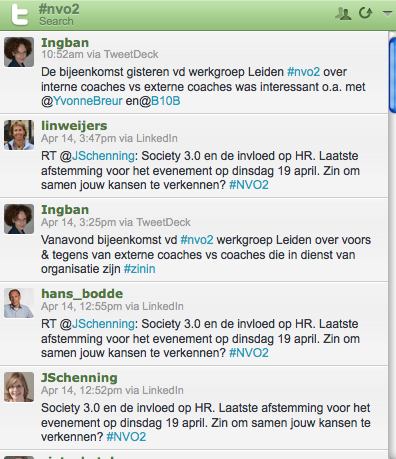
- Tools for filtering. Great tools to filter are hootsuite (or tweetdeck or seesmic as an alternative, for a good explanation written in Dutch see this blogpost). You can set up your own dashboard as a tab in your browser. You can create columns with either lists or hashtags, or even facebook's news feed. This brings me to another great filtering practice: lists and hashtags. Via Twitter you can decide to follow and participate in conversations with a certain twitter hashtags (eg. #lrnchat for learning with social media). This has the potential to create a certain community of people actively sharing around that hashtag. Here you see the hashtag #nv02 from NVO2, an association for HRD professionals.


After the bookpresentation I saw a short video of Jef Staes (also in Dutch, sorry!) and he remarked that people with a passion for something don't experience information overload.. I think that is an interesting angle to information overload too!. Passion gives focus and the greed to learn and digest information.

Tuesday, March 15, 2011

Book review: the new social learning

I read 'the New Social Learning' by Tony Bingham and Marcia Conner. There was actually less new information than I had hoped for, I missed a deeper layer of understanding how social media changes learning processes. How do social media change individual, team and organisational learning processes? And how to facilitate that change process? Maybe I'm looking for something that doesn't exist :).

Nevertheless it is a comprehensive overview of what is possible with sociale media in organisations. So if you plan to work with social media to support learning and knowledge management in an organisation it is a practical book with lots of examples. Information is organised neatly per chapter around online communities, multimedia (stories), microsharing/microblogging, collective intelligence, virtual environments and the use of social media to support events. The chapters have the same subheadings. My favorite is 'respond to critics'. I fully recognize the questions that critics ask and the book helps you deal with the questions.

A new term I picked up is 'ambient awareness'. It is similar too, but not the same as 'distant closeness' which is more about intimate contact without the need to have one on one contact. The new ways of communication ask for new concepts. Ambient awareness refers to continuous online contact. Because of this continuous contact it is like you are together and can read each other's mood. Every small message is relatively unimportant but you have to see the relationships through the lens of the stream of messages.

It is an important new term to me. The critics often wonder why I follow people on Twitter who tweet about 'what they have for breakfast'. Next time somebody asks me about Twitter I will not explain that there are also people who don't tweet (only) about breakfast but focus on helping them see that the value is in the full stream of small messages. And the relationships built through that stream.

If you are interested in the book, you can follow news about the book on twitter through @newsociallearn or go to the website.

Extra tip I got through the book: Oneforty is a great site for information about social media tools, for instance the page about twitter tools.
Enhanced by Zemanta

Monday, February 07, 2011

Social media: a new type of hammers for change facilitators in organisations


This is a column Sibrenne Wagenaar and I have written for the management site. I thought it might be worthwhile to translate it. The translation is mine (with a start by Google translate). We wrote this for the change facilitators working in and with organisations on change.

Many change processes fail because there is too little attention for the sub-public discourse. Social media can play a role in connecting the public discourse and the sub-public discours in organisations. Change management has to improve and we see social media play a key role.

The need for change as an organization is hardly disputed, but we observe that many organizational change projects that are not successful. Homan mentions in his book, Organization Dynamics (2005) that 70% of the change processes do not yield the desired result. The culture of interaction which you can create using social media has powerful features that are supportive to change processes. Through social media you can easily overcome silos and organisational boundaries and focus on the issues that people feel passionate about. Online silence is also an indication that people lack interest.. whereas in a meeting people may feel they have to respond politely.

Many change programs put the main emphasis on the formal side of change but without a new meaning in local communities there will not be any organisational change of substance. Homan refers to this as a 'sub-public' discourse. Employees may agree at conferences, but hold their own informal opinions which may not be expressed. Back at work they continue in the old way. There is little real movement and change as a result. A good facilitator is aware of both types of discourses and works to connect both. We believe social media can play a role because of the possibility it offers employees to contribute their own opinion as to interact with others.

Examples of creative use of social media in change trajectories

Here are some examples of creative use of social media to encourage you as change facilitator to experiment with different media:

* Prepare for the change trajectory using an online discussion to hear how people perceive the need for change and use this to form a core team. Invite people who care for the cause, or just people with different ideas and give them a role in the organizational core team that will closely follow and be engaged during the trajectory. This way you focus on creating a core group based on involvement and intrinsic motivation, rather than by function. Where a good representation of all departments in the core are important remains.

* Focus on online interaction rather distribution of (electronic) newsletters during a change process. Often an online or paper newsletter published to keep everyone informed. With social media you can make this much more interactive. You have the media to run more quickly into contact with the true opinions of people: linking the sub-public and public discourse. A manager decided to be available every Friday on an internal channel called Yammer (a Twitter-like a service on which you can send short messages). Everyone in the organization could ask him questions which were answered immediately. Thus a completely different dialogue than the employees were used to.

* Encourage an "outward-looking" view by using social media
dashboards. Many organizations suffer from an "inward-looking culture. Employees keep each other so busy with internal politics and procedures that there is little room for looking outward. In a strategic change project a social media dashboard setup can be a powerful intervention, which can be followed by number of employees. Let them periodically summarize what they notice and what this means for the organization. Or stimulate number of different departments to be actively following certain trends on Twitter. What do they learn from this?

* Make the individual network of people in the company visible and ensure that these networks can be used more effectively. This can be either via an online platform or use of each other contacts on LinkedIn. Many employees have a profile on LinkedIn, but do not use the opportunity to contact new people in their 'second ring'. Winkwaves describes an interesting example of a company that wanted to invest in Portugal, and through an online knowledge cafe found out that the wife of a employee was Portuguese, with good connections. A valuable link for the company.

* Neutralize power relations that communication about the changes influenced by the use of social media. In every organization there are formal and informal 'communities'. Such a community is formed by so-called 'carriers' of a particular vision of reality. This accounts for differences in power influencing face-to-face group dynamics. By using an online medium (eg, a private group on Facebook or a private Posterous group) communication gets leveled a little more and you can try to break certain power relations. There is ample room for everyone to express themselves online, unlike in a meeting where the boss speaks first or shows his body language. Interesting example: an organization where several employees on Facebook complain about the quality of personnel. The organization has taken these signals serious and started to talk to these workers.

* Let people see the problem from other angles by using youtube-like movies. Ask outsiders or departments for their opinion film it and put it online; whether in a password protected environment or openly on youtube. The advantage of a protected area is that people will talk more freely about problems. Because everyone in the organization will have access to the movies, the impact is much greater. Allow space for comments.

Is working with social media than the panacea to all change processes? Certainly not! The design of a good, flexible process and the quality of process management are still important success factors. In some cases it may be that the trust among employees is so low that they do not wish to express themselves through social media either. But there is a world of new approaches open to facilitators of change processes. We have little insights in the level of experimentation with social media in change processes. What are your experiences? Let us know by posting a comment!
Enhanced by Zemanta