Thursday, July 27, 2006

Toolkits: good, bad, ugly

Why do I have such a visceral reaction to certain toolkits? It's certainly a laudable thing to collect knowledge and information about how to do things -- especially subtle things like cultivating a community of practice or gathering tools for communities or reflecting on the experience of developing communities...

Here are some very different resources along these lines:

Thursday, July 20, 2006

Blogs, forums and their metaphors

John, your comments and suggestions relating to my previous entry have made me think a bit about the nature of a blog itself and it's metaphor: I see your feedback, and likewise my response to you, located off in a space apart from the original entry whereas to me this theme merits an ongoing conversation between 2 or 3 or more people and blogs aren't really set up for that, are they?

The metaphor underlying blog architecture is like that of an journalist article with some space for brief comments by the reader whereas a topic like this could usefully lead to an ongoing conversation which I suppose is better supported by something like a forum or community software designed more around a conversational metaphor.
Not that you can't go on and have a conversation down through a chain of comments, of course, but its not ideal, is it?

Wednesday, July 19, 2006

Training courses, linking people and community


I have been involved in country-based online training courses run by CIARIS/ILO in the area of Social Inclusion in Lusophone African countries over the last year or so. The issue of creating links between practitioners in different countries and also maintaining links between course participants after the course finishes (normally after 6 – 10 weeks) is one that has had me scratching my head more than once, I will confess. I would like to relate what we have attempted so far and invite comments or suggestions.

1) On the basis that initial contacts are more likely to be made when there is a specific motive for one or both parties to cooperate, we included a contacting task in the final part of a course for practitioners and university students in Mozambique. So, groups of participants had to collaborate in preparing a brief questionnaire on experience of Organizational Partnership which they were to send by email to organizations in their particular field (HIV/AIDS, Rural Poverty or Social Exclusion) and post the results online in the course space. We provided the lists of organisation and respective contact people from organisations who had collaborated with us in the past or from participants on previous courses.
The response rate was somewhat disappointing: of 10 emails with accompanying questionnaire sent out to organisations in Cape Verde, S Tomé and Guinea Bissau , only two received replies giving detailed information (both from previous course participants), one generated a brief social reply and one a promise of detailed response which did not materialise. This was after we had previously contacted these organizations requesting their cooperation.

The biggest problem, though, is that I don’t see these even these initial contacts generating much in the way of ongoing knowledge exchange and, at the same time, knowing the people involved on both sides and the quality of the work they are doing, I can see tremendous potential for collaboration.

2) We arranged for people on our present online facilitator training course in Mozambique to be enrolled in the e/merge 2006 international online conference currently being run by the University of Capetown right now. Our participants encounter 2 difficulties in this type of online situation:
language of communication (English)
Net access – sporadic and slow even for people based in the capital, Maputo.

Even so, they are resourceful individuals who have adapted rapidly to collaborating online during the course, so I am curious to see how this conference participation works out for them.

3) On a course in Cape Verde we had planned for alumni from a previous online course in Guinea Bissau to enter as invited visitors and comment on coursework etc but in practice logistical problems arising from very limited Net access of the Guinea people and the time constraints of coursework, led to us having to abandon this strategy on this particular course. However these courses have been running for a short time and with time we are building up a list of interested and Net-savvy people in the African Lusophone countries.

I know that the kind of steps described here are not in themselves going to build a knowledge sharing community or CoP but they could serve as pointers perhaps.

In general I believe that two key issues revolve around the Whys and Hows:
Why?
People need motives and incentive to maintain online contacts when they have to overcome logistical problems of slow and difficult Net access and also the low priority given to this type of online community building in organisations in Southern countries.

How?
Which tools are most appropriate for people in this situation: e-mail (usually Hotmail or Yahoo), d-group, Google-group, LMS (Moodle), Portal, Blog, Wiki .


I realise that this entry has run on a bit so I think I’d better stop here but, as I said above, all observations and suggestions will be gratefully received.

Bill

Saturday, July 15, 2006

Dynamic communities supported by hobbled donors?

Etienne Wenger has commented that it was a bit of a surprise that businesses became interested in the idea of cultivating communities of practice more quickly than schools. I think that creative destruction has something to do with it. Businesses have had to accept the idea that they need to make an effort to accelerate individual and collective learning -- and a community of practice approach is both natural and actionable.

While the idea of creative destruction describes dynamic change at an economic level, we've probably all experienced how smaller-scale change is going on in the communities in which we participate. Topics change, new people join, leaders come and go, etc. But communities are very much affected by the change (e.g., creative destruction) or resistance to change that exists in their surrounding environment.

What does this have to do with development? I was at a lunch meeting today sponsored by the Northwest Education Cluster, a community of people and businesses in the Portland area that are involved in education. A young woman sitting next to me described the project she was working on; she said it was a difficult project because it involved bringing foundations together to talk about how they could work together on a set of knotty issues. I asked her why she thought that was so difficult. She suggested that many foundations are restricted in specific ways by their articles of incorporation, and that goes beyond the normal tendency of every organization to become set in its ways. That got me to thinking about how foundations, like governments and other non-profits, can be hobbled by explicitly stated goals that might seem to be too narrow or limited for a business. On some level businesses have to be committed first and foremost to survival in an environment of creative destruction, and that may require them to change their goals, composition, structure, or methods of working.

And that got me to thinking about foundations that support communities of practice. Their donations may come with strings attached that could be problematic for communities. Governments (local or national) and other non-profits may need to impose requirements at the same time that they offer to provide some (much needed) support for a community of practice. From another point of view, once a community is established, it may be a good idea to look at the characteristics of a donor and ask:
  • Does the donor have to impose restrictions that will limit a community's growth in terms of membership, topic focus, or style
  • Can those restrictions be renegotiated? Are they unconscious, perhaps?
  • Is the community more exposed to more environmental change than the donor? (That is, creative destruction affects community member's practice in ways that the donor might find problematic?)
  • And perhaps most importantly, is the donor's support going to be withdrawn suddently or at a planned point in time?
Each one of those questions could be a starting point for conversations within the community (or within the community's leadership group) that could lead in many different directions:

  • The relationship with the donor might be perfect. Carry on!
  • The relationship might be problematic, and needs to be renegotiated.
  • The community needs to figure out how to function with no external support.
  • The community needs to find additional or replacement support that will meet its needs in the future.

Wednesday, July 12, 2006

Creative Destruction and CoPs

I've been thinking about creative destruction recently because of a speaker I was recruiting reminded me of the term. It's both the subtext of a series I'm organizing for my local Organization Development Network community and, by encouraging the use of a wiki for community note-taking, I think I'm engaging in it a bit. "Creative destruction" is not exactly a term that most organization development practitioners embrace with enthusiasm, however, especially when it brings up images of downsizing, mergers and acquisition or red in tooth and claw capitalism.

I think that all of us have a bit of an aversion to change, and the term creative destruction brings it right out. Despite the negative images, creative destruction is about the degree of change and people's reaction to it. Joseph Schumpeter, who proposed the term, argued that you couldn't stop it, it is a natural consequence of economic activity, and that it is beneficial in the end. Kind of like how our kids grow up: they leave behind childish ways, whether we like it or not and we can't really speed it up or slow it down too much.

Communities of practice have a developmental aspect that could be described as "creative destruction." Once they are actually working, they seem to grow in unpredictable ways -- but you can't really stop or reverse the clock. Several elements that move this process forward are:

  • New members -- as new people join a community, asking new questions, questioning old assumptions, holding different values, the membership changes but so does the collective thinking. And old members leave or die.
  • New tools -- new technologies can change the funamentals of how a community does its business, making old ways of meeting or of solving problems seem antiquated or wasteful. Old techniques or technologies are abandoned and forgotten.
  • New ideas and new problems -- as problems are solved, ideas become obsolete or outmoded and the very substance of a community's knowledge changes over time.
I think that the way Joitske has invited us in as guest bloggers is feeding creative destruction in a way -- it could push the discussion forward in certain ways and maybe even close off certain topics as a result. Creative destruction might be too grandiose a term, but I think that inviting guests into your community is a small-scale action that in the end can have large-scale consequences.

I've got some observations I'll share about how creative destruction might play out in communities of practice for development.

Saturday, July 08, 2006

Technology: holiday guest bloggership (blog worse than dog?)

I was so happy that we don't have a dog (even our 'walking branches' = 'wandelende takken' died), and now I suddenly have a blog to look after during my holidays .....

If you are going on holidays and have a blog, there are seven things you can do. And I decided to test the guest bloggership. So good luck, Bill and John! (uhm, not allowed to gossip).

I thought I'd introduce the guestbloggership, otherwise you might wonder why starting tomorrow there are suddenly blogposts in my blog without the usual spelling mistakes or with unexpected brilliant analytic thoughts and ideas :)

Practical example: Experiences with communities of practice in India

SCD and Intercooperation have commissioned a study called
Experiences with communities of practice in India, an important resource published in december 2005. It is a good study looking at exisiting CoPs in the development sector in India.

A wide variety of groups and networks were studied, like a farmers group producing a journal, an exchange programme, a listserv and email discussion group, and information sharing group on livelihoods and gender equity and a group championing women's rights.

The important features of the groups has been the leadership provided by a few individuals or organisations with the energy and time to contribute, not only with regard to initiation, but also for continuation. This feature was more important than financial arrangements. Most groups did not cite the need for financial resources as the major concern, most concerns were centred on roles played by the core group and alternatives to share the burden or succession arrangements (very recognisable from my experiences in Africa as well).

The study first looks at CoPs in the Indian private sector, before moving onto the development sector. The example which struck me was the example of the MBTI synergy group:

The MBTI Synergy Group was a spontaneous creation of all the people
who attended the MBTI accreditation course in April, 2004. (MBTI is a
personality or psychological type inventory developed by two
psychologists). It was built up as an e-group, participants being from 10
different Indian cities. The goal was to keep in touch with developments
and experiences of members as they continued their practice of MBTI.
The group started with around 30 members – of which most were active
through the first 6–8 months. There was no structure, as such – just
people who were excited about learning and practising MBTI and wanting
to keep in touch with each other. One of the more experienced persons
in the group took on the mantle of guiding the group including moderating
the exchanges, and another member volunteered to set up and manage
the e-group.
This community worked entirely through the electronic media. The
moderator suggested once or twice that people in the same city meet
up, but timing was an issue and this did not happen. Most were happy
posting their queries in the initial weeks. Since the moderator had more
hands-on experience than others, a lot of the questions were aimed at
getting his advice for specific issues. At times, the moderator took the
initiative of posting some tips that he thought people would find useful
– and always got a rich response in terms of others joining for a
‘conversation’ over a period of 10–15 days each time. The frequency was
almost daily in the initial weeks; from the third month onwards, it declined
to once a week or so. By the end of about 8 months, it became infrequent.
There was a visible shift from ‘practice’-oriented dialogue to more of
‘conceptual’ dialogue over a period of time, finally leading to dormancy.
The ‘group’ still exists (August 2005) but now has perhaps only one
exchange in several weeks.


Source: Bharat Krishnan, Note for CoP Study, Aug 2005

The interesting conclusion is that this group was not sustained beyond a certain point because the members could not practice what they were discussing. The 'tool' might also have been too specialised a subject for this group to make it a community of practice, or else the domain could have been defined much wider.

The paper ends with some lessons learned, comparing CoPs to 'Learning alliances' where a CoP would regroup peers and a learning alliances a wider diversity of people. I think this is semantics, and you'd have to find the right balance in drawing in a sufficiently wide diversity of people also within a CoP, so that you have sufficient innovation going on.

In the conclusions there is a useful distinction between the different types of knowledge that we are talking about; encoded, embedded, encultured and embrained knowledge. (cited from Blackler, 1995) Understanding the predominant type of knowledge will help to determine approaches and techniques for knowledge gathering and sharing with a CoP.

Friday, July 07, 2006

Technology: web2.0 writeshop

Just wanted to ask my colleague for some photos of the web2.0 writeshop, when I saw it on my RSS feed from the npk4dev tag!

IICD and Euforic organised a writeshop this wednesday and thursday to develop web2.0 training modules which will be shortly available on itrainonline. Since it was my last day in the office before the holidays, I didn't have time to participate (had to do all kind of boring reports and emails :(, . When I saw them working, I really regretted it. I think it was a very productive and creative process!

Monday, July 03, 2006

Advising communities of practice: using stories and metaphors

There is a lot of talk about story-telling in knowledge management circles "Pretty much everyone interested in knowledge management knows that storytelling can be an effective knowledge-sharing technique, largely because it conveys context, causal relationships, and emotional content more effectively than most other modes of communication."

In the plane I managed to read a whole book (and on top of that I learned that Scottish people take their quilts even while travelling to Ghana :)). Long live travelling by plane! The book is called: op verhaal komen by Wibe Veenbaas and I received the book during a two-days course I took last year on storytelling and the use of metaphors.

His take on the usefulness of stories is slightly different from the ordinary focus on letting people tell stories instead of only linear presentations: he stresses the use of stories and metaphors by trainers/advisors. He indicates that a metaphor works at various levels which circumvents the 'blocking' mindsets or frames a person or a group of persons may have in reaction to direct advice. Hence, its power to create room to find new solutions.

What made an impression on me during the training was his huge belief in everyone's capacity to tell, but also create new stories (so not only telling what you experienced, but creating new stories) and the fact that he could easily detect certain underlying patterns in stories- in that sense he was a real expert. Somewhere during the training he said it doesn't matter which story you tell, because in the end everyone tells roughly the same story again and again; his or her personal story (in different forms).

Technology: Pathuis cartoon

A cartoon from intermediair by Pathuis: "I used to ask my wife in the evening what she thought about my fusion plans, but now I have videoconferencing: Trudy do you hear me?"

Sunday, July 02, 2006

Communities of practice: expertise in CoPs

While reading my bloglines back in the Netherlands, I came across this post by Anecdote. It was so relevant to me that I decided to crosspost it on my own blog. In Ghana I had the impression my 3 years of work experience in Takoradi, Ghana, is still helping me in my work in Ghana, even though my current work is with different partners and in a completely different field (ICT4D). But I would have a hard time if I'd had to pinpoint to where it changes my practices/interventions. (beyond the occasional encounters during which I drop the fact that I lived in Takoradi, and it immediately creates a enthusiasm- 'oh, so you are a Ghanaian!').

I also had a car conversation during my stay in Ghana about professors and how you recognise a good one. People were impressed with a certain professor in Ghana because he could give clear examples and he could explain things in an easy way, which makes complex things easy to understand.

Here it the anecdote excerpt:
Expertise is more than simply possessing a skill. Summarized from Klein:


  1. Patterns: with experience experts can discern patterns that are invisible to novices. They have a good sense of what’s typical and can therefore detect the extraordinary.

  2. Anomalies: experts are surprised when a key event is absent while novices don’t know what is supposed to happen and therefore don’t pick up on the anomaly.

  3. The way things work: experts have mental models of how things work—how teams are supposed to work, equipment is supposed to function, power and politics is normally wielded.

  4. Opportunities and improvisations: Experts can imagine possibilities that contradict the prevailing viewpoint and data. They can also apply patterns from one context to a new situation creating new approaches and techniques.

  5. Past and future: experts can predict what might happen in the future. Just ask a grade 5 teacher about what the kids will be like at the beginning and the end of the year.

  6. Fine discriminations: experts can see differences which remain invisible to novices. Just think of expert wine tasters.

  7. Self aware: experts are aware of their own thought processes.

  8. Decision makers: experts can make decisions under time pressure.

I wonder if being able to distinguish between the larger picture, what's important and details shouldn't be part of expertise as well? (would that be number 6?)

And also being able to act by intuition without having to think first (and then being able to reason later why it was a good/bad move)?

Friday, June 30, 2006

Culture: the functioning of networks in Ghana

As I said in an earlier blogpost, Mr. Boateng who is a board member of GAPVOD, the NGO umbrella organisation of Ghana, gave an excellent and inspiring talk about networks in Ghana. Though not all networks in Ghana have learning at their core, as communities of practice have, I think it is interesting to explore where these dynamics stimulate or inhibit communities of practice within networks. Hence a summary of what he discussed (any reformulations may be mine):

o There are ad hoc and institutionalised networks, the latter help members to do their work in a more competent way. Ad hoc networks come together and dissolve after the work is done.

o In Ghana lots of networks compete with their members for project implementation as they start to do projects, rather than helping member to do their work eg. GINKS should not educate people on ICT4D, but rather help members to do so.

o Networks are expected to engage in advocacy to remove bottlenecks impeding member’s activities, create a conducive environment. Members need capacity to advocate. A network is credible in its advocacy attempt when it not only shows what’s going wrong, but also ways of moving forward. If a network criticises too much, it get a troublesome name and will be seen as ‘opposition’ hence closing the ears of people who should listen.

o For funding you can also look into the network. Members can put something on the table as well. Combine strengths to provide the necessary materials for the work.

o It is important to have strong people to be part of your network. The strength of a network is in its members. Executives don’t have to be everywhere, an executive doesn’t have to move to Tamale to do a project, while a member is there.

o Commitment and dues: if executives have to use their own money to travel it is demotivating, while there are members who can work. Dues are very important to sustain the work, either annual or monthly dues. Donors come to support what you are already doing, but most networks are donor-driven. “No representation without taxation, no taxation without representation”, dues also create commitment.

o Leadership, leaders who become employees of the network is a threat to the network. While choosing leaders, it is important to check the background of these leaders and monitor. Audit reports should be presented to the general assembly meeting.

o Local networks must appreciate that they are local and base decisions on its functioning on that. For instance, while choosing an office, how do you sustain the office rent? Development partners will not always help us.

o Information should flow, not only between the coordinator and the secretary. An audit report should be presented to all, so that people know about it.

o Look at your allies and supporters. Eg. the village chief. The chief has to give his support to get to work in the communities, this is something you have to respect.

o Network challenges are funding and fundraising, proposal writing, and making use of local assets. Everybody has limited resources, so be the link with others in the community. You need strong people to take the network off.

o Institutional structure. Talked about members and blocking information for the members, so that people are voted back in office. The constitution should not be manipulated. If people don’t understand things, you have to repackage it so that they can understand.

o It is important for network to identify the strength of its members. Eg. can use SMS to get quick feedback on issues. Have the right people managing the right positions, and partner with the media as important allies. Try to weave your way into the political leadership. ‘Who can I use? Where is he going to church?’ And tell them about alternatives. When presenting something, think about ‘what’s in it for me’ while packaging your advocacy message.

Tuesday, June 27, 2006

Culture: different meanings attached to the same word


Yesterday I experienced a nice example of different meaning attached to words. Ibrahim asked me, when we were going to have breakfast in Bolgatanga: "which tea do you want.?" "Uhm with milk?" I said, unsure of what he was looking for. I wanted to know whether you want lipton (=tea) or milo (=chocolate) or nescafe (=coffee) was the response. So for Ibrahim "tea" means either coffee, tea or chocolate, whereas for me tea = tea. (and yes, if it would be your first trip to Ghana, you might not know that milo is chocolate and lipton is tea either..)

By the way, this is a great way of using SMS: for typing the idea quickly, and cleaning up the blogpost and adding any pictures and links later!

Sunday, June 25, 2006

SMS To Email

this is a Blogpost by mobile phone ..feels weird not to be able to see the result . Dorine asked whether this will make any sense but i guess this is part of experimenting .an important habit to stimulate innovation. As you see this post is already longer than my last as i am now more Confident that it works....

Culture: A presentation in Ghana

I will add a picture later! Yesterday we had a meeting with GINKS members interested in discussing network membership and sustainability issues. We invited Mr. Boateng, board member from GAPVOD, a Ghanaian umbrella organisation for NGOs to talk about his experiences with networks in Ghana, so that GINKS can benefit from these lessons.

When he came in (in a hurry) without any support materials, saying he doesn't need a beamer or flipchart, I was a little worried. But when he started talking- he talked for 45 minutes with any break, in a loud voice- he had a his audience glued to his lips. His stories were so to the point, recognisable and honest that it got everyone attracted. (I made notes, so can share some of his points later). What's making me think all the time, is how he violates all the 'presentation rules' (at least the ones on visual aids) and still has a great presentation. I think some of the ingredients that contributed to the effect of the presentation were: the fact that he knows his topics by heart from many practical personal experiences with networks and network management, his passion for the topic and the fact that all present had a huge interest in network membership issues (if not, they would not sacrifice their saturday to it) and the use of very practical, recognisable examples.

It has happened to me before in Ghana, that various speakers had nice powerpoints, but the best presentation was by the person who excused himself that he had not had time to prepare a powerpoint, and he scribbled his ideas on the overhead sheet while talking.

Sunday, June 18, 2006

Communities of practice: we leren allang alleen niet bewust

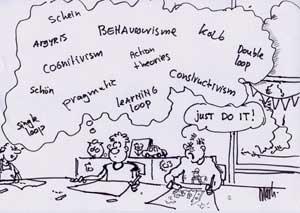
(cartoon by Mark de Koning- who was the cartoonist present during the workshop on organisational learning and made cartoons based upon what he overheard!)

This is our week of fame as I figured in the article we leren allang alleen niet bewust by Vice Versa, the volkskrantbanen and my daughter was interviewed for stadsblad about her views on the playground. (the last is not available online). The article talks about organisational learning for development organisation- is it a hype or not. Unfortunately, no mention of the role of communities of practice. But probably I should have brought that up as functional CoPs can play an important role in fostering learning processes and innovation within organisations.

Quite some media experience suddenly, and I think the volkskrant experience worked best (a face-to-face interview- represented by a column in the article). For Vice Versa, I was interviewed for almost an hour by phone (in the train, but that was my own fault) and only three quotes are taken from the interview for the article, which quotes various others (now can't believe why I actually said those silly things, but I remember I did, so that's also my own fault). I felt very dependent on the journalist's mercy and very powerless even though I got to see the text before it was published. She decided not to link to my blog for instance, even though I suggested this. But it makes me even more aware of the power of blogging (web2.0 thinking) versus old media (web1.0 thinking). Why didn't they tape the whole interview and make that available online? Why not provide as many links as people may find interesting?

By the way in the same Vice Versa there is another article which sounds interesting: cultuur en ontwikkeling een missie in het eigene? Another thing I don't understand about Vice Versa is why they publish in Dutch while talking about development cooperation. Several of my own colleagues will not be able to read it.

Thursday, June 15, 2006

Technology: supporting decision-making

Many articles (like this one by Wenger have written about the waves in knowledge management, the first focussing on technology, the second on people, the third on strategic capabilities). Nancy Dixon in Does your organisation have an asking problem? also talks about the challenges of software-based knowledge systems, and how to combine it with access to tacit knowledge in the heads of colleagues.

While planning our holiday in China (with a friend who lives in Beijing) I experienced a nice example of how technology (information from the internet) and people (talking to friends) interact for decision-making. Though we originally planned to visit Tibet from Liyang in southern China, a friend (met by coincidence in the train) alerted me to altitude sickness. I then started discussing it with my friend in Beijing and starting reading lots of things on the internet about altitude sickness (facts, like the name of a medicine, etc and personal accounts). Still it was hard to make a decision because the information is hard to evaluate and translate into a good decision (and information is sometimes contradictory). Till we talked to friends who have lived in Nepal. They have never been to Tibet, but were able to tell many stories about altitude sickness, what matters (for instance sleeping at the same altitude is very different from when you go up and sleep at a lower altitude). Knowing the friends, their experiences, their seriousness, etc. made it much easier to make a decision. So we are not going to Tibet and I'm very happy with our (well thought-through) decision!

Tuesday, June 13, 2006

Technology: more media and interaction

I was interviewed by Volkskrant banen as 'spouse' of someone who has worked abroad. (now my husband has spent more time as spouse than I have, but OK, let's face it, I'm the woman :)).

I thought it would just be an article in the paper, and it is, but it also available on the web. There you can click through the separate parts of the interview, like my interview you can react to the full article (title: 'Nice, work abroad, but what to do with your partner') and there is an animation which is funny. The animation highlights that people (read men) used to take the wives abroad, and the wives would decide to have the children there (see picture), whereas nowadays women want their own careers (and I did 15 years ago).

Now that I touched on gender roles; this morning we discovered that we have an overkill of women in our tagging experiment- and noticed that though men dominate in technical ICT things, women seem more predominant in web2.0?? (nothing scientific, could be a coincidence). So if you are male, interesting in tagging knowledge management for development sources, you can apply for participation...

Thursday, June 08, 2006

Communities of practice: Naava's example of the role of a facilitator

Naava Frank posted a comment on lurkers and I asked her if I could repost it. (thanks!). I liked the story as it demonstrates the role of a CoP facilitator (or weaver as she call it) in connecting people and stimulating private exchanges within the CoP, not only public- for all- meetings or discussions.

Below is a story from my work about a lurker who becomes a former lurker. The lesson I take from this is: Systematically reaching out to peripheral members of a community may have unexpected positive outcomes.

The Lurker
I was seated at a national conference session eight months after the HoS (Heads of School)community had formed, and a man came in and sat down in the seat next to me. When I looked at his name tag, I noted that he belonged to the one school in the area that had not participated in the HoS community to date. I had recently reached out to that school by making a call to a staff person who was not listed as the primary contact for the school but who had been identified by a friend as a promising audience. I introduced myself to the man at the session and asked him if he was familiar with our work, to which he responded:“I am a lurker. It looks like things are really moving along nicely.”He explained to me that he did not want to take the formal position of the primary contact, the Head of School, because someone else was currently holding that position. I mentioned that there were members of the HoS community who held other titles at their schools. He mentioned that he had talked to a friend about the CoP and about his hesitation to attend because of the potential issues of competition between his school and others, and that his friend had encouraged him to try it out. It was quite evident in our conversation that he had been reading the materials I was sending to him over the course of the HoS community’s development. This man was quite engaged with the community, though he had not to date attended any group events.

I saw the Lurker at another session at that same conference and introduced him to my co-weaver, and we all agreed to have lunch together. Over soup and salad, he filled us in on what was going on with his school. He told us about its special and unusual warmth and that he was working on how to grow and professionalize the school without losing that warmth. I asked what would be helpful to him in doing that and he said he would like to speak with “someone who has done it - or an expert.”I was impressed by his decisiveness and sophistication. As I sipped on my soup, I noticed at the table ahead of me another head from Boston, D, a very thoughtful and articulate man who had been through a similar process and who is very generative. After lunch, I introduced them and they exchanged contact information. A point of interest about this pair, and about the relationships that are often developed through Communities of Practice, is that the two men have very different backgrounds, coming from different religious streams.

Less than two weeks later I received the following email from the “former” Lurker: I met last night with B and had a nice chat over dinner. Thanks for the connection.