In the Netherlands we have Expedition Robinson. Some famous Dutch people go to an island and have to battle. Here is a very funny scene from Expedition Robinson. Remy gets a burger, but because everyone gets to eat all kinds of scary insects he can not get the idea out of his head that he's going to eat maggots or insects. As a result of that idea in his head he does not manage to eat the burger and fails. Watch the scene below, even though it is in Dutch it is a very visual scene.
I was reminded of this scene because an experience today made me think about the importance of beliefs for seeing possibilities of using new media. I had a consultation in the north of the Netherlands (only 150 km but still a 2 hours journey) and we proposed to do the meeting online. We had proposed this earlier last year, but the group thought it was very important to see each other. "it is really necessary for a good conversation." Finally we convinced the group and did a test using adobe webinar using a screen and individual ipads. I was especially proud that it went very well and everyone thought it was a good meeting. It took some persuasion to try this! My first experiences of working online was working with John Smith from Learning Alliances in 2004... At the time I didn't think it would be possible to collaborate without being face-to-face.
See below also the youtube video with interviews about cell phones from 1999 ... "I have an answering machine, and that's fine" "if people want to reach me, they can do so by letter and if it is urgent, I have a telephone at home" :). These beliefs about the need to have a mobile phone have certainly changed!
To introduce innovative ways of communication to improve effectiveness and collaboration in organzation need a number of people at least who see what is possible (who can eat the burger!). The belief that you do not always have to see each other face-to-face to have a meaningful conversation or to learn from each other is very important. What are your own beliefs? What is really not possible online in your opinion?

In my blog I share about learning design with technology, blended learning & knowmad learning. I started with a focus on communities of practice. I share personal experiences, articles and cases.
Showing posts with label technology introduction. Show all posts
Showing posts with label technology introduction. Show all posts
Friday, January 09, 2015

Thursday, September 18, 2014
Changing with technology: the example of collaborating with slack
I find it fascinating to see how our habits change (or don't change at all!) driven by new technologies.

In the Dutch cartoon Fokke and Sukke are making bookcovers for their ipads on the Steve Jobs school
Yesterday Patricia called and because she is in my phone contacts I took the phone with a "Hi Patricia, this is Joitske, how are you?" the answer was "Hi this is Patricia" What a weird start of the conversation... Apparently you can not easily change your default phrase which which you start a phone conversation. The starting phrase "hi, this is Patricia" comes from the time when there was no contact name on the screen of your phone. A phrase or habit which is apparently quite deeply ingrained in our minds. I think it's a funny example of the influence of technology on our communication and how our habits are sometimes matching older technologies ..
At the Ministry of Foreign Affairs, you had (until about 6 months ago) to pass a scanner as a visitor, so you had to walk counterclockwise. Three months after the scanner was removed I kept the same route walking to the escalator. Until I noticed that everyone in front of me walked to the right to go straight to the escalator which is faster! I felt pretty stupid that I had not noticed this before.
I have blogged earlier about my grandma from the North speaking dialect but who couldn't speak dialect on the phone. On the phone she would speak official Dutch which sounds very formal. One older manager I met did not want to read from the screen and had everything printed. He said he simply couldn't read from screens. It is like some of our habits are one step behind the new technology and can not catch up.
Sometimes it works the other way, and you can also use technology to stimulate a change in habits. In team of five people, we noticed that we mainly seek advice from those you work closely together with on a project and that the threshold for quickly asking advice from the others is quite high. My answer was actually consciously assigning a new role of 'advisor'. However, a colleague suggested to use slack as a teamtool. With slack you can create channels, ask questions and call somebody into a conversation by tagging his name. We've been slacking a month now and it works! Interestingly, another team had a look at slack and thought it was too chaotic. The reason why it works so well for us is that this colleague already uses it in another project and helped us to get into the tool. Which is not too hard, but there are many small things you need to explore.
In the Dutch cartoon Fokke and Sukke are making bookcovers for their ipads on the Steve Jobs school
Yesterday Patricia called and because she is in my phone contacts I took the phone with a "Hi Patricia, this is Joitske, how are you?" the answer was "Hi this is Patricia" What a weird start of the conversation... Apparently you can not easily change your default phrase which which you start a phone conversation. The starting phrase "hi, this is Patricia" comes from the time when there was no contact name on the screen of your phone. A phrase or habit which is apparently quite deeply ingrained in our minds. I think it's a funny example of the influence of technology on our communication and how our habits are sometimes matching older technologies ..
At the Ministry of Foreign Affairs, you had (until about 6 months ago) to pass a scanner as a visitor, so you had to walk counterclockwise. Three months after the scanner was removed I kept the same route walking to the escalator. Until I noticed that everyone in front of me walked to the right to go straight to the escalator which is faster! I felt pretty stupid that I had not noticed this before.
I have blogged earlier about my grandma from the North speaking dialect but who couldn't speak dialect on the phone. On the phone she would speak official Dutch which sounds very formal. One older manager I met did not want to read from the screen and had everything printed. He said he simply couldn't read from screens. It is like some of our habits are one step behind the new technology and can not catch up.
Sometimes it works the other way, and you can also use technology to stimulate a change in habits. In team of five people, we noticed that we mainly seek advice from those you work closely together with on a project and that the threshold for quickly asking advice from the others is quite high. My answer was actually consciously assigning a new role of 'advisor'. However, a colleague suggested to use slack as a teamtool. With slack you can create channels, ask questions and call somebody into a conversation by tagging his name. We've been slacking a month now and it works! Interestingly, another team had a look at slack and thought it was too chaotic. The reason why it works so well for us is that this colleague already uses it in another project and helped us to get into the tool. Which is not too hard, but there are many small things you need to explore.
Tuesday, April 19, 2011
Book presentation 'En nu online'

 Last week we had the book presentation of En nu online (unfortunately for some written in Dutch). A bit late, in February we had to cancel it because of the operation of Sibrenne 's son, but it felt good to celebrate the accomplishment. We had a twitter backchannel (#ennuonline) where unexpectedly people who couldn't make it were very active. I hardly had the time to read it, so next time I promise myself to better prepare and plan time for the backchannel.
After an introduction ( prezi) of the three parts of the book: social media for professionals, organisations and facilitators, we had 4 different rooms. People were invited to walk from one room to the other:
- A conferentie2.0 room
- The video room
- The online facilitator room
- The it's -not-information-overload-but-filter-failure room
The last room was run by me. We used the firehose metaphor to talk about information overload and ways to filter. Suppose you are thirsty, but you only have a firehose, how can you drink? Creative solutions included standing further away from the hose, making small holes in the pipeline so that you can drink from there. Or aim at a wall, so that you can catch the water indirectly. All ways to get the water in smaller portions. Some impressions of the conversations that followed after this starter:
- We all experience information overload, even the most experienced. The overload is not only in terms of information, but also in terms of the high number of tools. Continuously you have the feeling that there may be even better tools out there and that you are not using the best spaces. Important is also the mindset of the people who have grown up without social media. They easily have the feeling that they need to read everything, that they have to catch up with all information in their twitter stream for instance. Let go!! This mindset makes you feel very nervous. If you can let go, you experience less information overload.
- On twitter we asked: what is the most important social media for you? Twitter was mentioned as a favorite. Niel van Meeuwen: "I like to work with Twitter. It is fast and to the point and with many valuable interactions". Hans de Gruijter called twitter: "the miracle of serendipity, find what you have never looked for". Other tools mentioned were Dropbox, Ning, Linkedin, RSS Feeds, iphone, blog, facebook en Skype. Ger Driesen mentions the 'Big 4': facebook, twitter, linkedin and blog. Everyone on the backchannel agreed that face-to-face contact is crucial. Marcel Nooijen: "Face-to-face contact is essential and I'm surprised how social media contribute to face-to-face contact" Bart Bosch: "Twitter helps to connect people and to stay connected. Connection is strengthened by f2f contact and working together." Contact via sociale media and face-to-face contact are mutually reinforcing. Mariel noticed nevertheless that young people don't even know what twitter is. Is Twitter age-related?
- The groups were mixed in exposure to social media. Some wonder: "I'm not on Twitter or Yammer, so why should I start?" People with exposure report that they are really surprised by twitter as a medium for linking and learning. They gain new ideas. Angelica Senders who has recently joined Twitter is surprised by the speed and fun, compared to twitter LinkedIn is a very slow medium. An example was shared about Yammer too. Two professionals discovered they were working on the same issues, and started to collaborate. That can be the added value. For Mariel Rondeel twitter also supports reflection. At the end of the day, you send a tweet and have to think about what you gained, or what was of interest to you.
- A question: Suppose you want to tweet professionally, what should be the content of your tweets? The backchannel people had quite some good responses: Tweet about interesting moments at work, domain related interests, send links to interesting blogs, make sure your tweets sharpen your own ideas. But don't forget to react to other people. And try to find your own balance in sharing professional and more personal content. It is nice for followers to see the person behind the tweets. Saskia Tjepkema shares that she gets often a higher number of reactions on more personal tweets.. And you will most likely be influenced by the people you follow. A good test is the coffee break test: ask yourself whether you would share this with others during the coffee break.
- We also elaborated about the difference between reading books and tweets. Will our brains change from reading tweets? A person shared the example of a book of a frequently twittering person. The book reads like short pieces of text, without a good frame or story. This reminds me of the cartoon of the boy who says he has read only the first 140 characters of a book...Anybody remembers the cartoon?
- A good strategy to filter is to use 'experts', people or professionals you know who work in a certain field. Reading one blog will keep you up-to-date with major developments. You can also filter by sticking to a maximum to follow. A maximum of 10 or 100 blogs, a maximum of 100 people to follow on twitter. A tip is to make a list on Twitter with the people who are important to you, for instance only 20 of the 100 people you follow. By clicking on the list you see their contribution. This helps to stay focused on your network and your 'strong ties relationships'. As someone said "It is better to exchange meaningful with 10 people than superficially with 100". Others wondered why you follow 100 when you have a list of 20: "Why not unfollow the other 80?" The experienced twitters agreed that it is valuable to keep the 100, because of the unexpected links, insights and relationships.
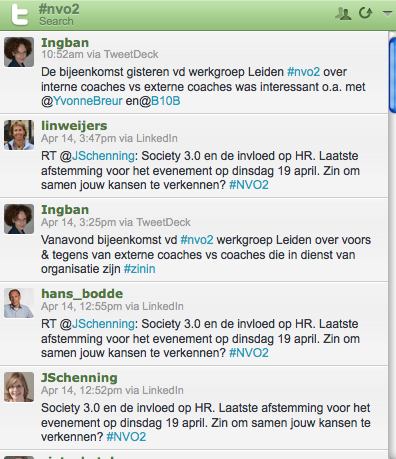
- Tools for filtering. Great tools to filter are hootsuite (or tweetdeck or seesmic as an alternative, for a good explanation written in Dutch see this blogpost). You can set up your own dashboard as a tab in your browser. You can create columns with either lists or hashtags, or even facebook's news feed. This brings me to another great filtering practice: lists and hashtags. Via Twitter you can decide to follow and participate in conversations with a certain twitter hashtags (eg. #lrnchat for learning with social media). This has the potential to create a certain community of people actively sharing around that hashtag. Here you see the hashtag #nv02 from NVO2, an association for HRD professionals.
After the bookpresentation I saw a short video of Jef Staes (also in Dutch, sorry!) and he remarked that people with a passion for something don't experience information overload.. I think that is an interesting angle to information overload too!. Passion gives focus and the greed to learn and digest information.
Thursday, November 04, 2010
Mister Strubbe and his ipad
Here's a Dutch movie about Mister Strubbe. He is an elder person and is still using his computer with wordperfect 5.1. He is very happy with it, and says 'this computer probably leaves this house after my death'. At the same time he is very happy with his ipad, to read the news. Whenever there is a 'www' on the news he can check is out with his ipad.
There is an on-going discussion about digital natives, do they exist and will digital immigrants always stay behind? Mister Strubbe is a nice illustration of the fact that people look carefully at what there is to win. He is not interested in all the new Word versions- why change all the time? But an ipad is a great new tool for him.
There is an on-going discussion about digital natives, do they exist and will digital immigrants always stay behind? Mister Strubbe is a nice illustration of the fact that people look carefully at what there is to win. He is not interested in all the new Word versions- why change all the time? But an ipad is a great new tool for him.
Wednesday, October 20, 2010
Switch for social media

I read the book Switch some time ago. Change management is definitely one of my favorite fields! Even though I am now not using the field as consciously as when I was guiding organisational change trajectories, I feel when I work on introducing social media I may apply it too and could improve. But maybe I already do it unconsciously based on my experiences.... Anyhow I also bought 'organisatiedynamica' by Thijs Homan and it's competing with social media for trainers by Jane Bozarth for my attention...
I want to use my blog to see if I can apply the lessons from Switch to the introduction of social media, whether for groups, organisations or networks. First a short intro of the ideas put forward in Switch. The book starts with a short story about moviegoers. Moviegoers were given wretched popcorn (I actually didn't know the word wretched but I assume it means that it is not nice to eat!). Some of them got a medium sized bucket popcorn, others a large one. The question was: will people with a large bucket eat more? And Yes! The people with a large bucket ate 53% more popcorn (21 extra hand-dips). Now suppose you want to stimulate people to eat healthier and less popcorn. Rather than changing the mindset, you could also give them smaller bowls. That's an easy solution to a difficult behaviour change. This was quite a revelation for me, doing a lot of work in the international development sector. Everything always end up complex, and I often think it could be more fun with a lighter approach. And here it is! The authors call it: shape the path, tweek the situation so that change is easier. But that's not the only thing to do.
The full three-part framework to follow is:
- Direct the rider. Provide crystal-clear direction about where to go (and where not to go)
- Motivate the elephant. Engage the emotional side
- Shape the path. Shape the situation to make change easy.
So what happens if we apply these ideas about change to introducing social media in organisations?
1. Direct the rider. Make it clear that you want (some) people to use social media and why.. What is your vision about using social media? Is it to increase internal communication and how will that help the organisation to achieve its mission? It is to connect to customers/stakeholders? Ofcourse it takes some time to know this yourself. So don't introduce it widely unless you have a vision yourself. Don't introduce a technology and insist on people using it without giving a clear rationale. And make sure you have some ways of measuring that your rationale is true. For instance, if you are hoping to get more donors through social media presence, keep track of the number of donors referred to you via social media.
2. Motivate the elephant. Try and find out what makes people interested. You may allow them to use the new technology for private purposes first. I have seen people learn about social networks and putting up a social network space for their family reunions and sports clubs. That's a great way to learn and become enthusiastic. So allow people to learn new technologies in connection to things that excite them. Invite people to experiment and allow them space to experiment. Experimenting is fun, having to use new tool because you have to is boring. Furthermore the fun of social media is in the social, so work with groups who can link up together.
3. Shape the path. Make it easy for people to use the media. Offer them a set of tools and shortcuts, work on their own computers. It is discouraging if you are starting a wiki not knowing what type of wiki to use. Make sure there is an accessible helpdesk. Help them for instance to set up an RSS dashboard. But also work on integrating social media in their routines (says the person who is now struggling with finding time to blog and to read blogs :). We are doing a 40-days coaching experiment whereby you have daily contact with one coach. That seems to work well! The idea behind the 40 days is that people can build up new routines in 40 days if they practice every day.
So you have other tips? Does this make sense?
Wednesday, March 24, 2010
The contraceptive pill and social media

The contraceptive pill (in the Netherlands we simply say: THE pill).. is an example of a revolutionary technology that changed behaviours. Evert Ketting explains the history of the contraceptive pill and shows it is an example of the right technology at the right place at the right moment. 10 years after its introduction in the Netherlands two-thirds of the women were using it. Twenty years later it had become the norm and a 16-years old girl even thought that it was impossible to have sex without the contraceptive pill, she didn't know it prevents pregnancy. The change brought by THE pill was that sexuality was disconnected from pregnancies.
Ketting argues that there were other contraceptives before the pill like the pessary and condoms. Yet, the pill was different because taking the pill is not connected to the act of having sex itself. And ofcourse it was controlled by the women. Lastly, it was more reliable so that doctors also accepted it.
Going back to social media and organizations: it is likely that social media will work embedded in an ongoing change process. And try to make sure the right type of technology at the right time is chosen...
![Reblog this post [with Zemanta]](https://lh3.googleusercontent.com/blogger_img_proxy/AEn0k_sDGNOsaqRFloqzk6JKLDpcoJlzkYFjRtG_jORgSa-j7UDbYeWCF4vrjWrumpFxp5DkLKV2K8ozBevnuQ2QOG9uk4HqrCp6OVbg6uVum5vc7Fff1d5LhxhO0UP2cCVDsUCfLvsQ6GISXrsUKqbGFba9=s0-d)
Sunday, November 08, 2009
Twitter to start your personal learning network
I'm working with a learning network in education using a sharepoint platform. It's hard to move from face-to-face meeting to online interaction (for a number of reasons and we're writing a whole paper about the challenges). We're experimenting with webconferences and I was suggesting to experiment with other tools like a weblog, ning, or a google group. Some are hesitant: if online interaction with one platform doesn't work well, will other tools not be even more confusing?
When I saw this video on the free technology for teachers blog with about the use of twitter for educators I was struck by the way they see twitter as THE only tool for educators. Watch the 15 minutes video if you're interested.
How is twitter used by the panel? They use twitter to connect with students, parents and other stakeholders, to share resources for teachers and to have tweetpolls and conversations. For instance, every tuesday there are discussions using hashtags. These discussions are with an international group of teachers, including teachers from Turkey etc. The one on the necessity of homework was particularly lively.
They stress that it is not twittering away about learning together. They don't call it twitter but rather a personal learning network. People become learners rather than workers and twitter helps them to continuously learn. It is a great support to teachers. One in three teachers leave because there is lack of support for them, and this can be the way to create support. They decided to start a ning to work as a repository.
Mmm, should we start a twitter experiment? I wonder whether twitter fits the teachers practice because it is so much to the point!
When I saw this video on the free technology for teachers blog with about the use of twitter for educators I was struck by the way they see twitter as THE only tool for educators. Watch the 15 minutes video if you're interested.
How is twitter used by the panel? They use twitter to connect with students, parents and other stakeholders, to share resources for teachers and to have tweetpolls and conversations. For instance, every tuesday there are discussions using hashtags. These discussions are with an international group of teachers, including teachers from Turkey etc. The one on the necessity of homework was particularly lively.
They stress that it is not twittering away about learning together. They don't call it twitter but rather a personal learning network. People become learners rather than workers and twitter helps them to continuously learn. It is a great support to teachers. One in three teachers leave because there is lack of support for them, and this can be the way to create support. They decided to start a ning to work as a repository.
Mmm, should we start a twitter experiment? I wonder whether twitter fits the teachers practice because it is so much to the point!
Twitter & Education - #140conf LA from RealPlayer SP on Vimeo.
Wednesday, June 24, 2009
Overcoming objections to social media reblogged
I found a great post by called Using social media in your nonprofit: overcoming objections, written by Debra Askanase. She writes about the need to engage in social media as a nonprofit, because conversations are happening online anyway. Her angle is more an organisational identity building angle, whereas I investigate the potential of social media for professionalisation and learning. But the objections are very recognisable.
She lists 5 objections she heard while presenting about social media
1. It’s not safe! What about the BU Craigslist killer? (someone REALLY asked this question in the presentation)
2. What if our biggest rival pretends to be us online?
3. Social media means a lot of work and we don’t have the staff time to do that.
4. There is no place in our organization for social media
5. People will attack us online with negative critique.
For each objection, she gives some answers. I liked the practical example of two organisations that practise 'online listening' through social media:
She lists 5 objections she heard while presenting about social media
1. It’s not safe! What about the BU Craigslist killer? (someone REALLY asked this question in the presentation)
2. What if our biggest rival pretends to be us online?
3. Social media means a lot of work and we don’t have the staff time to do that.
4. There is no place in our organization for social media
5. People will attack us online with negative critique.
For each objection, she gives some answers. I liked the practical example of two organisations that practise 'online listening' through social media:
Carie Lewis from the Humane Society of the US (she’s their Brand Ambassador) holds a 9-minute staff meeting every day to inform each and every one of the HSUS employees about “what’s going on that day - PR, what people are talking about on Twitter, etc.”
Wendy Harman, of the American Red Cross, writes that “We distribute a daily social media update email that contains a sampling of most relevant mentions.” Everyone must be involved. No more silos.
Other objections I often hear are fear for using software that is not within the organisation's firewall, fear for information overload (not seeing the trees through the forest). In development low bandwidth is also used as an excuse. Yet, taking into account how many people you work with are comfortable using social media is a necessary step. I think a lot of the objections boil down to fear for the unknown, something new.
One newspaper article was very sceptical about twitter in terms of social relations, fearing that the loose relationships are mistaken for real relationships. I think that is typically a view of a person who hasn't experienced twitter. If you do, you see it is a new communication means that people use, but it is complementary to all other means.
See also the 10 objections to social media I blogged earlier on.
Friday, June 05, 2009
Schein's ten step culture deciphering process for enterprise2.0
 I've reread Schein's Organizational Culture and Leadership. I read it in 2001 with the organisational change processes of Ghanaian organisations in mind. Now I'm reading it with social media introduction glasses. It's been a joy to read it, such good understanding and so practically applicable.
About a learning culture in organisations Schein writes that we don't know tomorrow's world,but we know it will be different, more complex, more fast-paced and more culturally diverse. Hence the need for organisations and their leaders to become perpetual learners. So there is a need to speed up our learning processes and mechanisms. I think social media can contribute to that. But there is a paradox with culture in organisations, culture being a stabilizer, a way to make things predictable. Strong cultures are stable and hard to change. So does it mean that we need more flexibility to change assumptions? A rapidly learning organisation will change its assumptions too.
How and when to assess cultural dimensions? Schein is very strongly saying that it is not useful to assess culture as part of a desire to change the culture. Rather, there should be a clear goal, an organisational problem to be worked on. If that problem has cultural dimensions, it would be good to assess culture and how the shared assumptions support or get in the way of solving the problem of the organisation.
If that is the case, you can use a ten-step culture assessment process to decipher the assumptions at work within the organisation. The steps role from obtaining leadership commitment, via group interviews to identifying artifacts and espoused values. From there you go to the shared tacit assumptions and identify cultural aids and hindrances in relation to the stated problem.
How does this relate to social media introduction in organisations? I think it is very relevant because social media is not introduced out of the blue, but linked to a certain objective. (see the POST model from the Groundswell). If you take the additional step of doing a culture assessment, it would help to decipher assumptions at play which help or hinder the use of social media. Though you may generalize by stating that you need a 'open' or 'knowledge sharing' culture this is so general that it's not helpful. The culture deciphering process could help you to find cultural or subcultural elements that need to shift. And elements that are already in place that match the use of social media for a certain objective. It will definitely increase the chances for success I strongly believe.
I would be very interested in trying this process out in an organization!
Tuesday, May 19, 2009
Joint decision-making about tool use in teams
Nancy White has a blogpost called Technology Stewardship and Unexpected Uses that resonates with what I'm working on. I'm consulting various people in organisations about the choice for online tools and how to introduce them for use by teams, groups or networks. What I noticed is that quite a lot of them would like to choose a tool, get up to speed with it themselves and then train others. However, in this networked world, it is my belief that we can be more participatory than that, with more chances of success.
Together with Sibrenne Wagenaar I wrote a Dutch article called "So you wanna be a virtual team?" - have to admit here that the Dutch are a little bit crazy giving an English title but the rest is really in Dutch- . In the article we try to explicitize our own way of working. We state that, amongst other things, it is good to:
Nancy White has some useful additions on how to introduce technology:
I'm curently reading Schein's organisational culture and leadership again, hope to draw some lessons from his insights too.
Together with Sibrenne Wagenaar I wrote a Dutch article called "So you wanna be a virtual team?" - have to admit here that the Dutch are a little bit crazy giving an English title but the rest is really in Dutch- . In the article we try to explicitize our own way of working. We state that, amongst other things, it is good to:
- Start with an exchange of experiences with tools for collaboration; start with familiarity
- Choose a starting toolset together with the team
- Stimulate an experimental culture within the team
- You can introduce new tools but don't overdo it
- Monitor individual feelings of ease and unease
Nancy White has some useful additions on how to introduce technology:
It is about a dynamic evolution of practices and applications of the technology, not about the installation or the simple availability of the tool. So here are some practice hints.In short develop shared leadership with regards to all these decisions. Though it may seem you know the best use of a tool, it's worthwhile to foster joint decision-making and let the routines within the team evolve organically within the team.
- Role model your experience and practices with tools, but don’t present them as the only options.
- Watch for experimentation and amplify new, useful practices. Better yet, encourage community members to talk about and share their practices.
- When members ask for tool adjustments based on their experimentation, work hard to accommodate rather than block innovation. This may mean going to bat with “higher-ups” to gain permission, or to allow the experimentation to fly “under the radar” until you can make a case for the value of the changes.
- Encourage the fringies - the people who push the limits of a tool. Make them allies rather than enemies. Their pushing of your buttons may also create the innovation that you need to foster wider adoption.
I'm curently reading Schein's organisational culture and leadership again, hope to draw some lessons from his insights too.
Thursday, May 14, 2009
Any tool can do, culture matters

I'm writing blogging tips for a book we're writing and one of the tips is to create a rhythm of posting. I had a good blogging rhythm but now I seem to loose it! So I need tips how to keep your rhythm. All the holidays in the Netherlands starting from queen's day on 30 april are definitely fun, but don't help me to keep into any rhythm. But let's try to stick to a weekly rhythm and blogging about a past experience still lingering in my head.
In a teleconference Davee Evans, active participant in wikipedia organised by CPsquare I was very much struck by the complete unimportance of selecting the right tool for online interaction. What's really important is creating a culture of exchange. Since my consultancies started to include online methods for learning and collaboration a lot of the initial questions I get are about help to select the right tool. Or sometimes people have selected a tool and want to know how to tweek it. Though engagement in an intake conversation, all the other questions about introduction, designing the change process, the facilitation of the online interaction surface rapidly. Nevertheless, most of the time I also do some tool advice because I have the feeling that's part of the expertise asked of me. So both clients and myself seem to be drawn to tool selection.
What was the example? Davee talked about a voting process taking place in wikipedia about combatting vandalism. From the teleconference minutes:
The "flagged revisions project" is an attempt to deal with the enduring problem of vandalism. It's a very slow community process held in a very peculiar local style of discussion. Voting, with the pro's and con's about voting, happens in a free text space that is unique.You can see the polling process in the picture displayed or by clicking on this link. What's interesting is that the tools used are in my opinion not the most appropriate for the job. The poll is done in the form of an online discussion in a wiki. I'd say you need an online survey tool to conduct a poll. And if you want to discuss an issue, you need a discussion thread function. What the wikipedians do, is use the wiki they are so familiar to and write in a threaded fashion in the wiki page that seems to work for them.
A strong example of the fact that when culture of working together online is very strong, the tool doesn't really matter. (it definitely put my idea about the best tools upside down!).
Tuesday, March 10, 2009
Grown up digital
 I read the book 'Grown up digital' by Don Tapscott. I was curious to understand more about the generational differences. I've definitely not grown up digital; I almost missed the introduction of digital technologies because I was living in a village in Mali that did not even have telephone or electricity...
Often when I mention generational differences, people start whiping the issue under the carpet by refering to their grandma who is 86 and skypes with her daughter in Australia. I have a mother who can't really learn how to handle her phone, let alone her email and a daughter of 7 who has profiles on various sites like webpet and hyves (and has won a price with a blogpost about a book :) and I'm somewhere in between. So I do think there are differences. What are the real generational differences and how will they influence collaboration at the workplace?
The book is based upon a research program which involved interviews with close to 10,000 people in 12 countries. Despite that good basis, I grew a little tired of the examples of the children of Tapscott, though they are great illustrations. The Tapscott kids are not examplary for a whole generation. I have the feeling there are more differences between the use of internet within the 'netgeneration' that could have been explained in more detail. The book is one big attempt to prove the point that the netgeneration is really different from other generations (like my own). OK, I agree, but how about differences within the netgeneration?
Nevertheless I enjoyed reading it and I gained some very useful insights from the book where it links to my own observations:
1. The social media technology is a given for the netgeneration.
A great phrase is "technology is technology only for people who are born before it was invented". and "Learning a new way of communicating is hard work.. established patterns of thinkng must change to accomodate the new technology". For the netgeneration (born between 1977-1997) new technologies are like air. They can't understand others are so obsessed with it. This is really funny and true. All the writing about the enormous shift in communication patterns are from the people who are not did not grow up with the new social media; they are still amazed at what's possible (including me!). Skyping with a webcam: I still think it's exciting. For a netgener it's normal. Like a washing machine is normal to me and I don't talk about it (till I went to Kenya and did my own hand washing...). That brings along a huge difference in perception. For netgeneration respondents email is a more formal method of communication. So we all know how to send mails, but use and perceive it differently. It's hard to be fully comfortable with a technology if you haven't grown up with it- it takes a personal change process. See the story about my grandma on the phone. I can learn to twitter, but may use it differently than netgeners- so there is a difference.
2. Brains get wired differently.
'listening to an audio book leaves a different set of memories than reading does'. It is hence clear that the netgeneration (and our?) brains get wired differently. More research is needed, but IQ scores are on the rise. Tapscott is convinced that you need similar skills as before the web, but you need more skills. A book guides you from beginning to the end, but on the internet, you have to click and make your own decisions. Online reading is hence more complex than offline reading. It's an area that needs research.
3. The netgeneration may shake up hierarchies.
Or is it social media that already shakes hierarchies? On page 158 the example of Chris Rasmussen is introduced, 33 years old. Through blogging, he got noticed and invited to panels where others are appointed by majors or governors. He gained a reputation on merit, not on age or rank or a preset careerflow. Social media is hence shaking up hierarchies. The netgeners themselves will do some shaking too. At home and at school, the netgeneration may have some knowledge (about the technology) that parents and teachers don't have. Changing power relations. My mother was taught to use her mobile by some secondary school students (after I had given up :). Parents and teachers don't automatically earn respect because they know everything the youngsters don't know.
4. And this leads to some netgenophobia.
Netgenophobia is the irrational and morbid fear of youth, especially with regards to their use of the internet. Part of the fear is because of the unknown, part is because of the shaking of hierarchies mentioned under point 3 I believe. During the period of read the book, I met so many people of my age that confirmed the fact that there is some phobia, I notice a lot of fear (cyberbullying, everything is open, everything is so fast, online pedophiles). Take the example of the schooldoctor telling my daughter not to add any new people to her online network that she may not know. (and what do I do??). I have the impression I think differently about participation online because I engage in it myself (unlike the majority of my age). Though I do understand that there are dangers, the dangers also exist in real life and I fully agree with Tapscott's advice that we'd help children more in dealing with these, rather than block or limit access to certain technologies. Though cyberbullying happens, we may help cultivate a positive behaviour. It may only worsen the situation when certain use of the internet is blocked- there are plenty of other ways to bully. But for this type coaching about online behaviour, we need to understand more about online interaction as parents and teachers first.
5. It's the first global generation and less prejudiced
An enormously optimistic last difference: this generation is very global and more tolerant about differences between people. Both as a result of technology and globalisation/immigration, they might be the most tolerant and least prejudiced generation. (Geert Wilders is probably not of the netgeneration :). The tolerance is supported by some figures. 91% of the netgen respondents agree that interracial dating is acceptable, compared to 50% of the GI generation that reached adulthood during world war II (pretty tolerant for that time by the way).
Monday, January 05, 2009
Web2.0 as alternative to watching television
I'm trying to compile a short presentation on how to create structure in the web2.0 chaos for people who are not web2.0 adepts. It will probably start with the recognition that web2.0 offers a personalized experience, and that you can help people to filter and aggregate and navigate. I haven't found many relevant materials, but during my search I found this video.
I'm a big fan of Clay Shirky and I found another brilliant speech (roughly 15 minutes) through the boondoogle blog. Shirky start refering to the industrial revolution and the fact that gin was probably the most critical technology during that revolution. It took some (gin drinking) time before the revolution got crystallized. In the 20th century the big challenge is managing freetime, leisure. It takes some time to see freetime as an asset. Everyone started to watch television. But now web2.0 offers other ways to use the cognitive surplus created by the surplus of freetime. All over the world 1 trillion hours per year is spent on watching television. We are now just entering the early phases of the revolution with presentation of cases like wikipedia. The huge potential of carving the cognitive surplus through cheap tools is yet to be exploited. If you have the time, watch Shirky explain this!
I'm a big fan of Clay Shirky and I found another brilliant speech (roughly 15 minutes) through the boondoogle blog. Shirky start refering to the industrial revolution and the fact that gin was probably the most critical technology during that revolution. It took some (gin drinking) time before the revolution got crystallized. In the 20th century the big challenge is managing freetime, leisure. It takes some time to see freetime as an asset. Everyone started to watch television. But now web2.0 offers other ways to use the cognitive surplus created by the surplus of freetime. All over the world 1 trillion hours per year is spent on watching television. We are now just entering the early phases of the revolution with presentation of cases like wikipedia. The huge potential of carving the cognitive surplus through cheap tools is yet to be exploited. If you have the time, watch Shirky explain this!
Thursday, December 18, 2008
How do you introduce a web2.0 way of working in your organisation?

 Guess who these two gentlemen are? They are two of the 'civil servants2.0' or rather the initiators of such a project within the ministry of agriculture in the Netherlands. I interviewed them and posted it in my Dutch blog, but since their lessons about introducing web2.0 in a (civil service) organisation are very relevant I'm going to cross-blog it.
The initiative started with a small (roughly 10) group of people from different departments, but it started from the information policy side. They wanted to create room to discuss the implication of an open, web2.0 way of working as a strategic change for the ministry. They started with the joint drafting of a plan: in a wiki because they wanted to walk the web2.0 talk. In the meantime, they worked on influencing the various management layers. Almost two years later, Davied was appointed full-time project leader of 'civil servant2.0'. They formulated 4 critical success factors looking back at the process so far:
- The small but growing network they created was crucial. It created its own dynamics and energy.
- Creation of support throughout the layers of the organisation by means of informal contacts rather than using the formal decision-making ways.
- Recruting and working with people with enthusiasm and energy. Not investing time in people who are not interested at all. (but remain aware of those people at all times)
- Collaboration and interaction with other organisations (the 'outside') has had a positive influence on putting web2.0 high on the agenda.
Interestingly enough, this could read like advice for any change trajectory... I'd be happy to explore more in-depth how you can design the introduction trajectory as a change process.. What's special about this process as compared to other change processes?
Sunday, December 07, 2008
Social media for 'draagvlakversterking'

 Last Thursday I had a great day with communication specialists (and a few technologists) of the Dutch development sector at the Context Masterclass about 'web2.0 for draagvlakversterking'. This really completely untranslatable word refers to the creation of support for development cooperation- apparently that is a science in itself :). The day started with two presentations, an introduction into web2.0 by Sandra van Heeswijk and the experiences of Nabuur as a platform where neighbours in north and south can collaborate. I was asked to help with the interactive workshop.
We played the Dutch social media game in 3 groups of 10 people. After the game we organised peer coaching in small groups of 4 behind the computer. People could show each other examples of how they used web2.0 for 'draagvlakversterking' and/or ask each other for informal advice. The game was inspired by the social media game developed by Beth Kanter and David Wilcox. In itself an example of how web2.0 can help you do your work! I used the motivation that people wrote before the workshop to tailor the cards towards the questions in the group. It worked really well, in my group the first card already started a 20 minutes discussion! At the end of the day we discovered by reading twitters that it was snowing outside in Utrecht :). From the evaluation I noticed that it opened people's eyes to the complexity of 'using' web2.0 and realized web2.0 is not a panacea. They appreciated the realism, attention for the difficulties and risks involved. Some learned that working with web2.0 is not equivalent to building your own communities, but that your strategies may include making use of other online spaces like hyves, facebook or twitter.
A few questions that I remember:
- How to deal with the paradox of 'promoting' something and the spontaneous nature of web2.0 conversations?
- Where are the spontaneous online conversations about development cooperation or our topics taking place?
- How are trusted sources constructed within web2.0?
- Is there prove that using web2.0 tools works to create 'draagvlak'?
- and... where to start?
Talking about where to start I showed a few people the graph of museum2.0 about how much time does web2.0 take? On the techsoup site Jacob Colker answers the question: "If my nonprofit were to start using only one of these (web2.0) technologies, which one should we adopt?" Jacob's answer was 'start blogging'. For draagvlakversterking I'd say: start following what's discussed about your organisation, your campaign or your causes online, using tools like technorati (for blogs) or socialmention.
Some interesting web2.0 examples that I learned about (or already knew) in the context of 'draagvlakversterking', with a few exceptions Dutch-based:
- Doenersnet ( a ning platform started by OXFAM NOVIB)
- 1procentclub ( a social network for people who want to devote 1% of their time)
- Helpalot (a social network for charities)
- JongOS ( a ning platform for professionals in development cooperation)
- KIVA (lending directly to enterpreneurs in the south)
- Nabuur (neighbours al over the world helping each other)
- Our future network on Hyves by Pax Christi
- HIVOS blogs (on their website)
- HIVOS.net (Knowledge integration, learning and capacity building for development)
- Dederdekamer (for concerned citizen)
- Change.org (gathers people around causes)
- Couchsurfing ( a worldwide network for making connections between travelers and the local communities they visit)
- Voordewereldvanmorgen (Heb je een goed idee waarmee je bijdraagt aan de wereld van morgen?) via Rolf Kleef
- Geefsamen (Start je eigen actie voor een goed doel)
- Endpovertyblog (daily log of experts from around the world promoting the Millennium Development Goals and the global fight against poverty)
- Een (Samen maken we een einde aan armoede)
Great to notice that Doenersnet and JongOS make use of the easily available NING service rather than building their own (expensive) social network site. Other interesting examples?
Sunday, November 02, 2008
Thinking out of the in-box
Luis Suarez works for IBM and I've been following his experiment to reduce his email through his weblog. I was a little sceptical about his efforts. I don't have any problem keeping up with my mails I see it as communication concerning the tasks I'm working on with other people. If people have problems with their mails, they probably have problems with setting the boundaries of their tasks too. I felt he was blaming the medium email for the mailculture, like blaming the telephone for the fact that many people are calling you. I thought the solution would be in becoming better at deleting non-relevant mails and knowing when to use other means, like telephone or walking by. But then it is true that there is a real problem. I have heard so many people complain about email. They tell me for instance that they still have 150 mails to 'work through'. Or that working at home is problematic because these people start sending so many mails. Email seems to de-energize many professionals and makes people feel not in control of their work. When I worked for an organization I had more mails, which made it hard to wait a few days in checking your mail. Now that I'm freelancing, it seems easier to control my mail.
So I was happy to see Luis Suarez presenting on this topic in a 9-minutes presentation in a youtube video, and I get his point. Luis tells us basically: Most of the people get over 30-50 mails per day, taking about 2-3 hours per day spent on emailing. Mails are not transparent- there is a political game around bcc's and cc's. When you spend the same amount of time on social media like twitter, it is more supportive of a colleagial teamspirit. It sounds like an important difference. Be in control of your online communication, rather than be controlled by it.
You can watch the video here, unfortunately he doesn't explain how he did it, but you can get that information from his blog.
This seems an excellent entry point to get people interested in social media in organizations!
So I was happy to see Luis Suarez presenting on this topic in a 9-minutes presentation in a youtube video, and I get his point. Luis tells us basically: Most of the people get over 30-50 mails per day, taking about 2-3 hours per day spent on emailing. Mails are not transparent- there is a political game around bcc's and cc's. When you spend the same amount of time on social media like twitter, it is more supportive of a colleagial teamspirit. It sounds like an important difference. Be in control of your online communication, rather than be controlled by it.
You can watch the video here, unfortunately he doesn't explain how he did it, but you can get that information from his blog.
This seems an excellent entry point to get people interested in social media in organizations!
Tuesday, September 30, 2008
Call answering practices change -very- slowly


I had a sudden insight on Friday that was a bit shocking and funny at the same time. During a discussion about online 'openess' someone explained that his daughter answers the phone by greeting the person calling, she knows who is calling her. I realized I always say my own name when I answer the phone.. but in a way it is ridiculous, because on my display I already see who is calling me! It is just a matter of habit. It's an old habit from the time when you could not see on the display who is calling you... There is my age-group playing out a small act as if we don't know who is calling.. It shows clearly that practices change very slowly following technical solutions. The way we interact and communicate with friends is grounded in a lot of conventions. If a persons picks up the phone saying her name, you know she is from the era before the displays!
Friday, September 26, 2008
Jaroslav Azhnyuk on education 2.0 in Ukrain
 Jaroslav is 19 years old, lives in Ukrain, and started an NGO called Internet Initiatives. Is also a founder of Semantica Company.
 What's education 2.0. Education + web2.0= education 2.0?? It is not as simple as that. First we need to educate people how to use the internet. A sixth of the population use internet, but mainly browsing and email. They don't use web2.0 tools, RSS feeds etc. Primary skills are using email; secondary skills are use of RSS feeds, slideshare, blogs, social networking, etc. How to use this, not only for fun, but also for business.
Hence Internet Initiatives organises:
- Barcamps where everyone can give presentations of about 30 minutes, a very open format. It's cool and fun. Barcamps were very inspiring and successful, starting a barcamp virus- 12 barcamps en monthly minicamps organized in a cafe. Lots of fun, beer and snacks. See blogcampCEE for an impression.
- New technologies on the Internet with 18 seminars on universities sponsored by EJC and Apple IMC. 6 topics, social networks, blogs, RSS feeds, search. Found out level of knowledge highly varies. Some students are deeply engaged, other don't know about it.
- Educamp in Kyiv on 8-9 november 2008. First day with prescheduled sessions, the second day with asked questions. For more information contact Jaroslav, he answers all his mails!
Saturday, September 20, 2008
Pathways into working in virtual teams
I'm working with Mark Turpin and Sibrenne Wagenaar on a study into impact evaluation of knowledge management interventions for the IKM emergent research programme. Since Mark is based in South Africa, and we are based in the Netherlands, we have to use online tools to communicate and organize our work.
When we had a skype conference call, we opened a chatroom to take notes. However, Mark couldn't see the chatroom and I explained what he should see on the bottom of the screen. He couldn't see it. Then it appeared he had a Mac computer and it was showing up at the top of his screen! It makes me think starting to work online has similarities to working in a different culture. You have to be prepared to open yourself up to new ways of working and alternatives to what you expect. It's a whole new world and you are a total stranger till you get familiar with it.
Sibrenne and I have worked online quite a lot, but Mark is new to our way of working. It's amazing to see how easy he is picking up on working with various tools, as compared to efforts to introduce tools in organisations! We are using skype, Unyte, various google docs and write for the giraffe weblog. Mark is enthusiastic about google docs and has started using it for other projects too, and has recently started his own weblog about learning and social capital in South Africa.
Linking this to the lessons about teaching web2 tools to researcher by Pete Shelton, I think you can say that Mark has experienced how it can work from peers (us) and is therefore able to apply it to his own work situation. And ofcourse we are great, patient co-workers that don't make him feel stupid when he doesn't know how it works (or do we?)...
I'm not sure if I linked already to the article that I wrote with Sibrenne about tools for virtual teams - (because it is in Dutch I may not have linked it on this blog but here it is for any interested Dutch speaking persons)
When we had a skype conference call, we opened a chatroom to take notes. However, Mark couldn't see the chatroom and I explained what he should see on the bottom of the screen. He couldn't see it. Then it appeared he had a Mac computer and it was showing up at the top of his screen! It makes me think starting to work online has similarities to working in a different culture. You have to be prepared to open yourself up to new ways of working and alternatives to what you expect. It's a whole new world and you are a total stranger till you get familiar with it.
Sibrenne and I have worked online quite a lot, but Mark is new to our way of working. It's amazing to see how easy he is picking up on working with various tools, as compared to efforts to introduce tools in organisations! We are using skype, Unyte, various google docs and write for the giraffe weblog. Mark is enthusiastic about google docs and has started using it for other projects too, and has recently started his own weblog about learning and social capital in South Africa.
Linking this to the lessons about teaching web2 tools to researcher by Pete Shelton, I think you can say that Mark has experienced how it can work from peers (us) and is therefore able to apply it to his own work situation. And ofcourse we are great, patient co-workers that don't make him feel stupid when he doesn't know how it works (or do we?)...
I'm not sure if I linked already to the article that I wrote with Sibrenne about tools for virtual teams - (because it is in Dutch I may not have linked it on this blog but here it is for any interested Dutch speaking persons)
Friday, September 05, 2008
Here comes everybody: book review
 I blogged a video with presentation by Clay Shirky before I read his book 'Here comes Everybody'. I'm happy to blog his book too, since I was very impressed by it, despite some weak parts.
To start with the weaknesses: I don't buy into his idea that social media will make organizations obsolete, because they will bring the power of 'organizing without organizations'. His explanation of the raison d'etre of organizations is very simplistic; when you want to organize something with a group of people, you start an organization. First of all he overlooks the fact that there are many more informal and formal forms of organizing - families, networks, associations, friendship groups etc. Secondly, he does not enter into a description of the different functions of businesses, governmental and civil society organisations. Each have a function to play in society and I don't think this function will disappear because people can organize things without costs by using online tools.
What I'm impressed with is his understanding of the impact of new communication tools. "communication tools don't get socially interesting untill they get technologically boring. The invention of a tools doesn't create change; it has to have been around long enough that most of society is using it". I think that is very well said. The tools don't change us. It is through experimenting with the tools, and becoming at ease with new tools that our behaviour changes. Shirky provides the recognisable example of the cell phone- now with cell phone, we don't make clear appointments, we say- I'll call you later. It's not the cell phone that makes us sloppy, it's the fact that we've become comfortable and used to cell phone that changes our appointment making habits. When anorexia patients meet over the internet, it's not caused by the internet, but it is a latent interest of anorexia patient to connect that gets crystallized into a network because of they make creative use of the new tools. I recall that when the students went on strike, the Dutch newspaper headlines were: MSN calls for strike! But in reality it's the students that called for strike and they were very effective in organizing themselves because they had their MSN networks. Online tools remove the barriers to collective action. He provides a very convincing example of the first groups that used Meetup to connect. They were not the well-established groups you'd expect. On the contrary groups that used Meetup to organize gatherings were groups with a latent desire to meet, but for whom it was difficult to organize it (for whatever reason).
As a result of experimenting, behaviour may change and the balance of power may change too. And that's the exciting - or revolutionary if you wish, part of the story. Clay Shirky: " the most profound effects of social tools lag their inventions by years, because it isn't until they have a critical mass of adopters, adopters who take these tools for granted, that their real effects begin to appear." So this is a stage of intense experimentation. There are definitely chapters of the book I'm going to reread.
By the way, you can find all the weblinks mentioned in the book (often annoying to retyp a paper weblink into your browser) here.
Subscribe to:
Posts (Atom)