Friday, November 18, 2005

Uhm.....

Fortunately I found the text in English and here's the tune you will sing:
'Zie ginds...'

Look there is the steamer
from far-away lands it
brings us Saint Nicholas
he's waving his hands

his horse is a-prancing
on deek up and down
the hamers are waving
in village and town

Black Peter is laughing
and tells everyone
the good kids get candy
the bad ones get none

Oh dearest St. Nicholas
if Pete and you would just
visit our house
for we all have been good

(lost track of how THIS relates to CoP4D but how about seeing it as an experiment in exporting traditions across language areas by means of blogs??)

Practical example: community of practice on e-government

(Picture: One of the ministry buildings in Ghana)
The World Bank has embraced communities of practice as an important strategy for knowledge management. They have a question and answers section on communities of practice. November 15 they organised a videoconference session for a community of practice on e-government. The two-hours webcast where participants from Sri Lanka, Tunisia, Ghana, Rwanda, Kzakhstan, Moldova and the USA exchange experiences on their e-government projects is available online. (Ghana starts at 1:32 minutes :)). I must say I admire the fact that these kind of webcasts make these project very transparent. On the other hand, it is very raw information, and I rather had a good article on their projects and lessons. I did not hear so many interesting things, and tried to read e-mail, the newspaper, cook and pour drinks for the children at the same time. I can imagine a face-to-face meeting would have provided much more opportunities for participants to exchange and dig deeper. I visited the videoconference facility at GIMPA in Accra (also described in the Iconnect story on Ghana) and the manager told me some people regret the fact that videoconferences reduce the opportunities to travel around the globe....

Ghana reported that it is working on an enabling regulatory environment, including policies and a Telecom Act. And it has set up an information and communication agency. To come up with concrete projects and programs they have surveyed the MDAs (goverment bodies) and found a specific interest in revenue mobilisation, business registration and payroll applications. Public-Private Partnerships are seen an important way to implement more projects with less funding.

The World Bank mentioned that they see this group as a community of practice. I'm very curious to know how the community functions beyond this type of videoconferences. I got the impression there is much more communication between the World Bank (weekly teleconferences were mentioned) and the individual country participants than amongst the countries themselves. I haven't found many case descriptions from the World Bank describing the community of practice nurturing process (but haven't dug their whole website).

Thursday, November 17, 2005

Culture: Again Sinterklaas (even deeply embedded traditions are dynamic)

In the newspaper, a puppetplayer complained about the sinterklaasjournaal, which is a daily program on television for kids on sinterklaas. Traditionally (read: in my time), sinterklaas would arrive by boat from spain on television mid November to disappear apart from a felt presence through the chocolate sigarettes you would find in your shoe. He would visit your school by December and on the 5th the whole event would peak by the sudden appearance of a bag full of presents. Now, there is a lot of drama added to the event by the daily edition of the sinterklaasjournaal, there is a movie, pop music, etc. The puppetplayer is especially worried about the use of cliffhangers in this program, whereas toddlers need short stories. (don't know about this, my children seem to like it a lot..) Also by seeing sinterklaas daily on television, children tend to notice the difference between the one of television and the one they see face-to-face, taking away part of the mystery around sinterklaas. (I recognise this from nasty questions about the colour of his eyes!).

Anyhow, this shows that even deeply embedded traditions do change to go with overall changes in society (in Den Bosch, see picture, the music played has a carnaval rhythm :)).

The dynamics of tradition reminds me of my visit to a village in Ghana where we met a female chief. Since we were always tracking the numbers of female mayors in Ghana (thinking of the traditional authorities as something static and male), I was curious to know her story. She explained that she had been very involved in development activities in her village, so when the old chief died she was invited to become the new chief (traditionally, one of the eligible men of certain families will be chosen). Everything can change.

Culture: gender roles (and the mystery of how they are transmitted)

Yesterday my youngest announced that she wants to be a doctor when she grows up. Before I could say anything (this a big step up from her aspirations to be a mother or a fairy) my eldest daughter said:
"No! You are not a boy! Boys can be doctors! You can be a nurse!"
I can't figure out where she gets these very strong beliefs, as in Ghana, I had a contract and my husband was at home... so we thought we were the perfect role models :). And I know the teachers at school are not telling her these things either, neither television. She has the same strong ideas on football, boys should play football and girls do ballet. So is it genetic after all?? 1-0 for nature versus nurture in the ongoing debate.

Tuesday, November 15, 2005

Technology: Iraqi bloggers

Cecile Landman and Jo van der spek wrote about the work with Iraqi bloggers for the incommunicado conference in Amsterdam in June 2005. The streamtime project started with radio transmissions in Iraq, but this became impossible mid 2004 and so they decided to dedicate to linking with Iraqis in Iraq and the diaspora. Bloggers were linked by the streamtime site. The blogs are interesting because they offer insights, information and stories and cover a wide spectrum of opinions. Streamtime reposts a daily selection, and encourages exchanges between Iraqis (even face-to-face). The Iraqi blogosphere is attacked by rough and aggressive comments, forcing some to close down the comment sections. The challenge of streamtime is reported to be about moderating different perspectives; the editiorial guideline is for instance that unarmed resistance is justified. By linking to every blogger, mailing and chatting, streamtime has started to work as a real network. The latest development is to propose collective posting on one subject on the same day, as well as phone calls for weekly web-transmissions.

I think it's an interesting example of how you may facilitate a blogging community and some practical ideas of interventions (collective topic on a given day, linking blogs on a website). The article does not say whether the Iraqi bloggers were already blogging or whether they were stimulated to do so.

Technology: blogging and development

I searched to find out about the number of people blogging in the South. The blogherald reports on over 50 million blogs in April 2005. Counting local services it's reported that there are 2 million in China, 1 million in South America and an insignificant number in Africa, though there is a growing number of bloggers in South Africa (must be due to Brenda who started there :)).

BlogAfrica is a collection of weblogs by Africans, both on the continent and living in the diaspora, as well as non-Africans writing about Africa and is reported to be undergoing a move from allafrica, a news site to Global Voices Online (the world is talking are you listening?).
In KM4Dev someone linked to Will blogs change development thinking? by Tim Harford and Pablo Halkyard (if I knew the trackback function I could use it, I'm really lazy in finding out these kind of things, I still have to start using RSS feeds). Anyhow, they are quite optimistic and think blogging can improve the quality of debate. The technology makes it easy to see who is citing similar ideas to you. New research and opinion-forming analysis is quickly disseminated and discussed. They argue it changes the terms of the development debate too. Being a big organisation counts for very little, what counts is quick, relevant content. They conclude by stating people all over the world are talking , but only now we can hear what they're saying.

Such an optimistic view almost leads me to place a more critical remark: all tourists flying all over the world do not automatically listen to a local view, and often our own views gets confirmed because of the process of selective interpretations which works to confirm our own assumptions. See Ladder of inference. So wouldn't that be even more true for blogger opinions from the south (that we end up reading only the blogs which confirm what we already believe?). Uhm, have to start reading myself (but time?!).

Sunday, November 13, 2005

Technology: ICT4D in the Netherlands

Wim de Bie mentioned his first videoconference with students at a school in Etten-Leur in the Netherlands at his Bieslog. You can see the one hour session (in Dutch) here. Its part of a program called the expert at a distance whereby students can interview an expert by videoconference. This is amazingly new in the Netherlands. Even though the technology had probably been available for a long time, it has not been explored much to bring expertise closer to the classroom.

Culture: Dutch views on development cooperation

I struggle a bit with what falls within the domain of communities of practice, but OK some wandering off... Good, old SNV (with whom I spend almost 9 years) organised a great reunion for its 40-years anniversary. The minister of development cooperation, Agnes van Ardenne had the most visionary speech. She talked about 1965, the time SNV started to send out volunteers to the 'third' world. The world was orderly from a conceptual view: the first world getting wealthy, the third world as poor (where the volunteer were coming to aid) and a second world where you don't mingle. This has changed and the boundaries between first, second and third world have blurred and problems are more complex and intertwined. She proposed that SNV could use its expertise to bring parties together around concrete societal issues ('connecting people's capacities) in the South to do exactly the same in the Netherlands. I think this is great because it departs from an assumption that the problem on living together and dealing with diversity in society are universal (and that we are not ahead of other countries). For instance, I have always admired the way Malian society accomodates various ethnic groups (and all cultural practices around it). As long as you look down upon others, you will not learn from them.

The second great comment was from Jan Pronk, talking about the need for organisations to listen to the people in the south and not going by hypes alone. He stressed the need to retain the voluntary spirit in development cooperation amidst all 'professionalisation' and 'result/efficiency orientation'. I can relate this easily to communities of practice where practitioners are connected who are passionate about their field and work. Without this commitment, its much harder to connect and innovate.

To add one anecdote: when my husband talked in Unicef about his experiences with FAO in Ethiopia, it was reported in a magazine that he worked to 'eradicate hunger'. So if you work in a supermarket in the Netherlands would you be reported to 'enhance food security'? Sometimes work in development cooperation gets mystified.

Saturday, November 12, 2005

Culture: Sinterklaas is coming..

My daughters have put their shoes already. Nice try, girls, but Sinterklaas is still on his boat....

I wonder if blogging about Sinterklaas every day would help spread this tradition? :)

Friday, November 11, 2005

Practical example: analysis questions for a community of practice of ICT4D trainers

Beth Kanter asked (by the way this is not Beth in the picture, this is the REAL Sinterklaas): What types of analysis questions would ask at the beginning of a COP project assessment? I am a bit slow in responding, because I had to figure out how to deal with comments. I'll try and respond in this post.

I was involved in a community readiness assessment for a potential community of ICT4D trainers in the south for IICD with John Smith of Learning Alliances. The idea was to assess whether it is possible to form a community of practice of trainers to ensure a continuous social learning process linked to the Itrain online website, which is full of training resources. Even though there is no single best way of doing a community readiness assessment I think it's good to share our experiences, even though the official research brief for public use is not ready yet. We did an online survey, followed by a 4-weeks online focus group discussion to deepen the findings of the survey. Amongst the main topics of the assessment were (starting from the basics of domain, community and practice):
  1. Work profile
  2. Knowledge areas
  3. Group identity in terms of expertise
  4. Ease with technologies and languages
  5. Existing networks/informal networks
  6. Interest in a community of practice and to play certain roles in the community

We did lots of brainstorming and thinking, as well as a pretest of the survey in Zambia. Looking back I would say the focus group was really an important follow-on of the survey, which helped to make the findings more dynamic and tease out some of the difficulties of nurturing such a community. Next time, a southern trainer could be part of the assessment team. As soon as the research brief is ready, I'll try and link to it. But one of the findings of the assessment which amazed me was that this group (we had a good response of almost 100 trainers) did not have such a problem with access to the net, some working over 40 hours per week with their computers (on and offline), and had lots of experiences with online discussion groups. Of course this is influenced by our method (an online survey) but nevertheless. During WSIS the partner organisations will discuss the results.

A summary of seven principles for cultivating communities of practice by Wenger, McDermott and Snyder can be found here

Technology: more Web 2.0


Nancy White reacted on my posting on web 2.0. My first critical comment :). I like it, because that makes you think (and it made me think I know very little about all these issues, but having a job related to ICT for development gives me a good excuse to read and learn more). In the newspaper (Volkskrant) was an article about the upcoming 'revolution' at Microsoft. The new products Windows Live and Office Live will be available at every moment from every location. (similar to the idea of writely where you can write jointly in a document on the web I imagine.) But the revolution I can understand easily is that most of the new services will be for free. Even though the design is not purposely done with southern end-users in mind, it may by coincidence suit them. (like Gmail seems to suit the needs of people in eg. Ghana perfectly).

Thursday, November 10, 2005

Culture: sinterklaas

The sinterklaasjournaal has started!! I'm a big fan of sinterklaas so don't be surprised to find only sinterklaas pictures on my blog till December 5. He will arrive Saturday in the Netherlands in Sneek. In the newspaper (Volkskrant) there was an article by Peter Giesen on traditions and how they change. For instance, mother's day was introduced in 1925 in the Netherlands, and is now fully incorporated in Dutch culture (that is: children in school are preparing some presents and songs for mother's day). He states that the number of such traditions seem to augment (Halloween starts to slowly enter the Netherlands too though it gets twisted and celebrated in different ways). With globalisation and looser social groupings, people cling more to these kind of traditions. Well, I cling only to Sinterklaas.

Practical example: per diem and learning


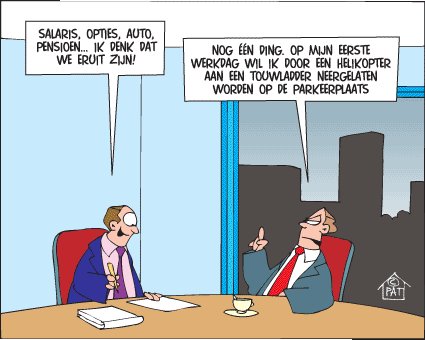
(cartoon text: salaries, options, car, pension, I think we have a deal! .....One more thing: on my first workday I want to be dropped by a helicopter on the parking lot)

I started working at IICD, the International Institute for Communication and Development as Knowledge Sharing Officer (I had always wanted to be an officer :)). I'm very happy having colleagues again, and such an international team as well. During lunchtime, the hard topic of payment of per diem or daily subsistence allowance came up. It is customary practice in most development trainings, conferences and workshops to pay participants a per diem. It's such an engrained practice that it's hard to go around it. And it an important additional to their incomes for participants. In one event, participants from the south came to Europe and were given a per diem under the assumption that it would enable them to socialize and have dinner with fellow participants. But they ended up eating take-away food in their rooms to save the money.

It's a practice which influences learning processes negatively because people may participate for the per diem rather than the topic. And within organisations the question of who participates in a learning event becomes politicised, because it is not only about learning, but also about additional income. It makes it much harder to get people to take their own personal learning processes in hand and become active learners rather than training or workshop attendants. Whereas a Community of Practice thrives on a personal connection with the domain of the community and passion for this topic.

By the way, I noticed the same difference in a training for which I paid for myself and others had it paid for by their employers. I was more fanatic in getting everything out of it. Sometimes lunch conversations touch upon the core of all issues, more easily than formal meetings....

Tuesday, November 08, 2005

Culture: Hofstede

I had never read a book by Geert Hofstede, but had come across his 'onion' on layers of culture a lot of times. As well as his indexes on national cultures. I always wondered if it's useful to look at national cultures if there are so many sub-cultures in one country, and how to avoid stereotyping. You can compare your country with a host country on this site.

I finally read a book he wrote with his son Gert Jan Hofstede (you can find out how to pronounce his name here) and Paul Pedersen who has a site with practical exercises. The book I read is called 'werken met cultuurverschillen' (in English 'Exploring culture: Exercises, Stories and Synthetic Cultures' and is a practical book with lots of exercises. What I learned is that the core of working across culture is learning to separate observations on what people do or say from interpretations (which is easier said than done). The book includes a description of the five basic dimensions which can be used to describe a culture. Interestingly, they link the collectivism dimension (as opposed to individualism) to poverty, as a cultural adaptation to scarse resources and individualism as an adaptation to wealth and abundance. The same for hierarchy, they link a high power distance to poverty (but the link is less strong than for collectivism).

And they do state that regional, ethnic, class or other differences lead to the forming of separate groups with quite different subcultures. Another important distinction is between culture and personality, it is quite easy to misinterpret behaviour as bad intentions or difficult personality, whereas the underlying reasons may be cultural differences.

So if countries in the south are -generally speaking- more collectivist oriented, how does that affect communities of practice? Will it be easier because people are used to live and feel part of groups? How will the preference for harmony affect the innovation in the knowledge domain of the community? and will the expert/reputation building in a CoP be different? Hope to get more practical cases!

Culture and technology: grandma on the phone

Thinking about new technologies and why people may or may not use the technologies, the story of my grandma keeps on running through my head. She used to speak some kind of dialect from the north of the Netherlands. But on the phone, it was impossible for her to speak dialect and she would resort to 'correct' Dutch. The phone never became so comfortable that she could be at ease and speak dialect. It seems that it really takes time for people to get used to new technologies and be comfortable with them. Though it may depend how different the technology is from known technologies (like telephone may have been the first disembodied communication experience for my grandmother, but skype may be closer to normal telephone).

Sunday, November 06, 2005

Technology: web 2.0

So here's technology again.... WEB 2.0. I have to admit I was ignorant about the term till last thursday. Even though I had come across the term I had happily skipped it; thinking that it was another software application... (to cope with information overload I'm applying optimal ignorance all the time). Till thursday when John Barben did a great tooltour for the foundations of communities of practice workshop in which I'm a mentor this time. He explained the difference between web 1.0 and web 2.0. You can find it explained by Tim O'Reilly in an article here. Tim O'Reilly and Dale Dougherty seem to have coined the term to indicate the shift in applications on the web since the dotcom collapse.

The shift he talks about is from the web as a platform for information updates and scheduled software releases on the basis of proprietary control towards the web as an 'architecture of participation', with services acting as brokers connecting the edges of the web and harnessing the power of the users themselves. These applications get better the more people use it (eg. the more people use skype, the easier it gets to phone all your friends with skype and forget about the phone). Web 2.0 giants have used the power of the web to harness collective intelligence by the use of hyperlinking, associations becoming stronger with repetition or intensity. Examples of innovations are the peer (and free) productions of wikipedia, flickr and open source software. And of course blogging as creating dynamic content versus the more static webpages. Uhm, so much more to explore... The mindset behind it seems to be one of sharing ideas and experiences freely in public, with a different definition of trust. John Barben has a blog as well.

Why I was struck by web 2.0 is because I can see the potential of web 2.0 applications for development. Harnessing collective intelligence by linking southern views. And the opportunity for northerners to listen to southern views and vice versa (though I realize the opportunity to listen does not mean that people will be interested in listening, they need a rationale first) . For instance, southern bloggers (think of eg. NGO leaders) could help partners organisations in the North to understand their realities. But blogging needs time, ease of writing and a certain mindset of freely sharing thoughts. So blogging may seem a luxuory to southern NGO leaders (and for a blogging community to emerge, bloggers need to read each other's blogs as well, which makes it even more time consuming). Maybe I'll try and trace more about the number of southern bloggers.

By the way, Beth's suggestion on my previous post to introduce the sentence 'my mom is a blogger' into Dutch school books reminded me of the school's project on mail, where they invited a postman and walked all children to the postbox to send a letter to their grandparents or friends. My suggestion to link the theme mail to email as well was well appreciated :-). So I'm not sure my daughter's teachers would even know what a blog is (and neither did I till last February... ).

Friday, November 04, 2005

Culture: Dutch mothers sewing trousers


I wanted to blog about web 2.0, but that would be technology again, so culture (which is everywhere... ). My daughter is learning to read and write in school this year. This morning she showed me her work from school. They had to read a sentence and say whether it is right or wrong. One sentence said: My mother is sewing my trousers. So she said it was wrong (the poor girl never had trousers sewn by her mother). And the teacher corrected her that it was right. Another sentence read: In the freezer you make icecream (in Dutch it makes more sense: in de ijskast maak je ijsjes). And she said it was right (because just the day before we had gelled drinks in the freezer to make icecream). But it was wrong.

In community of practice terms it might be that reifications (school exercises) are static and expression of a certain practice. In reality practice is changing and moving on. Or the materials are made by people who do believe the mothers are still sewing trousers.

Thursday, November 03, 2005

Practical example: Thailand

David Mould has posted something in com-prac@yahoogroups.com with regard to his experiences with communities of practice in Thailand:
http://groups.yahoo.com/group/com-prac/message/5690

I recognised especially his important point about the extensive social networks (from the countries I worked in), which are very effective in getting questions and answers across. He states that the community of practice has to add additional value to be an alternative to this system. I wonder about the differences; the social networks are not typically centered around a certain practice. I also wonder how you may use the power of these networks for CoP purposes? (nice question to take along on my trip to Ghana and it reminds me that I read an article on social networks in Ghana I may review. It also reminds me that I may read old messages of com-prac to see which other practical examples of CoPs in the south are shared...)

technology: e-collaboration

During this day on e-collaboration for development organisations (I mentioned in the last post), lots of interesting experiences came up. The most striking ideas/observations I gained from all discussions :

* A virtual conference with southern partners in 1999 was evaluated and time rather than language or technology was the limiting factor for participation. Looks like there is often a perception that online is fast and cheap and something you do in your own time: not taken as serious work like face-to-face meetings for instance. (same came up in the online facilitation workshop I mentioned in the last posting!). The MSN group also mentioned that MSN is frequently used for private conversations but not at work.

* Dgroups (www.dgroups.org) as an interesting example of a platform designed specifically with southern users and demands in mind. I wonder what other examples are there of designs specifically for southern users like dgroups. (maybe lots of linux groups in the south actually do??). Specific design differs from general designs (like skype or Gmail) which happen to match southern users' interests. However, the example of a training/coaching experience with limited interaction within the group made me also wonder whether the Dgroups features would make it more challenging to facilitate intense interactions (f.i. because discussions are not threaded?) in smaller or larger groups.

* The question whether sometimes southern partners are not ahead of northern partners in adopting some distance communication technologies (especially for easy-to-use, free technologies like skype) came up several times. Which raises a question for me: do northern partners find it difficult to learn from southern partners in this regard, do they feel they have to lead?

* It matters whether you perceive some of these technologies as cost-reducing and a bad substitute for face-to-face contacts, or whether you can see the different modes of communication as a source of creativity and a means to stimulate various ways of communications and create new links (and hence something which can enrich conversations and learning). Interesting in this regard was the discussion of the price of an online workshop/conference. Whether you see it as cheap or expensive depends on your perception of the value it brings and whether you equal its value with a face-to-face workshop or not.

Technology: post-it exercise to introduce the dynamics of asynchronous online communication

Today I could not get into my own blog :( and I really wanted to get my experiences out so I felt frustrated. Already addicted?

Yesterday we had a full day on e-collaboration for Dutch development organisations (organised by PSO/ICCO/IICD). In my 'round' we used an idea that I picked from my recent workshop facilitating online interaction http://www.fullcirc.com/ : to use post-its for simulating the experience of asynchronous online communication in a face-to-face group. It really worked well!! When the 'facilitator' started to ask questions, they also started to ask each other questions. Amazing how a really short experience can draw out so many of the aspects of online communication (eg. the speed of communication, importance of clarity, no interruptions in your communication, the excitement when you post leads to a thread (or the reverse), the insecurity when you don't get response, etiquette, role of moderator in asking good questions and modeling behaviour, difference in defining and monitoring participation, etc.). We used it as an introductory exercise, but if you make it longer, you could probably use it to go much deeper into some of the aspects of asynchronous communication. I can think of using it with different groups in the south to get people to talk about how it feels for discuss online (for instance this group did not mention the fact that it is difficult to express your thoughts in writing as they may be used to doing so).