Showing posts with label artificial intelligence. Show all posts

Sunday, December 09, 2018

My takeaways from OEB18: communities, AI and 3D-smarts and some very practical stuff

For the first time in my life I went to the OEB learning technologies conference in Berlin. It was a great conference. I did not feel tired Friday at 18.00 when it ended, but completely energized and full of new ideas! Thanks to Wilfred Rubens for pointing me to this conference and tips to navigate the conference. I followed his advice of doing a pre-conference session with Jef Staes which was one of my highlights. Wilfred also blogged about the conference. He notices people were looking for practical applications, whereas a conference like this is to challenge your thinking. I had both. My thinking was sharpened, but I also took away really practical lessons for the things I am working on (like the idea to embed peergradio in Moodle for instance....) and new relationships. The day after the conference I spent cycling around Berlin with Natasja, which felt both like a 'dessert' and a cooling down.

Communities of practice are powerful but not appealing
A powerful things happened in the very last session at 17.00 on Friday: my last session was about 'defense and security'. I decided to go there because of my work with the Defense academy in Breda to create an Open Defense Academy. We were 8 in the room, the beamer was ready, as were 4 chairs for a panel, but no convenor or speaker showed up. I had already jokingly appointed someone as the facilitator, who then did take up this role. We decided to exchange. People from Denmark, Finland, the US and the Netherlands exchanged working on 360 degree and VR, e-learning, open academy, video in action, micro learning as support for deployed troops. You could see the recognition,  openness to share. It was really an added value to talk about a common sector. I'm sure for some it was the best thing to happen. Still don't know whether the lack of convenor was by purpose or an omission in the program though :).

However the topic of building communities of practice or social learning was not high on the agenda of the conference (neither was performance support). Many sessions were about learning in general (learning a skill or memorizing). The example of driving a car, learning a new profession, onboarding was often used. However there are also many other situations which call for learning, like interdisciplinary learning, learning from mistakes, driving innovation, making use of tacit knowledge, reflection. For innovation and sharing tacit knowledge, (online) communities of practice can be a powerful intervention.

I'm not sure why this focus was much stronger. I guess it is because learning in communities is quite invisible and it takes time. And it does happen even when you don't influence it. L&D professionals may not see they can make a difference? People are aware of the power of networking and connections but may think it is automatic. The art of making space, facilitating, identifying the right domains is hence undervalued. I am one of the facilitators of the LOSmakers, but not doing a good job to create that space for real exchange. Will do that more and try to promote community learning more often (many clients ask for online or blended learning design rather than community design). If you see OEB as a community- who are the convenors, the brokers, where does innovation come from?


AI is real and scary for many
Anita Schjøll Brede did a really good keynote about AI and machine learning. She had five examples of how AI might change the learning landscape, for instance having one (AI) tutor per child, which was long thought too expensive. I learnt French for six weeks with one teacher for myself before going to Mali and that was a great experience. She said one of the challenges is not to copy our own biases into AI. I also attended the chatbot session. Cognitive bots have huge potential, the first wave was Frequently Asked Questions bots, but more is possible. Follow Donald Clark.

I hence visited a boardroom session by Inge de Waard about old philosophers and new learning and had an evening-long discussion about the topic. What I noticed that AI and machine learning does scare people.. Maybe because it is invisible/uncontrollable/difficult to understand? I am not scared because I don't believe in the technological singularity theory. My take away is that L&D-ers have to understand more about machine learning and algorithms, that ethics is becoming more important and that more power is going to the AI programmers who define the algorithms. Plus, L&D-ers need to help people to understand algorithms and burst bubbles. (first idea of L&D as bubble bursters by Ger Driesen). We need people who understand both learning and AI. (Elliot Masie said we can forget about AI for now- that might sound reassuring but I disagree!).

We should move to a 3D-smarts organization /knowmadic way of working
Jef was my hero of the conference. Maybe because his ideas of the 3D-smarts are close to my ideas about knowmads. Let me explain the 3D concept. The difference between the 2D world (before the internet) and 3D world (after the internet) is the ubiquity of information. However, many organizations and schools are still working from the 2D concept, with diplomas and function descriptions. Jef thinks we should move to a competency playlist. In a way I see this is already happening. For instance, as freelance consultant I am never asked for my diplomas, but asked for relevant knowledge or previous assignments. 3D smarting is a merger of working and learning. Jef reaffirmed two ideas:

  1. My idea that a knowmad needs to use social media and online. An offline knowmad is simply too slow in a 3D society. 
  2. There is a connection between who you are at home and at work. You cannot be passionate about something and turn that off at home. Sliding and morphing to find your passions and work that fits your talents best. A question for me is that this seems a lifelong struggle? 
The challenge for organizations is the power defect. The hunter passes on the spear to his son, but do we do that now? Do we have red monkeys (disruptive ideas) and how do we manage those? In most organizations the disruptive ideas are killed by the settlers. A lesson about change management: disruptive innovation is a change process in which you start with the pioneers and creators. Respect the settlers and followers though. This is a practical lesson for my work with the ambulances. 

NB: Again something I missed: I heard few people talking and the important of domain knowledge. I think domain knowledge is becoming more important than soft skills like critical thinking. Learning how to acquire domain knowledge rapidly. Maybe knowledge and skills can not be separated really.  
Some very practical stuff


  • Jef Staes had a great idea: 22 posters on stage and everybody who wanted to have a poster will have to make a video to explain the concept on the poster. We do have an online method called "adopt a concept" which is similar but people don't make a video and don't make connections. This is a nice variation. 
  • The reflection session had a nice BINGO model with numbers. Each number would lead to a different reflection question. (didn't attend this session but will definitely copy this)
  • In Jef's session strengthfinder was mentioned as a good tool to help you reflect about your talents and passion. An alternative is the high5 test. I did a great one in 2003 but not sure anymore whether it was the strengthfinder or something with happiness in the name. But number one was love of learning :) 
  • The facebook MOOCbot was a very creative idea too. A bot would ask design questions and students would design a MOOC. After this a peer review took place, also through the bot. I will try to find out more. 
  • There is a gamification toolbox with 20 game ideas. You may use it to design your own game and get inspiration through the toolbox, or you can use it to have groups of learners to develop a game and play eachother's game. 

Tuesday, January 09, 2018

Bookreviews Kevin Kelly: mind artificial intelligence, attention and quantified self


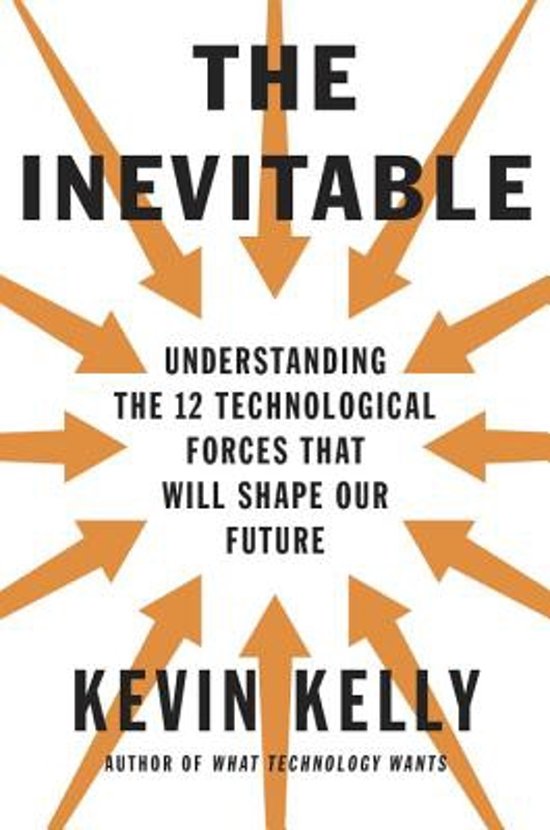
 I read two books by Kevin Kelly about technology, one on my kindle and one on paper (not the same book by the way :). The first was What technology wants; the second the Inevitable. I found both through Twitter. Now that I think about it: I get most of the book tips via my Twitter network.

I have read these two books because I want to know how technology is going to influence my field of work: learning and knowledge. I was also curious about what lens he uses to looks at technology. In my study Irrigation Engineering we learnt about various lenses. For example, you had the techno-optimists who thought that technological developments would solve all problems of developing countries, for example agricultural production would go up by invention of artificial fertilizer and pesticides. On the other hand, there are the skeptics. I was more skeptic because I saw how great the influence of culture and the way people react to technology is. At times people do reject technologies. Farmers in Africa did not make massive use of fertilizers and pesticides at all. Are there differences in visions on (learning) technologies? What lens can I use?

Kevin Kelly ends his book The inevitable with a clear position: he sees that we are at the beginning of a new phase, the last chapter is hence called 'the beginning' since he sees that we are at the start of a new phase. In this phase we move towards a collective consciousness that he calls the holos. We can not imagine the holos because it is something unseen yet. Another phase change from the past was the invention of the language. The people before the invention of language could not imagine the world with language either. Through language cooperation and coordination got a boost, but also idea development and fantasy. Ideas and knowledge travels with generations through language. The holos is a connection of all people and machines via artificial intelligence. The holos arises because we increasingly share, track, mix, filter, etc. via the internet. He also mentions two different visions on artificial intelligence: hard and soft singularity. The hard singularity theory is that we make a superintelligence that becomes increasingly smart, solves all problems and bypasses us. The soft singularity's theory is based upon a complex interface between people and artificial intelligence.

Some ideas I take from his books are: 

  • Technology takes an increasingly more central place in our lives. We sleep with the smartphone. My daughter sometimes sits with a laptop on her lap, ipad next to it and a smartphone in her hand. 10,000 years ago, a farmer only ran a few hours a day with a tool in his hand. The rest of the day was technology free. 
  • Apart from an addiction to a smartphone, for example, we may be addicted to what Kelly calls the 'technium', the technological innovation itself. This explains the interest in gadgets. The guild of French scholars has been able to delay the introduction of the printing press in Paris but could not stop it. Hence the general technology advancement seems inevitable?
  • Social changes in history are almost always driven by technology. He clearly recognizes that not all changes due to technology are positive. For instance the large-scale slave trade has become possible because of the sailing ships that could sail across the oceans. A quote from Karl Marx: the hand-mill gives you a society with the feudal lords, the steam-mill society with industrial capitalists.
  • The society and what we are working on is much more about intangibles (services, not tangible things) than about goods. 40% of US exports are intangible.

the picturephone


  • According to Kelly, new technologies are sometimes inevitable, but every technology needs a momentum. He gives the example of the videophone. Already in 1938 there were prototypes at the German post office. Picturephones were installed on the streets in New York in 1964, but were discontinued because there were only 500 subscribers. Now we use Skype, Zoom, Facetime or use video to call Whatsapp. Often similar technologies are invented or tried out simultaneously in different places. Only if the supporting technology is right and matches the social dynamics is it widely accepted. There is often a point where technology seems to be an option to individuals but in fact society has already changed so that people feel compelled to use it, in fact it is no longer an option. I recognize this with Whatsapp and the chip card for public transport. My mother could still buy tickets, but that is becoming increasingly difficult. Also think about how difficult it is if you do not want to use Whatsapp?
  • He summarizes the major changes of our time in the inevitable: Our time is knowledge / information-oriented, flows of information such as in your timeline are increasing. Sharing, linking, tagging are all on the rise. 40% of the web is commercial information, however 60% is voluntarily shared, from a passion. Artificial intelligence is going to have a big impact. The time of huge influence of Artificial intelligence has arrived because we have cheap computing power, big data and better algorithms. These three are the optimal conditions for artificial intelligence.
  • Can you redesign the economy based upon attention rather than material goods? If information is no longer scarce, then attention is. What if I was paid to look at an advertisement? If information is not scarce, and we can work more efficiently through artificial intelligence, people will focus on actual experiences. They will become very expensive and a new industry. 
  • There is a whole movement of quantified self. There is so much data that you can collect and analyze about yourself. Does this really make us a better person?
The books offer a lot of ideas about the influence of technology. It is quite overwhelming to me. On a philosophical level, I recognize the inevitably of technological advancements as in society. Being addicted to technology development in general by humanity would explain the focus on new technology and the 'shiny tool syndrome' that I often encounter. The intrusion of technology also gives me an uneasy feeling, as if you lose control. I am not happy about the inevitability. My own feeling says that we do not always need to get better from all new technology and that we still have to stay connected to nature because we depend on it (just look at black mirror). Nor do I believe that technology can solve all our problems, think of climate change, which is quite scary. 

My question was: what will be the influence of technology on learning and sharing knowledge?. What I will take away from these two books is the increasing importance of information, we have to relate to information in a different way. We drown in information but does it help us further? Dealing with big data and information is becoming increasingly important. Attention is becoming scarce. Artificial intelligence will play a major role in this. The quantified self also comes back. 

A conclusion is to pay attention to: (1) artificial intelligence (2) attention scarcity and focus and (3) learning through feedback about ourselves (quantified self). As far as the hard and soft singularity is concerned, I certainly believe in the soft singularity that we determine how artificial intelligence will support us. 

What kind of feeling do you get from all these developments?

Friday, October 20, 2017

Why you should be interested in artificial intelligence as L&D professional

In our book Leren in tijden van tweets, apps en likes there is a clear call for people working with learning, change and innovation processes to dive into technology. Everyone sees that technology is increasingly taking an important place in our lives- even people who are not into technology. I did intakes with vocational teachers this week and I heard that they experienced daily competition with mobile phones. The attention span of students got shorter. If you compete with technology you might make technology work for you and help you? My advice is be curious about technology and get started. But how deep do you dive into different technologies and tools? and why? There are so many developments, think of blockchain, of which I do not know what it actually is. Sometimes it feels like you are in a tsunami of new developments and you let it flow by. For learning professional e-learning seems a clearer need than knowing about artificial intelligence and blockchain.

the allerhande recipes
Artificial Intelligence- What the heck?

A great example of such a what-the-heck development is artificial intelligence (AI). Artificial intelligence is a collective name for software that manages creative thinking by the computer: the learning computer. I've heard about AI regularly, but a lot of it is at the level of 'HEEE, it's coming'. What can you really do? What's going to change? It doesn't click for me unless I get to work with it and start to apply it. A clear application of AI are chat bots. I have written about chatbots before. Those crazy puppets are everywhere if you have an eye for! Especially in Facebook messenger there are many chat bots to follow. I follow Poncho for the weather and a joke, and the allerhande chatbot with a daily recipe. For Slack users: the Slackbot helps you with all your questions about Slack. By the way, there are also chatbots which are not driven by AI, but those will be less smart in their conversations.

What is the influence of AI on the L&D profession? 

During the L&D unconference in Rotterdam I hence threw the  above question to the group: I thought I would be alone in my group, but there were 8 people with interest in the topic. Additionally, those who did not attend seemed to regret it :). The nice thing was that there were concrete experiences in the group with AI applications. The first was the experience of a bank to have Watson analyze credit applications. You will have to teach Watson how to do this, but then you can save a lot of time. Another application shared: At a factory in Japan, a robot runs around (powered by AI) that connects with employees and coaches workers, for example, to take a break. It's not a big brother, but a very helpful robot. The time saved by the use of AI can be put into more creative tasks. A third example was an application that receives information from the internet to make predictions about the market.

The Calimero effect

The AI group acknowledged that you as L&D-er might be afraid of this type of development or may think it's got nothing to do with your business. The famous Calimero effect: What can we do as advisers / trainers / facilitators? This too big for us and something for the ICTs and decision makers and visionaries in the organization. It's not for us but for others. Perhaps AI will take over L & D's work by doing performance support tasks, for example. There is already one AI online teacher doing a great job. Or people are scared of the smart youth who understand it all. Look at the example of  Tanmay Bakshi a 12-year old programmer of IBM.

You will only see it when you get it

This famous quote by Cruijf applies to AI.  You can only imagine or dream up an application if you have seen enough examples and those examples inspired you. Because I opened my eyes (with a group of colleagues), we see different applications. For example, we will experiment with an online confession box for reflection. We could not have thought of this AI application if we had not followed the developments and many examples. In addition, many applications already use AI, think of your news feed on Facebook (does it?) Or your results in Google search. The danger here is that we are increasingly dealing with filter bubbles, you are getting more and more closed in the same line of thought.  Think of the Netflix bubbles. It might be another role for L&D? Ger Driesen calls this the bubble bursting role.

So what to do as learning and development professional?
  • Read, watch, follow. Read an article, attend a summit or start to follow some chatbots. This is a dutch article by Ger Driesen over de invloed op HRD van AI.
  • Investigate whether there are AI projects in the core business and try and learn from those. 
  • Help people in the organization to prepare for robotization.
  • Brainstorm applications of AI to support your work and make it easier. Think of the selections of CVs, relevant chatbots or analysis of online learning data. You might be able to start an innovative project together with others. 
  • Take up a role in the consciousness about algorithms. Burst the bubbles.
Are you working with AI? I'd be happy to know about it in a reaction.