Thursday, November 09, 2006

Managing communities of practice in organizations

Of late, I have printed more articles than I can read, so maybe I should stop printing them... But I have read one article written by Joeri an Laere called Managing communities of practice in organizations. I don't know how I found it, but had a hard time finding it back on the internet (googling didn't work).

He writes about the management dilemma: should a manager interfere with communities of practice (rule them or support them) or would it be wiser to leave them in peace? His paper based on research within the Amsterdam Police Force suggests that 'managers should not make a choice, but rather manage the competing values of different strategies'. The manager could both guide and facilitate the community from time to time rather than only support it.

He did 3 years of action-research including a simulation game. He noted down 4 coordination problems with the CoPs of the Amsterdam Police Force:

  1. Work for the CoP (called regional projects) has low priority, participation is hence unreliable.
  2. Intranet only supports formal, static information (eg. on laws) but there is a need for technologies that support informal coordination mechanisms.
  3. Police culture; policemen are selected for their self-conceit, but don't often show their weaknesses and thus do not consult others very often.
  4. The central coordinator is the only reliable source of information.

At the same time he does report that part of the members is very enthusiastic and they often work for the CoP in their free time.

He recommends that management can make a big difference by rewarding the preferred behaviour (consulting, reflecting, spending time with communities, focus on quality instead of quantity). CoP Coordinators have a lot of freedom, and might benefit from stronger monitoring.

A great explanation is given on the possible strategies of managers, from defensive blocking strategies, via neutral nurturing strategies to active interference strategies. (check that out if that is an area of interest to you).


I really liked the explanation of the possible strategies of managers, I think I will use it to analyze the behaviour of managers vis-a-vis a community of practice.

I think in this case of the Amsterdam Police Force, the CoPs work within the setting of a general organizational culture which is not favourable to the kind of knowledge sharing within CoPs. So I agree that managers can (and should) play a strong role there to turn the organisational culture around. On the other hand, I have a question about the role of CoPs themselves in turning the organizational culture around. In my own experience in West Africa the CoP created a completely different culture (much more positive) than the organisational culture.

Lastly, I would recommend coaching the coordinators, in addition to monitoring the results. Also, I would recommend to pay attention to the group of members who invest free time in their community of practice. Those are the people who are probably very passionate about the domain of the CoP because they experience it in their daily practice.

Communities of practice: two disastrous approaches

Dave Snowden wrote on his own blog about communities of practice. He writes about the dilemma that communities of practice are self-organising versus whether you can direct communities of practice.

The two disastrous approaches he sees are:


"1 - Creating an organisational template for communities of practice, with a full roll out plan, dedicated staff etc. etc. This is the classic engineering approach which assumes that there must be a top down, designable RIGHT answer.
In practice different communities work in different ways and in different ways at different times. A list serve may be good enough, maybe Grove or similar to get started. A point may arise where you need a taxonomy, formal roles, start up
processes etc. but that is expensive and requires a lot of energy to give it any chance of working. Better to create the right ecology in which different types of collaboration can take place, and then consolidate successful experiments when (and only if) they or the organisation can benefit from formalism.

2 - Taking a paternalistic (or maternalistic approach) in which people are held to be children or kids needing help or assistance. This to my mind often goes with consultants to take up therapeutic techniches (in narrative Appreciative Inquiry is one) and move them sideways into organisations. Such approaches were designed for situations where the Therapist takes a dominant role (which is why some consultants like them) and assumes that the recipients are in need of therapy. Most of the time they are not - its the management and consultants who need it not their subjects/victims."

I agree that both approaches are disastrous. There is definitely a balance you have to find between designing events and linking people and trying to find initiatives that emerge 'naturally'. So you have to build in flexibility in how you are going to proceed. The paternalistic approach probably works nowhere working with adults on the long run (at least not in international development settings). In the short run though, it may seem to work well.

Tuesday, November 07, 2006

Culture: diversity and inclusion

Via Gurteen I found 3 conversations about diversity and inclusion talking about the UK and France. The audio quality was bad, but there is a transcript as well. Interestingly, there are questions that go with the interview (see the blue slide here).

In one of the three conversations, Hamid Senni interviews Daniele Joly, Director of the Centre of Research in Ethnic Relations, who grew up in Africa. She states that a society has to look into diversity issues because of the need to create a well-balanced society.

She talks about the business case for diversity; you should not think about diversity as part of charity, but for equal opportunities and enhancing business capacity. On top of that, there is the legislation in Europe.

On direct and indirect benefits of a diversity policy:
* The babyboom generation will retire, there will be workforce scarcity and we need migrants (Europe is now not welcoming migrants like the US/Canada)
* You develop more harmonious relations with open attitudes leading to better productivity
* It appeals to the clientele
* It introduces novel ideas

A roadmap could be to do an audit, develop a public policy, implement it and monitor this. The other interview on the UK touches very similar issues.


I first thought that diversity is approached from the positive side, rather than as a problem. But on second thoughts, it still sounds quite defensive, to fill the labour gap when babyboomer retire? Also, unfortunately she does not go deeply into what organisations should do to deal with diversity constructively. Because it sets organisations up for confict situations too. I read the book the inclusion breakthrough by Miller and Katz which deals with that in much more detail. (I read it before I blogged, maybe I should still blog it)

Culture: prisoners and inhabitants of Amsterdam

Last week I heard on the news that in Amsterdam 15% of the inhabitants don't live on the address where they live according to municipality's administration. That was followed this week by the news about our 17.000 prisoners. From a sample it was deducted that in about 7% of the cases the person in prison is not the person he/she should be. In other words, people send their representatives to sit in jail for them.

When I read these kind of stories I'm always impressed with how ways people act are stronger than the system. That's why I think it is strong that people working with a communities of practice perspective try to leverage what happens organically between people. Not to say that they should not try to get the right people in prison though...

Monday, November 06, 2006

Technology: 10 ways and 5 quick tips into blogging


cartoon by gapingvoid

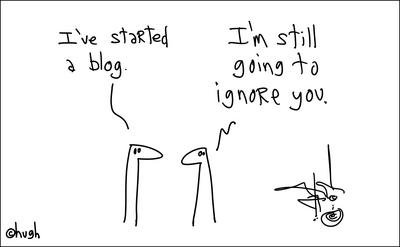
I found two great blog resources if you are looking for 'how to's'. The first one uses the cartoons of gapingvoid to point out the 10 ways to a killer blog. The cartoon doesn't always match the advice but never mind.

If you want to focus on 5 tips there are the Five Quick Tips to Building a Great Blog by Meryl K. Evans. Thanks to Cincy for the link. Meryl Evans' tips are not very special in my opinion (a little obvious like make them silent, don't let them start with music), but I really liked her personal way of talking about her blogs. And to be honest, thanks to her I have editing my blogging profile (and found out it had been viewed over 1000 times, just to find out there was nothing!!). An excerpt:
' Entering a blog compares to stepping into one's home where the owner feels at his or her most comfortable. In other words, we are more apt to be ourselves when blogging, and that's a good thing.'

Saturday, November 04, 2006

Practical examples: Rede Nos in Brasil and PEM-Pal in Eastern Europe

(in the picture you see Monica Amorim from Brasil)
Erik Johnson from the World Bank sent me the link to the World Bank video of a brown-bag lunch about client communities of practice on October 23 at the World Bank. Since I'm always on the outlook for practical examples, I am very grateful to be able to sit in on a brown bag lunch in the US! I do wonder if it affects the level of exchange, knowing that you will be visible in public on the internet. The participants do not seem to bother much...

The whole exchange is 81 minutes but you can watch separate parts: either the presentation on the Rede Nos project in Brasil (Monica Amorim; 18 minutes) or the presentation by Elena Nikulina on the PEM-PAL program for learning on public expenditure in Eastern Europe that covers 13 countries (10 minutes). Personally, I found the comments by Phil Karp and Erik Johnson more interesting if you want to learn about the process of cultivating the communities.

The community of practice in Brasil focuses on poverty alleviation and social inlusion in Northern Regions in Brasil, and started as a World Bank initiative in 2004 out of a need to develop more practical, low-cost solutions to local economic development. To create a space for people to interact, often working on projects in an isolated way. It uses online discussions (Dgroups), a website, tours, seminars and storytelling as its main learning tools. Phil adds that the value of this community of practice is really on connecting rather than collecting. There seems to be a large demand as people keep on showing up. It has also helped the World Bank to be closer to client needs, small and medium scale enterprise came on the Bank's radar through this community of practice. The mutual learning is very valuable, rather than asking another consultant to do a study.

The community of practice PEM-PAL on public expenditure management regrouping practitioners from 13 countries in Eastern Europe started only this year, and will rather be a constellation of communities of practitioners like treasurers, auditors, etc. The community of treasurers has been launched, and other communities may come up through a rather organic process. The main challenge is that the launch started donor-driven and hence the World Bank will need to make sure that their is sufficient ownership with the community itself. Some of the lessons shared are:

* Working across 13 countries is challenging due to timezones and language variations.

* A good preparation for the launch is key, you have
to get in touch with interested parties and get a sense of their interests.

* For sustainability sake, it's important to show that something happens
after the launch, to show that it's not an one-off event, for instance in
this case the topic of 'single treasury account' seemed a 'hot topic' during the launch and hence
a new event will be organised on this topic.

* Evaluation will need to be different from project evaluation as the results will be harder to define. Stories which understand the impact of the community of practice on inidividual participant's level may be important.

During the question and answer session a participant asked about the cultural sensitivity to the target groups. In the given responses, I found it interesting to hear that there was very little hierarchy in the e-discussion in Brasil. The virtual medium for discussion seemed to work as a leveling mechanism for this group.

Another remark I found highly interesting was about the nature of the community of treasurers. As a 'technocratic' community it gets harder to find their energy. From this response you would guess that the 'culture' of the field of treasurers is more determining for the way knowledge is exchanged and the community will function than the various national cultures involved. (which links back to my earlier post on dealing with differences)

Thursday, November 02, 2006

Technology: Helpalot

I met Julius Huijnk of Helpalot online and we decided to meet and exchange in Utrecht. Since we had both done our online homework, I could explain him the concepts, and he knew where I worked, so we could get to the point very rapidly. (which was useful since I had missed my train..)

When we did a scenario planning with IICD on the changing future of development cooperation, the influence on the internet on establishing direct linkages north-north, north-south and south-south surfaced as one topic. We also thought humanitarian aid will play a bigger role in future and saw rapidly changing alliances as well as changing power blocks.

Helpalot is a nice example of a new initiative to create a site which aims to linking people around their interest in charity through the internet. The idea is to leverage the power of social networking tools like hyves for 'charities' (goede doelen in Dutch). Its mission is to "Help individuals and organisations to find a charity that fits them, by making objective and subjective information on charities accessible and transparent. By strengthening social contacts and stimulate feedback, Helpalot aims to increase the trust people have in charities and stimulate charitable activities. "

You can see a one minutes introduction of the concept by clicking on the video:


There are existing sites with information on Dutch charities like goede doelen, alle goede doelen, helphelpen and geef gratis. On an international level there is for instance the charitynavigator. There is the initiative of Nabuur, linking villages to expertise and assistance. None of them works from the principle of leveraging online social networking though. It does make opinions very visible in a rapid way, and has the potential to change power relations and give the individual donors more influence. So I'm curious to see how this is going to work. It seems most beneficial for small organisations and volunteers. Given the number of times I'm asked if I know a place where a volunteer can work I'd definitely say this has potential, but provided it attracks a sufficient number of organisations and people... If you are interested you can sign up at the site of helpalot

On the way back I thought about the fact that this is new for me, to think from the 'charity' or 'donor' side. As I've mostly been a direct advisor in the south working with local organisations. I started thinking: Suppose we would use this idea to link civil society organisations in the south to talk about donor agencies and partners in the north? Wouldn't that have the potential for a real power shift?

Tuesday, October 31, 2006

Culture and stereotypes

Cartoon via handvest van de aarde
At the site of project implicit you can do tests about your prejudices conderining fat people, gender stereotypes or ethnicity ( in Dutch, the english version is here). I did the alcohol test and have a slight preference for alcohol over non-alcoholic drinks. I also did the Martha Stewart versus Oprah Winfrey test and have a slight preference for Martha too. (I do dislike Oprah Winfrey even explicitly).

It is tested by your reactions to combining alcoholic drinks (or Oprah Winfrey) with either positive or negative terms. When you associate terms, your reaction is faster. I was quite convinced that it was easier to combine alcohol with negative terms, but apparently I was faster with positive terms. I'm just reading though that heavy drinkers have negative associations (phew!)

From the site: 'A stereotype is a belief that members of a group generally possess some characteristic (for example, the belief that women are typically nurturing). An implicit stereotype is a stereotype that is powerful enough to operate without conscious control. Example: Try answering this question: Is John Walters the name of a famous person? If you suspect yes, and especially if you were more likely to think yes than if the question had been about Jane Walters, you might be indirectly expressing a stereotype that associates the category of male (more than that of female) with fame-deserving achievement. And this may be the case even if there is famous female with a similar sounding last name (e.g., Barbara Walters). This type of judgment was used in one of the first experimental studies of implicit stereotypes (Banaji and Greenwald, 1995; Banaji, Hardin, & Rothman, 1994).

Technology: gathering on 'online kennisdelen' organised by oneworld

Last week, I was invited by One world the Netherlands to do a presentation about online knowledge sharing jointly with Julie Ferguson from HIVOS. We were asked to look at tools, experiences within development cooperation and some do's and don'ts.

You can find our slides in Dutch here. I did not manage to embed them in my blog. As you can see in the second picture, only few people raised their hands when asked whether they could explain terms like 'web2.0' or 'blogs' or 'podcasting'. I was surprised about the low numbers, and almost suspect they did know about them, but were scared to be asked to explain it.

At the end I realized that most of the people were communications people with a task related to their organisation's website, looking for tools to integrate in their websites. Which is different from the way I mostly look at some of these tools, as supporting (small) groups in their communication and learning efforts.

One world will make a report available here where you can also find reports of previous gatherings. Of course in such a meeting, you only cratch the surface of a lot of topics and experiences.

In the end, I realized the value of the e-collaboration community of practice, which brings a wide range of people interested in this topic together for a longer period of time. Because of the longer attachment to one domain and with a (growing) group, we are able create more exchanges which build on each other.

Saturday, October 28, 2006

The blog birthday

Photo by Thom Watson

One year (and four days) ago I started this blog with this blogpost... A nice moment to list all my previous blogposts about blogging:

  1. How to read blogs
  2. What is a blog?
  3. Blogging communities
  4. blogging ripples
  5. Knowing the number of subscribers to your blog
  6. Blogging popular amongst Arab women
  7. David Maister on blogging
  8. Using mobile phone and SMS to blog
  9. Some blogging reflections
  10. Blog mentoring projects
  11. Blogging and development
  12. My pathway into blogging
  13. How to start blogging
  14. Iraqi bloggers

Britt Bravo started a nice, practical blog Basic blogging for women (with lots of tips for men as well :)

Now, one year, 4 days, 240 posts, 57 blogs on my blogroll and over 90 subscribers and 6,600 views later, I'm very happy that I started blogging and don't think it will be easy to stop. It has focused my readings and stimulated me to interview people, plus it's a place to write down my own experiences. I guess I imagined the blog to be more factual than it is now. Gruadually I've include some of my personal experiences which make me think of aspects related to communities of practice. It's become a great archive for myself. If I had blogged since I learned how to write, it would be a documentation of my thinking too. On the other hand, there are many interesting experiences and discussions which I don't blog, mostly for privacy reasons.

Thursday someone asked me whether I have children, so I responded, yes and a job and we were joking about the rest of the list (a car? a dog?). Next time, I should probably summarize my life by saying I have a job, two children and a blog.

Friday, October 27, 2006

Communities of practice: comm.unities.of.prac.tice 2.0


Martin Kloos wrote his thesis for the University of Amsterdam on communities of practice 2.0. It's written in English, so if you are interested, you can download it and read it too. I think it's brilliant that I can be in touch with research results through blogs! Martin studied the effects of weblogs, wikis and social bookmarking on communities of practice, as part of his thesis for Business Informations Studies. Students were experimenting with blogs, wikis and social bookmarking and he interviewed them individually and did focus group interviews. The setting in which the tools were used were small familiar groups and all were master students, using the tools in an educational setting. He analysed what the tools influence is on mutuality, competence and continuity in the community of practice. And secondly, at orientation, reflection and exploration. There is a table at page 108 which summarizes these results.

It is interesting that though the tools are 'public' tools, and have potentially boundary crossing potential (to draw in other people with different ideas) no outsider jointed the conversations on the blog during the course. The blog was very successful in influencing the face-to-face discussions. People who were less assertive in class felt they got a voice on the blog, leading to an increased willingness to join the conversation. It was also seen as a source of inspiration. It was experiences that knowing what other colleagues read, what they share through their bookmarks can enhance the feeling of engagement. Finally wikis created a form of accountability for both process and product, whereas the meta content of a wiki provides insights into the composition, objectives and development of a community.

Very interesting are the conclusions, one interviewee wonders what triggers the enthusiasm of users when it comes to web2.0 software. He/or she believes: " it has to do with personal values. The essence is that we are all trapped in a system of top-down corporations and so forth. I believe that we are slowly crossing a line where larger groups of people want different things." They talked about at length about the acceptance of open source values and principles, as openly sharing information and collaboration as the key to success.

Participants classified the main functions and feel of the tools and what kind of processes within a community of practice they can support. Blogs are characterized in terms of reflection. Social bookmarking more in terms of exploration, and wikis support varying levels of participation. Blogs and wikis support engagement more than social bookmarking and stimulate orientation and reflection. Wikis and social bookmarking offer facilitaties that better support the work of alignment than blogs.


This research again highlights that people determine the use of the tools. Example is the fact that the blog did not have any boundary function, as a result of barriers created by the group. A blog can work as a boundary crossing tool, but probably only works when the blogger is a broker him/herself (and has people from various communities of practice reading the blog). It is not an 'embedded' feature of the blog.

In this case master students were testing all these tools in a course setting. Ofcourse you may look at the class as a community of practice, but it is a very specific situation with members in the same age group, not resembling other (corporate, inter-organisational) CoPs with members of a wide range of ages.

The tools did energize and stimulate different conversations and engagement. I think it is important to know the ins- and outs of the various tools as a facilitator, plus the group process, so that you know how to stimulate certain processes by introducing tools that energize the group.

One common feature of all web2.0 tools is that they leave visible traces, and hence make it easier to document or analyse what's been happening, as compared to informal, face-to-face interactions. So it could make result measurement of communities of practice much easier!

Tuesday, October 24, 2006

Technology: slide show by Nancy White

After reading a post from Tony Karrer talking about the fact that powerpoint slides without the presentation will not easily make sense to anyone. He confesses he is too impatient to sit through an audio presentation. I can watch vodcasts, but have problems with audio too. My thoughts just wander off. I'll do a test by downloading and listening in the train tomorrow.

Then I found this slide setfrom Nancy White which she shared on her Australian blog. I really liked the visual and condensed presentation. I especially liked slide 7 which talks about the different uses of communication technologies by different age groups, distinguishing it groups by 10 years age difference. Probably because that links very closely with my recent discovery that people of 18 have again a different use from people who are 28. (I assumed they were all the same user type). I was also inspired because I just made a slide presentation, not half as nice as this one. Next time, I'll try and use more pictures too. So slides can make sense I guess, but maybe only if they link very closely with your own line of thoughts or questions and when they are very visual and clear. By the way, Nancy used slideshare a place where you can find millions of slides.

Practical examples: the ICT4D trainers meeting in pictures


The ICT4D trainers community meeting in Zambia that I blogged about in my previous post, this time some impression by means of pictures (provided by Saskia Harmsen).

Monday, October 23, 2006

Practical examples: the community of practice of ICT4D trainers


IICD in collaboration with its Itrainonline partners did a community readiness assessment for ICT4D trainers. In July, a first meeting was organized for a group of interested trainers in Zambia. My colleague, Saskia Harmsen, was one of the organisers. She answered the question:
What advice would you give to someone who was going to organise a first community of practice meeting?

Her response is, organise for getting to know eachother by means of storytelling exercises and facilitate peer assists in small groups. This can set the scene for what can be done with the community of practice in terms of knowledge sharing. The trainers really appreciated this 'facilitated' approach rather than a train-the-trainer approach.

A challenge is how to translate the practice-based experiences and make it available to others who were not present at the event. In this case, people were asked to write summaries in a wiki, but felt that limited the free-flowing knowledge sharing process.

Sunday, October 22, 2006

Technology...never fails

This week was 'herfstvakantie' (autumn holidays) at school, and I took my kids swimming. The pool has access gates which you can only enter by scanning with a bracelet (that you get instead of a ticket).

Unfortunately the access gate reported that I had no access (whereas I had already scanned my children, so they were already in). When I asked at the ticketing office (upstairs) they said that I had scanned it twice. That would be surprising as I have used the bracelets for years going for swimming lessons. But I said 'sorry!' and they reloaded the bracelet for me and it worked!

I had forgotten about it, when I exited my children after swimming and I got stuck myself in the swimming pool area because the same thing happened at the gate. This time it said, 'error, please contact staff'. No staff around and staff in the pool did not want to help. So I squeezed myself with another person through the gate. I could have thrown the useless bracelet, but thought I'd be helpful and notify the people at the ticketing office, explaining that there was a problem with this bracelet. But they said that I made a mistake, I had not scanned the bracelet well enough while entering.... And after my response that there is no reason to get angry.... :).


But why do I blog this story while talking about technology in relation to communities of practice? I think what we can learn from this is that as a technologist or online facilitator you should never assume that technology works and that people are making a mistake. So you have to be patient and prepared to find out what doesn't work and why it doesn't work. This can be dull and time-consuming, but is a necessary part of the job. Secondly, if you have support systems ('call staff'), you have to make sure they work ('there is staff around').

Technology: Sil and continuous partial attention

Photo by John Smith

Thursday, October 19, 2006

Culture: Dealing with differences

I read Dealing with differences by Nico Vink, who looks at communication as scanning of social spaces and positions, rather than exchange of information.

One of the questions of the book is: Does globalization lead to homogenisation of cultures? Nico Vink challenges the existing crucial role of national cultures against the context of globalization. Cultural fields are introduced as a new context for intercultural communications. "Fields are distinct, smaller social spaces, When a person wants to participate in a field, he/she should learn the values and practices, the rules and the language of the field." Fields may become trans-cultural bypassing national borders and cultures. Globalizations is not leading to homogenization of cultures but to exchange and hybridisation. So where do we currently find the cultural differences? Between rich and poor, differences remain large, as well as between believers and secular people. Miscommunication ocurs also in our own society.

He provides some vivid examples of cultural fields, like rock music. Rock music knows many forms, it is a mix of local styles with international musical idioms, originating in the Anglo-Saxon world. Rock music is an important way to emphasize local identity, and in many places local varieties of the international rock-idiom can be found. There is some influence of local music on the global field too, the question is how and how much? The chinese rock musician Cui Jian is quoted when he says: 'Rock is worldwide. During the festival of Roskilde in Denmark I was the only Chinese, but I felt like at home. Yet there is a difference. I think in Chinese, I feel Chinese, I use Chinese images.

Intercultural communication competences listed by Vink:
* Insights into the general communication process and awareness of our own strong and weak points
* Basic attitude of curiosity in people who are different
* Social skills; social poistions in cultures are very different
* Patience; changing habits is a long process


The book did not have real eye-openers for me. By reading this book, I start to think more strongly about the importance of organisational cultures, and communities of practice as places where a certain 'culture' is cultivated. Will organisations become more important than nations in shaping ways people interact? And what will be the role of communities of practice? And how 'deep' does organizational culture impact on individuals? I have the impression I act slightly differently in different organisations because you are stimulated by your colleagues and managers to act in a certain manner. But I have my own core values and interests I take with me. When people start to identify with inter-organisational communities of practice, how does that influence the way they act within their own organisations, and will they start to influence the culture in their own organisation? (that influence will probably be much larger when managers are part of communities of practice).


I also wonder whether the way Vink uses field is similar to the use of domain with the communities of practice theory?

Wednesday, October 18, 2006

Technology: how to read blogs?

At the launch of the group blog on e-collaboration we got the request for a basic introduction to blog reading for people new to blogs. Together with Dorine Ruter, we worked on a writely document and I was able to post the document directly to my blog. This is a more technical introduction, the 'why to read blogs' should probably follow later! So here we go:

How to read blogs?

There are various ways to read a webblog ('blog') that you think is of interest to you. The main choice you have to make is whether you want to visit the blog every now and then, or that you want to be up to date with every new post on that blog.

1. You want to read the blog every now and then

The following are ways to remember the blogsite online; (of course another option is to write down the link in your agenda or wherever is handy for you...):

  • * You can add the link to your Favorites / Bookmarks in your internet browser;
  • * You can use the History of your internet browser. This will only work if you are visiting the blog regularly. In that case the blog address will appear in your recently visited web addresses. If you don't visit it for a long period, the history of your browser may no longer remember the URL (=the weblink)
  • * You can tag it with an online social bookmarking tool, like e.g. del.icio.us (http://del.icio.us). To find the blog, you have to make sure that you use a tag that helps you to find the blog whenever you want to read it. This has the advantage that you can find it on any computer with an internet connection. The other advantage of using a social bookmarking tool is that others may find the blog of your interest through the tags you use. A more elaborate explanation of del.icio.us can be found at:
    • http://del.icio.us/help - Some basic information;
    • ottergroup - A screencast on how to use del.icio.us to store and share weblinks.
      * If you have a blog yourself, you can add blogs to your blogroll on the sidebar. Then you may click on them every now and then.

2. You want to read the blog systematically and you want to track any new post

There are various options again if you don't want to miss any new post on the blog. Almost all blogs have an RSS feed system and if you 'catch' those feeds with a RSS feed reader you will know whenever something new has been written. A lot of blogs have a 'subcribe by email' function. You may have to find out what works for you.

Email

You can use the subscribe by e-mail function which looks like the following and can be found at the right side of the blog (sometimes on the left-hand side). The only thing you have to do is enter your e-mail address and hit the 'subscribe me!' button. You will receive every new post in your e-mail inbox.


Powered by FeedBlitz
If your favorite blog does not have this option, you may ask the owner(s) to add this function! Alternatively you can create an account at e.g. Feedblitz and add a new feed yourself by entering the blog address.

RSS

A program known as a RSS feed reader or aggregator (the names RSS reader and RSS aggregator are both used) can check a blog on behalf of a user and will display any new blogposts that it finds. You can use any RSS reader. An RSS reader can be used not only to stay up-to-date with blogs, but with any other website that has an RSS feed. You can recognise the RSS feed on a blog for example by these signs:


There are lots of RSS readers; some allow you to read whole news items through the reader, others show the first lines and you can click on the item to read the full article online:

More on RSS reader, what it is and how to use it for non-profits can be found here: http://www.missionmovers.org/overview.pdf

Learning 2.0 tip of the week has a series of very clear podcasts on aggregators http://learning2.0.ottergroup.com/blog/Podcasts

Or you can use an aggregator specialized in blogs. Here you can subscribe to the blogs you like to read and it will indicate which blogs have new blogposts. You will also be able to read them without going to the actual blog itself.

Personalised home pages

Personalised home pages are a special type of RSS reader which offer RSS aggregating functions too. The home page will open every time when you start your internet browser (eg. Firefox or Internet Explorer). In one glance you can see the new headlines of services you are subscribed to (see picture). You can add blogs to your personalised home pages too, discussion groups with RSS feeds or the weather forecast. You will see the headlines of new blogposts and can click on them if you want to read them.

Tuesday, October 17, 2006

Technology: what is a blog?


( Cartoon from
travelinlibrarian)

I've had to explain various times what a blog is. So I liked the blogpost by Jack Vinson on how to explain blogs and RSS. Jack writes: 'Blogs are places where you can read the regular writings of friends, colleagues, clients or industry experts. You'll find a variety of writing styles, from journalistic to informal. The articles tend to be less formal than journalistic or academic writing, and you will find writers who post things every day and those who post weekly. The ideas for articles frequently come from articles that have been posted elsewhere on blogs (such as this one), or in the newspaper or in current events. Articles range from a few sentences to lengthy discussions, though most tend to be shorter.

I used to explain that a blog is an online diary format, with archives, resorting to explaining the technical features, and I do forget to mention the RSS aspect, which goes with blogs. But of course what would be much more interesting to explain is the blogging culture and subcultures (blogosphere), which consists of the habits of people blogging. Bloggers have gotten used to using the technical format for certain purposes like emphasizing links (blogs function often as infomediary places), making their thoughts explicit, commenting on blogposts etc. This allows people to stay in touch with each other's ideas and occupations and enables a wider group of people to stay in touch with ideas, activities, readings, etc.. It's like the informal talk to your colleagues in the corridor, but made accessible to a much larger group. The blog rhythm (daily, weekly) makes for very dynamic, easy to read and 'here and now' content, personally I hardly go through the archives of blogs I know.

A little later Jack pointed to a blog which consists of only pdf files. I think that's just a different means of using a blog, but may be an odd one out in terms of the predominant 'blogosphere' culture. I think travel or baby blogs written for friends maybe another means of using the format, and may have its own subculture.

Anecdote then started to collect stories about the most significant change that blogging made:

  1. Describe a story that epitomises the most significant change that has resulted from your blogging .
  2. Why was this story significant for you?

The now 17 responses are interesting and show a wide variety, from reading and writing more consciously, via power over your own virtual identity, providing an uncensored platform and seeing intimate opinions, to invitation to speak at conferences and making friends or deepening friendships. So next time when I'll explain what a blog is, I'll be much more careful in stressing these kinds of aspects of blogging!

Wednesday, October 11, 2006

Technology: gaming communities

I had a very rich conversation in Utrecht with Marinka Copier who works at the University there as a game-researcher. She has a keen interest in communities of practice too. Her interest in games has grown from entertainment role-playing (and the effect on learning). Her Phd research follows an ethnographic approach so she is doing lots of gaming and observes how the gaming communities function and develop. She has also done research for the University of Maastrict on games that olders gamers play. Marinka shared some interesting observations, like the observation that there is a gap in the age group of 40-50, but that there exists a group of people above the age of 60 who is really involved in gaming. And that this somehow a taboo; illustrated by the story that she went with an elder gamer to a shop to buy a game and the salesperson said: "I assume this is for your grandchild?" Another observation was that a lot of the younger gamers don't use e-mail but rely fully on MSN, so she had to change her habits too. (interestingly I assumed there is somehow an online generation 'younger than me= younger than 40', but apparently you may be able to distinguish important sub-groups with different habits, like the 30s and 20s and younger.)

One of the topics we discussed in-depth is what is it that online interaction can add to learning repertoires?. We both agreed that learning processes are central, and online tools should help to support learning processes rather than using tools because it is 'cheap' or 'time saving' (as for newcomers it is often not time-saving!). I think online interactions have the potential to stimulate creativity, to push people outside their confort zones; to add a new layer of learning possibilities. It pushes you out of your routines, which in itself is an experiences. But ofcourse the type of online experience matters. I was quite intrigued by the gaming stories and how people learn intercultural skills amongst others. Some gamers do not realize that they learn, but say that they learned English, made friends in other countries and may even visit them in those countries too. In some games, it is a chance to experiment with different behaviours, it can hence stimulate phantasy and imagination and open up new ways of acting for people. But not all games have that automatically. She had the impression for instance that second life stimulates more a replication of real face-to-face life.

Another central question was also: how do people learn and get excited about new online technologies (eg. how are you introduced into gaming?); often this works via a strong interest, or via a peer group or network you belong to. You might learn how to use skype because your aunt has migrated to New Zealand.... And how does this translate in use of technologies within organisations? What determines how organisations use technologies and how does this support (or frustrate) their work processes? It does not seem there is abundant literature and research on this topic. My hypothesis would be that it depends a lot on the management team's capacities to see and stimulate the potential use of new technologies. We came back to one of the things we also discussed last week, that use of technologies is not something which is easily discussed at the workplace, so that colleague learn across generations. Developments like the energy put into blogs, wikis, social networking tools, videos, show that people do like to express themselves and their ideas via the web. A lot of energy which has in many cases no directly relation to the work people do in organisations.

Again, we agreed though, that it is not about using the latest tools, but about being able to communicate and work effectively. How can organisations leverage the energy displayed by individual bloggers or vodcasters? I'm so curious how the generational gap work out in the workplace in terms of use of technology, so any articles or pointers to resources welcome!

Monday, October 09, 2006

Knowledge management: Creativity by Mihaly Csikszentmihalyi


With such a name, you have to be creative yourself probably... I enjoyed reading this book by Mihaly Csikszentmihalyi. In English it is called Creativity. Flow and the psychology of discovery and invention. It's easy to read and become very practical in the end.

I was actually drawn to the concept of communities of practice in 2002/2003, when I was a member of a community of practice of organizational development advisors of SNV in West Africa. I thought it was a real creative space within the organisation. Since then, I have been interested in the topic of communities of practice, probably most for their potential to stimulate creativity. Mihaly C. has interviewed more than 90 highly creative, older people; his definition is different from the usual casual use of the word creativity though; often used to talk about a person with lots of new ideas. He talks about creativity as a process which changes a symbolic (cultural) field, like a tradition. In order to be able to do so, you have to know the field very well. So many of the people he interviewed are actually Nobel Price winners.

To be able to make a creative contribution, you need creative personalities, but that's not enough. Creative personalities need to invest in knowing one field thoroughly. And they need to link up with other people who know the field to determine what a really creative contribution or innovation is. Friendship and encounters with thought leaders are very important for creative people because they offer a platform to talk about their own work, offer a competitive culture which stimulated people to get the best out of themselves, offer constructive critism and opportunities and information for career paths. I can see an analogy to the function of a community of practice that goes through a phase of mapping its domain before it can move towards real innovation. And communities of practice can connect people to though leaders too.

The interviewed creative people have very different lives, but Mihaly is able to detect 10 elements in common; all are two extreme poles that creative people know how to combine much better than others:
  1. lots of energy while being calm and quiet at the same time
  2. smart but naief
  3. disciplined yet playful
  4. with a sense of reality but lots of imagination
  5. both intro and extrovert
  6. modest and proud,
  7. psychologically androgyn
  8. conservative and irreverent
  9. objective yet engaged
  10. and finally their sensitivity leads to more pain but also pleasure.

Rewards, intrinsic and extrinsic help to stimulate creativity. Money for materials or travels can help, recognition is nice (expecially for people who are insecure or work in isolated ways). Intrinsic motivation is the flow created by working on difficult problems, but this intrinsic motivation can also be fustrated by bureacratic work environments, too much pressure etc. Though a creative person may concur resistance, rewards and the right environment may stimulate it.

Practical suggestions are formulated towards the end, 'borrowing' from creative people's lives to make your own life more creative eg.

  1. Be curious by looking more thoroughly at things that surprise you, trying to surprise others, writing down what surprised you, doing something with the things that surprise you.
  2. Bring flow into your daily life by starting the day with a clear goal, having fun, doing more complex things.
  3. Become a strong person by working with schemes, reserving time for reflection and relaxation, form your space (house, office) wirting down what you like and dislike to do, and the next step doing more of what you like and less of what you dislike.
  4. Personal characteristics; develop what's missing, alternate between being outward and inward looking, aim for complexity
  5. Applying creative energy by finding a way to express your emotions, looking at a problem from various angles, think about the consequences and implement solutions.
  6. Think divergently by producing more and more different ideas, illogical ideas too.
  7. And finally choose a field you want to explore.

We just had a scenario thinking exercise in IICD, facilitated by Alain Wouters of Whole Systems; which was also a very creative process. I do like facilitation methods which stimulate creative thinking, and they seem to work through some of the same principles like be curious, divergent thinking, looking at problems from various angles, etc.

Saturday, October 07, 2006

Culture: Borat in Kazachstan


Though the government of Kazachstan is not happy about it, Borat, the movie is coming soon. I think Borat is really funny.
Once, I watched Hakim perform. He said humour is very important for intercultural communication. (it is a pity he is a mime-player, his sense of humour while talking is great).

Friday, October 06, 2006

Technology: Nancy White on blogging communities

It's fun to see all the Nancy Whites when you use google images. Very different people, all called Nancy White. But I guess this is the right picture of the Nancy White who wrote an interesting piece on the Knowledge Tree called blogs and community- launching a new paradigm for online community?

In it she distinguishes 3 types of blogging communities:
1. The single blog/blogger centric community with the power vested in the central blogger.
2. The Central connecting topic community which is a community that arises between blogs linked by a common passion or topic.
3. The boundaried communities like myspaces or multiply where members register and join and are offered the chance to create a blog.

I'm particularly happy with the distinction between 1 and 2 versus 3, because I think that it is a completely different use of the medium blog, to use it within a boundaried community. A blog in itself is a very simplistic software with not too special features, but it is the use that people make of it that makes a difference. I have the impression boundaried communities blog are more often used for friendship blogs than professional blogs, and may be more within the paradigm of the bulletin board systems. As distinguished from the 'blogosphere' with it own culture of linking and hyperlinking. But, as Nancy states, the three forms are to show the extremes, and in reality there are hybrid forms.

What she does not talk about in this article, but what really interests me, is the story the other way around; how do existing communities of practice stimulate blogging and how does blogging or blogs change the community of practice? I think it is true that communities may be formed around blogs, but I think there is often a step before the blogging community where people have connected through other ways (conferences, face-to-face events, online courses, etc). How do blogs enhance the permeability of the community of practice? In this video Nancy White talks about blogs as perfect tools for crossing boundaries between communities. For instance, the people in Ghana with whom I work may read my blog, as may the people in CPsquare, colleagues from IICD, etc.

Thursday, October 05, 2006

Practical examples: a one-year old community of practice

The e-collaboration community of practice, a group of people working for development organisations in the Netherlands (which started a blog on its domain here) is almost one year old and the 'facilitators' decided to ask an external person, John Smith, to look back and help to design the next steps. I co-facilitate the group of behalf of IICD with Sibrenne Wagenaar from PSO. We wanted the exercise to function as an exchange between members of the group rather than having a formal external evalution, so John had about 5 teleconferences with small groups of people, and we had a face-to-face session yesterday. I was a little hesitant to ask people to talk about the group at a meta-level (talking more about the process of group development, rather than about a content topic). In general, I had been hesitant to use the name community of practice for the group too, because in a way even after a full year, it feels we are just at the beginning.

Without posting all the minutes, I think this blog is a good place to share my reflections about this whole exercise.

1. I think the exercise in itself was powerful to strengthen the group, by calling it a community of practice outloud. One person said she now realizes that she is part of this community of practice. Having an outsider name the dilemmas the CoP is facing is also a very good intervention in itself, when it is not named, the group can not work with the dilemmas as a group. I'm thinking that could be stronger function for us, as leaders of this community of practice in future too.

2. It was funny to see how people have different interpretations of the history. My history starts where I joined the process, but there were other interactions before I joined, and I assumed that my co-facilitator Sibrenne was part of the initial stages, but she wasn't either. Though I'm a big advocate of building on what has happened rather than starting new things from scratch, I see how easy it is to ignore processes that are important but which you were not part of.

3. Though the set-up of the exercise did not allow us to look at the value created by the community of practice (a big worry for me), I learned to look at value simply by 'voting with their feet'. The fact that people show up at meetings and that the group is growing is also an indication of value created. How to articulate this value to the organisations is another question though.

4. John mentioned the word 'shoptalk' a lot. As important for learning within a community of practice. Though I have an idea of what this means, I forgot to ask what exactly he means by this, but it did make a lot of sense to the group. We also talked about the important of creating both private and public spaces. This exercise is a nice example of that for myself; though it was good to have the face-to-face meeting, I feel I learned most from the preparatory teleconference where we discussed the evolution of our domain, and the talks afterwards where Sibrenne and I had the chance to ask all our questions about community leadership. Our exchange about 'removing' skype contacts, dealing with overload of contacts and other skype conventions in the bus is a good example of this kind of talk too I think.

5. Co-facilitating this group has been very important. Not only in sharing the burden of 'work' and being there when the other is on holidays or travelling, but also to be less lonely and have someone to share your observations and dilemmas.

Though we have a private, password-protected wiki for reflections, I'm first blogging this. Half a year ago, it would have been the other way around. That means my level of comfort with blogging my own learning process has increased tremendously! (beyond embarassment :))

Saturday, September 30, 2006

Practical example: the value of the Poverty Analysis Community for the World Bank


Via Elsua I found and was able to watch the 14-minutes video with Ludovick Leon Shirima, community leader of the Poverty Analysis Community (PAC) interviewing Frannie Leautier, the World Bank Vice President. You can view it too here

You can watch it in 4 separate parts too:
- The PAC and knowledge sharing
- What does the PAC add to the World Bank?
- The PAC benefits for the World Bank?
- What is the impact of the PAC community of practice on World Bank clients?

Some highlights: The whole approach of communities of practice is based on the idea that people get knowledge around the coffee machine, and hence CoPs work to make learning easy and flexible.The thematic groups (the CoPs in the World Bank) deal with immediately relevant and available knowledge. Lessons learned flow from the CoP into the World Bank. It hence helps the World Bank to learn from the outside.

How to keep people interested if they are not meeting face-to-face (from the interview you'd assume the PAC functions completely virtually)? If you have a good topic or domain and real practitioners, you can create excitement with real creation of ideas. If you have this, you can manage to keep people connected and create more value in the long run. You keep people connected to each other and the materials. Plus you can identify knowledge gaps easily by the CoP.

Impact on clients of the World Bank can be enhanced by linking the CoP to other CoPs. It is important to make sure members of the CoP are linked to changes and policy discussion. They could work with the media and hence disseminate the agenda.

Friday, September 29, 2006

Technology, culture and virtual weddings in Zimbabwe

(picture from BBC article)
The BBC writes about virtual weddings in Zimbabwe.

"Zimbabwe's traditional weddings, usually joyous occasions with singing, dancing and plenty of food, are now increasingly being held in the absence of those whose presence might be considered vital - the bride and groom. "

Couples living abroad find it hard to be there for the traditional wedding ceremony, so instead send money home for the ceremony to take place without them. This means some parts of the tradition can not take place, for instance, "A day or two after lobola has been paid the bride is supposed to be covered in a white sheet and taken by her aunts to join her husband and in-laws at their homestead, where she carries out household duties."

Playwright and cultural analyst Stephen Chifunyise says: "It does satisfy minimum requirements, because in the actual process of paying lobola, the couple does not play a major role," he says, explaining that everybody appreciates the reason they are out of the country. And it also shows that we've been able to marry technology and tradition adequately."

Another example of how cultural habits do shift over time. It was not clear to me, how exactly technology was used to support this wedding, apart from the couple phoning afterwards to hear how it has been.

Thursday, September 28, 2006

Technology: the Dgroups success story


Last week we had several discussions on how to get lively discussions going on online fora. It made me think again about the success of Dgroups "the starting point for fostering groups and communities in international development" and how hard it is to pinpoint the critical success factors and hence to replicate this success.

In July there was a meeting for Dgroup administrators and moderators in the Netherlands. The slogan of Dgroups is "Development through dialogue". Dgroups was designed in 2001 from the desire to create a simple, reliable and accessible communication and information-sharing tool that could be used by development organisations and its partners. Currently there are 21 supporting organizations. The system is e-mail based, but has an online platform as well, where message, resources, members and a calendar are accessible. In 2006, 12.000 messages pass through Dgroups every month, and a 1000 files or links to files are shared. In total, since the beginning of Dgroups, 288.000 messages have passed and 27.000 resources. The growth in number of groups has gone in rapid expansion since 2004 as you can see in the graph.

The report highlights some different organizational uses of Dgroups, ranging from Dgroups as a handy way to reach a group of people through a single email address by INASP, to the moderated topic and case discussions by the Pelican initiative . For PPGIS, a group on Geographical Information Systems, Dgroups is one of many tools, like a website, RSS, translation tools, webring, skype and more. I guess this may be true for most groups. Future directions for Dgroups include Improving facilitation of Dgroups, engaging Dgroups administrators and users and improving the web platform and interface.

Through a blogpost by Sarah Cummings I had the chance to read a report on the use and characterization of Dgroups in Latin America. This report identifies 7 different ways organizations utilize the platform:

* Internal communication in one organization
* Communication between organizations
* Organization of events
* Virtual communities
* Virtual forums of limited duration
* Work groups
* Publications

With the majority defining themselves as virtual communities (34%). It concludes that Dgroups is simple to use, suits low bandwith, is free of publicity and has the endorsement of a partnership of organizations working in development themes. These characteristics may explain in part its success I guess. It also states that Dgroups is not useful for all purposes it is currently used for. So there may be scope for more appropriate design of online tools, specifically designed for southern users. This may work better than adopting 'northern' tools.

The story of how ICCO, a Dutch development organisation introduced and uses Dgroups can be found here

Technology: videoconferencing

Cartoon by Pathuis: Bert Beamer via SNT conferencing services.

"finally after all those months! Free World! Seeing Family! Fresh Air! Birds!"

"Eh, no, nowadays we use life videoconferencing for bringing prisoners up to court"

Wednesday, September 27, 2006

Technology: Help! New train ticketing software

Today the Dutch Railways (NS) had new software on their ticketing machines.
I got to know about it because the lady in front of me said the machine was not working. It normally asks you for the first letter of the city you want to travel to. Then it gives you the options of the various cities starting with that letter. With the new software, it still asks for the first letter of the city you want to travel to; but then it asks for the second letter. On top of that -totally unexpected- question there are only few letters of the alphabet you can chose from (for instance if you chose D from the Hague, you can only chose the a, o, e and i. So the lady kept on repeated her first letter again and again, and the machine did not react. Later in the train they announced the introduction of the new software because they had a lot of questions about it.

It's a story about how easily people get used to routineous use of technology and get upset when things work differently. Or a story about how to upset the Netherlands (people are no longer upset by train delay....)

I just discovered you can practice with the ticketing machines online. A nice exercise for people abroad who intend to travel to the Netherlands. Unfortunately it still runs with the old software.

Tuesday, September 26, 2006

Technology: using flickr for find digital pictures you can use

Beth Kanter has made a perfectly clear screencast (explanation supported by visual from your computer screen). You can watch it when you click here. The screencast explains how you can use the photo service flickr to find digital pictures which you may use for your publications, blog or website or whatever. You can do so by looking for certain tags and the creative commons license.

Culture: international experience and innovation


Via life2.0 I found the post: are you a lulu? The company is seeking smart, creative, energetic, web-savvy people and have developed this quiz to find innovative people.

I'm happy with the 'have you studied or lived abroad' and 'are you multilingual' as an appreciation for what this does to your capacity to see other patterns. On the other hand there is a huge number of people who have studied or lived abroad, and I wonder if this automatically enhances innovative skills.

But most of all, this brings me to my deep conviction that you can have a company full of innovative people, if the organisational culture does not favour innovation, these people will just be frustrated. (hm, how do I know?)

Sunday, September 24, 2006

Technology: how to develop the Dutch online competences?

I talked to Jos van Brummelen who is doing his thesis for the Erasmus University in Rotterdam about communities of practice. In particular he is investigating whether developing an online game would work to stimulate people into online corporate conversations. The idea followed from the observation (an observation I share!) that a learning event like an in-house training could trigger a more continuous online community of practice. He found me via my statements about online competences of Dutch companies on the emerce website. (it's amazing to find out this has been copied here and here amongst others, sort of rapid pumping around of information on the web!). The way he found me is a good example of how online networking exists in addition to the good old way of networking. It also brings me back to my old fascination that information travels so rapidly when people are really interested in the information.

His questions forced me to formulate some of my ideas that I developed over the past year more clearly. I thought I'd blog them before I loose them (rather than scribbling them down in one of my paper notebooks).

1. It is only meaningful to think of developing a community of practice after a learning event when the training topic constitutes of an appropriate level of domain, not to narrow, not too broad; when a sufficient number of people is passionate about that domain, and when the domain is important enough for the organisation (or organisations). And if you want a training to develop into a community of practice, it needs a high level of investment, it is not something that develops completely organically.

2. People have to develop a certain trust in online communications; this type of trust is different from the face-to-face trust. Once people have developed that trust they can more rapidly interact online and with more confidence. There is an interesting article called communication and trust in global virtual teams by Leidner and Jarvenpaa, which I also blogged about here. They talk about swift trust and their questions is: from where is trust imported to the global virtual team and how is trust maintained via electronic communication? rather than how to 'build trust'. So the radical difference is not saying that people need to build the same level of trust, but that it is important they they have built previous trust in online communication in general! My positive experience was the foundations workshop during which I developed a lot of 'swift trust' in the possibilities of online communications.

3. There is a generational thing: probably the younger generations will have that type of trust online, confidence automatically, and will have access to a wider range of communications. Yet, organisations can not wait for them to fully take over before they can add easy online interaction for effective learning and innovation to the face-to-face repertoire. So how to deal with this variety in organisations? One thing is to use the younger generational advantage to your own advantage. The fact that management team are often made up of older people who are 'blind' to the full range of online possibilities does not help make an important shift.

4. I consider myself as part of the older generation (I learned wordperfect as a student and handed over my first report in university typed with the aid of a typewriter). I believe I have developed some level of online trust over the past year which allows me to blog rapidly, enter online discussion fora etc. (so there is hope :)). Hence, I think it is important to realize that people can learn new ways of interacting online and new ways of building trust. I think we have to understand more about how people learn this; how to open up their interest, etc. I think for instance that when people are uncomfortable for whatever reason (at the start of a new group, because of a reorganisation), introducing new technologies adds up to their level of discomfort. So you'd have to introduce the use of new technologies when people are sufficiently at ease in general. There is probably a relationship with individual learning styles too.

5. It would be great to see research into companies in the Netherlands about these differences, how are the number of employees conversant online distributed over the organisation and how does this influence the level of online interactions and learning? I need to dive more into Dutch articles and literature, which I haven't done so far. Tips for interesting articles and blogs are welcome.

Tuesday, September 19, 2006

Technology: the mzalendo project

Through a post by Ethan Zuckerman I can sit in a boring place and still know what
Ory Okolloh talked about during the citizen media and blogging conference in South Africa.

Ory observes, “In Kenya, you hide information without knowing why you’re hiding it. With technology, you can break that open.” Mzalendo is putting draft bills online and reporting their status, letting people search by issue, and providing a bill tracker so you can watch the progress of a piece of legislation. They’re offering a database of MPs, searchable by gender, province, district, and party affiliation. Coming soon is a list of bills sponsored from 2003 to the present. It’s difficult to put voting records online, because many Kenyan votes are voice votes. But a searchable Hansard online is a future goal. Her project, Mzalendo (pronounced: “me za len do”) uses new technologies to try to hold Kenya’s government accountable.

I think this case tries and change things from the technology side. On one hand I'd think people will try and meddle or withhold information (a database or blog in itself will not make you share), on the other hand, presenting information in new ways can also be helpful to draw new conclusions or ask new questions. My favorite example is the level of salaries of development agencies directors. Most information was available through annual reports. But it wasn't till journalists picked it up that the individual donors to these organisations started paying attention to the level of salaries of the organisations they donate to.

Monday, September 18, 2006

Technology: I collaborate, e-collaborate, we collaborate


I'm very proud to link to a new group blog I collaborate, e-collaborate, we collaborate, of the e-collaboration group that I co-facilitate on behalf of IICD. Interested people meet quarterly, exchange by Dgroup, and now the group has a new public space by means of this blog. From the description: This blog belongs to the “e-collaboration among Dutch NGO’s,” group, which is facilitated by a joined initiative of PSO, IICD and ICCO in The Netherlands. The members of this group all work in the development sector and have a shared interest in e-collaboration. The purpose of this blog is to share personal stories about encounters and experiences with working over the internet. I'm very fond of the blog's name, which was selected through an online poll.

Maaike van Steenhoven, student from the University of Utrecht, faculty of new media and digital culture interviewed about 15 people from this group to talk about the introduction of a new tool for e-collaboration. The stories are very interesting and easy to read. I think it will be both inspiring to read the stories for the creative use of the tools, as well as interesting to use the stories to detect some common trends about the introduction of new technologies in development organisations. There are already 5 stories up, and the rest will follow soon.

The blog will continue to be the public space of the e-collaboration group, after Maaike has put up her stories, a group of 6 members will take up this challenge. We thought about linking up to the Netsquared case studies blog, but finally decided that it would be a different kind of case as the netsquared blog highlights the various initiatives, but does not talk about the introduction process itself.

Friday, September 15, 2006

Technology: loosing skills through the virtual world?

Dave Snowden blogged about the virtual and the real. He wonders about the younger generation, reflecting on his own past and the way he learned to interact with other minded people:

" We played on the street, with whoever else was on the street at the time and we learnt to adapt to different people and different attitudes and backgrounds. Our interaction was not virtual, it was physical; it was not restricted to people we wanted to be with, it required us to play (and then work) with people we would not necessarily choose to be with"

'Now if this is the case, and the next generation are only used to operating in a symbolic virtual world, in which they limit their interactions to like minded social groups (and it is at least arguable that this is happening), what will happen when they enter the world of business?'

And his question: "So the dilemma and the question, to which I have not developed any answer. How do we take advantage of social computing and all it offers, while not degenerating the richness of human intelligence to the poverty of a machine?"

This is a question I and others raised too when talking about the faster linking web2.0 world of communities of practice. How to leverage the power of differences if you quickly find like-minded people all over the world? How to make sure communities of practice are diverse enough to innovate? How to make sure you don't loose the skills of conflict resolution and at the first sign of conflict people hop on to find like-minded people?

I think this trend of homogenenisation started with urbanisation and is continuing. In smaller villages, people were forced to live together and find ways of solving conflicts (or not- and then forever living cut off from their families due to feuds... ). Personally, I learned a lot about completely different people through hitchhiking all across europe. When I lived with a smaller community of Dutch people in Takoradi, Ghana, I have the idea I was able to go 'back in time' to experience village life including its social pressure and force to conform. On the other hand, people would always help when in troubles and you are forced to live and work with people with different styles etc. that are useful skills. I currently invest more time in communicating via the computer (this blog etc.), time I do not use to communicate with my neighbours (people with very different ways of thinking).

I hence recognise the dilemma quite well. I don't have an answer, but I tend to think positively, that there are new additional ways of learning social skills by the new media. For instance, with the current ability to peek into other lives, there is a different way of learning about group dynamics and other people. Eg. a program like boer zoekt vrouw is very popular and a great way of learning about farmers, and the diversity amongst farmers. Same for expedition Robinson and other programs, and blogs... I wonder if the younger generation will not just be much smarter in finding and switching groups which help them enhance some of their knowledge and skills. Better in coping with changes and different social settings. And how does that support innovation, being able to focus on a topic with a like-minded group? Don't know really. And these are such generalizations.

But I sure think a large challenge will be in bridging the generational differences in use of technologies in companies.

I do think it's funny that I'm now of the generation who knows how life was before the internet. When I talked to our intern, she said that when she did not have an internet connection she wondered how to find out about the train schedule (without internet). Well...., then you need dinosaurs like me who still know the OV telephone number as well as the 'spoorboekje' :).

Thursday, September 14, 2006

Technology: blogging ripples


I found the blogging ripples model via knowledge cafe on the logic+emotion blog

"Yet another stab at the blog levels of influence idea. There are multiple ripples overlapping, happening in a three dimensional space—in real time. If this were animated, the ripples would not dissapear, but radiate."

Personally, most of the times I try to upload unique stories because I think people already read the same blogs as I do. I did notice though that a lot of blogs do copy ideas and links (and building on them as well) - like this post does. In a way, it then works as a measurement of what is important in a certain field. A way to test ideas and see whether they get picked up and amplified by other blogs. The good thing is ofcourse that even 'small' blogs have the chance to come up a superbe idea, which could be amplified. This as compared to a f2f meeting or conference where the 'small' blogger might not dare to speak up. So I might do it more often if I think something is important.

On the other hand blog influences seem to work very subtle. You read something, you start thinking about it, and it leads to a new blogpost which is much harder to trace. Sort of cross pollination. Harder to track but still influence ripples?

Wednesday, September 13, 2006

Knowledge management: the typical mom

On the beach, my daughters thought of a nice game; in turns, they were making drawings of 'typical mama' , 'typical grandpa', etc. - including themselves. After that the others had to guess. It was really an exercise which gives some feedback. Besides what I expected (mom behind the computer), there was a typical mom who doesn't want to read to them in the early morning and prefers to sleep. And talks to Sil like she is 2 years old (though she is 5)...

Never knew that. It reminded me of the catch phrase that we learn from our mistakes. Often when someone makes an obvious mistake eg sending a mail to the wrong address and it bounces, we do learn from this mistake and correct the mail address. But I wonder if we really learn from our mistakes. Most of the 'mistakes' are not outright mistakes, but rather imperfect actions, are not so obvious and we may never get the feedback to know the effect of our actions. Or the effect takes place much later. Or the people affected do not tell you how they feel (for instance because they are subordinates, or do not want to hurt you). So to enhance learning from mistakes it is crucial to increase the various feedback mechanisms and channels, not only formal anomymous evaluations, but short evaluations, informal checking, sensing or asking for feedback outrightly.

Friday, September 08, 2006

Knowledge management: interpretations and online car parking)

I received quite some online jokes and I won't bother blogging all of them. I received a joke where you are asked whether you want a salary increase. When you try to click on Yes, it is impossible (the yes moves away) so you can only click on No.

So when I got this online driving test where you have to park a car and had game over! You hit another car! for three subsequent times, I thought it was the same joke structure as with the salary and that it was impossible .... only to discover much later that it was possible and that I am a bad driver after all (online that is :)). But it is a nice example of how what you see and perceive is coloured by your recent experiences. Like the typical seeing pregnant women when you are pregnant.

By the way I have added a sixth stream to my blog: knowledge management in general; as some knowledge related posts are beyond just CoPs.