Tuesday, May 23, 2006

Communities of practice: from fishermen guilds to the global village

Miguel Cornejo Castro has written an article called Revisiting Communities of practice, from fishermen guilds to the global village. He attempts to revisit the basic concepts of communities of practice with the goal of updating it, to ease the fitting in of contemporary communities (specifically refering to online communities of practice).

Going online changes the breed of communities by virtue of the following changes:
- Shrinking cost of communication
- Rise of information longevity
- Universal access
- Differentiation and competition in the global village

He describes various changes which are characteristic for (large) online communities of people who find each other via the internet.

I agree with the described changes, on the other hand, I don't think it is either/or. I think he describes a particular kind of community, which works for people who are fast working online and know what they are looking for (and probably works best for explicit knowledge). I think there will still also be other types of CoPs (smaller, localised, closed). So I'd disagree with tagging one type of CoP as 'traditional' and the other as 'modern'. And of course there will be a hybrid model, of communities of practice using both face-to-face and online media (open or closed will make for a large difference). What will be the difference in influencing the practices of a community of practice?

It's a good question whether the basic theory of socially-constructed learning is useful for the changes brought about by the internet and web2.0 'thinking', which comes with imported trust, more openess and faster exchange and networking. Is it still useful to talk about CoPs or are the dynamics so different that the theory looses its explanatory and predictory value?

Communities on flickr: the finished mural

On the sidebar of my blog I have the photos labelled with community (see on the right side). I often click on interesting pictures, and many times it was related to a mural. It is now finished. I don't have a clue about the mural, but it's become a beautiful piece of work!

Culture: stereotypes

From Dorine Ruter I got these stereotypes in my delicious inbox! I just stumbled across my own inbox because Jack Vinson had a game whereby you have to post an interesting resource in his inbox (which I did of course, mention game and off I go..).

There are no stereotypes about the Netherlands in the map. Probably because it is so special, you can hardly stereotype it. That americans dislike walking is new to me. The german punctuality is a stereotype the germans in Berlin really confirmed when most of their answers included 'punktlich' (which seemed to be there first criteria for measuring something good). So a stereotype map is useful while travelling!!

Communities of practice: online workshop in Dutch

I'm working with Maarten de Laat and Marc Coenders to prepare a Dutch online workshop about online communities of practice in September. We meet every month face-to-face to talk through the design, which is slowly cristallyzing. We involve two mentors and former participants in the design phase. In between, we use the online workshop space and skype sessions to discuss. Marc and Maarten have already facilitated an online workshop together, but I haven't, so we really need this time to get used to each other and become a team. What helps, though, is our common base in CPsquare as our own community of practice which seems to represent a sort of being at ease with chaotic, creative processes; apart from a shared base in theory of course.

Even though I get worried at times whether we are suffiently on the same line of thinking I do think we are a strong team in terms of complementary and overlapping knowledge areas. This is something I start to recognise in good teams: people not only complement eachother, but there should be a right balance in shared knowledge and complementary knowledge. Through CPsquare we can tap into the experiences of other online workshops as well.

Interestingly, the reaction to the price (1250 euros for 7 weeks) are very mixed. Some people think it's cheap, others think this is amazingly expensive. It probably depends what you compare it with. If you compare it with the experience of a face-to-face workshop (which I do) it is reasonable. If you compare it with online course, which are self tutoring and where you download standard materials, it may sound expensive. This workshop is a completely different overwhelming, highly interactive experience, which demands intense facilitation.

Friday, May 19, 2006

Culture: Hirsi Ali/Magan

There has been a lot of commotion in the Netherlands around Ayaan Hirsi Ali. I don't want to describe all the ins- and outs of the case, but I do like to point out to an intercultural aspect of the whole affair. For the Dutch people, it was a shocking detail to see that she had changed her name (from Hirsi Magan to Hirsi Ali). In Somalia, there is no such thing as a family name, but there is a long line of names going back to your descendency. As she explained in a press conference "I am Ayaan, the daughter of Hirsi, who is the son of Magan, son of Isse, son of Guleid, etc." So there the use of names is much more fluid; and using a different name may feel less of a 'crime'. (I actually think the timing of the news and her general position played a much bigger role than this -minor- intercultural element).

Naming conventions differ alot. This weekend my friend could not check in because they had booked her on her first name (booking done in China) rather than her second name. I had many problems in Ethiopia where they could not understand that my passport has two Christian names (Gerberig Johanna) rather than my 'roepnaam' Joitske. So I became very careful in using my Christian names in all official communications.

Technology: Electronic conferencing and gender

There are gender differences in the use of internet. The potential and use of electronic conferencing: a study of women's involvement in a global context looks at steps that can be taken by e-conference organizers to promote greater participation by women in the south. The article starts from the premises that there is a link between information and empowerment, and women should not miss out on the benefits offered by the information revolution. The internet is seen as a male tool with opportunities for women to adapt it for their own uses and benefits. In one case girls involvement in classroom discussions was enhanced by using electronic media, as there was time for reflection and they could determine the pace of the discussion in spite of their more dominant and outspoken classmates.

The study looks at e-conferences in the field of water supply and sanitation in Kenya, Columbia, Russia, Bangladesh, Zimbabwe, India and Ghana. 41% of women had subscribed to e-conferences but never sent messages, as compared to only 17% of men. On a positive note though, 3 women from South Africa felt that they enjoyed a greater degree of confidence online as compared to a physical forum. The hurddles were that women would be the last to be given access to the internet (physical access), women's percepton was that e-conferences were male dominated domains, and lack of confidence as e-conferences were seen as a large public arena. Technophobia was perceived more as a problem for women than for men.

So there is a potential strength in the medium of e-conferences to draw in women, but it needs careful attention, starting from the promotion stages. Female chairpersons and moderators may be of help as well as skillful facilitation by prompting women. I can also think of using smaller groups in which women may feel safer.

Thursday, May 18, 2006

Communities of practice: creativity and innovation

My uncle-in-law (or how do you call the uncle of your husband?) is a piano player in the Dutch Swing College Band. The fact that we have never gone to hear them play will show how much we care about jazz music... (he is the fourth from the left side). If you want to listen to their music there's a webcast from their appearance on Barend en van Dorp. The person who forced us listen to jazz was Nii Ofuso in Takoradi, who was our Fanti teacher and had an hour jazz on the radio on Monday evenings. He would often tell us to listen because he would send us greetings on the radio.

But that's a long introduction to a really great article on Creativity and improvisation in jazz and organisations (I forgot where it was posted; I printed it and took it later from the pile of papers). I'm intrigued by the power of CoPs to stimulate innovation and creativity (it may even be the only reason why I'm so attracted to CoPs). And Frank Barrett neatly unpeels some of the dimensions of creativity in jazz and translates that into very solid recommendations for organisations. His parallels are really good.

He looks at
- provocative competence
- embracing errors
- shared orientation towards minimal structures that allow maximum flexibility
- distributed task
- reliance on retrospective sense-making
- hanging out in a community of practice
- taking turns soloing and supporting
(but these terms will not tell you much unless you read the paper).

For instance, the deliberate attempt by jazz musicians to guard against reliance on habits and patterns that worked in the past is his inspiration to point at the compentency trap: the tendency to become competent as an organization and to loose the edge of experimentation. Breaking routines (and that's what some technologies can do as well!). Organisations should encourage small disruptions and incremental re-orientations to sharpen perceptions and activate thought processes.

He also notes that most studies of organizational behaviour have a rational-cognitive orientation. The experience of synergy etc. would warrant further study, for instance the role of supportive relationships in drawing out one another's latent capacities.
" To foster learning, organisations must see beyond conventional, anonical job descriptions and recognise the rich practices themselves." I thinkthis is true for so many professions today, where managers are not sufficiently in touch with the practices or fail to see them.

He provides all kind of advices for organisations like "organisations must go beyond merely inviting new voices, but must also create processes that suspend the tendency to criticize, judge, express disbelief that might kill a nascent idea"

I will definitely add this one to my favorite articles. In a meeting somebody suggested a delicious tag called top10; I could start using that to be able to trace your favourites easily over time.

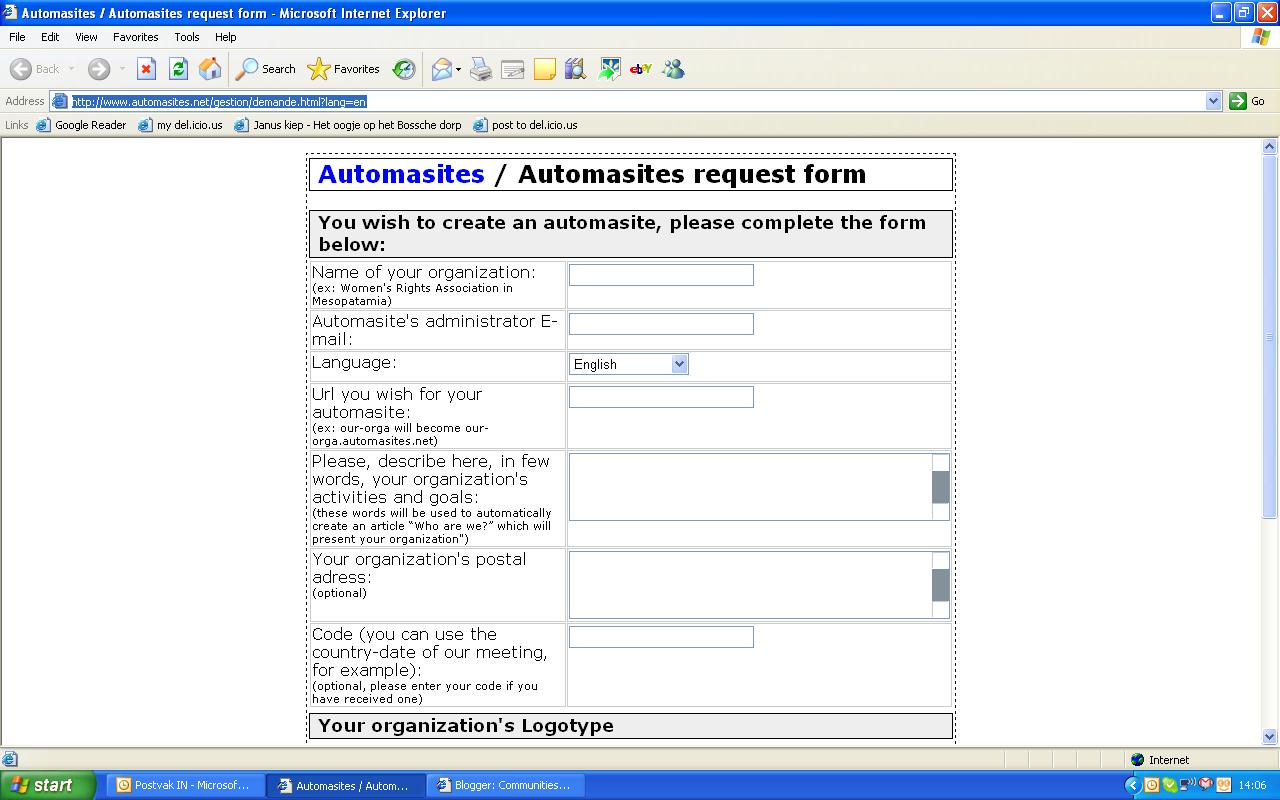
Technology: automasites

Via the bytes for all yahoo group I found
Automasites

"It seems to be a very useful tool for civil society groups. They allow to created one's own
website by filling a simple online form. The form will automatically send an e-mail to one's email address, containing all the information
necessary to proceed. The application is based on the free and open source software (FOSS) publication system Spip."

I really feel like trying it out, but then suddenly I would have a website...? And would need to update it? Anybody interested to have a new website?

Friday, May 12, 2006

Culture: organisational learning masterclass with Nancy Dixon

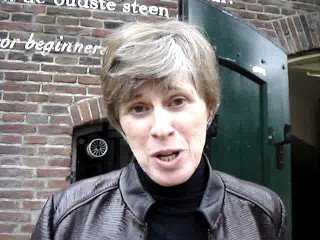
Sarah Cummings blogged about the masterclass with Nancy Dixon we both attended. This photo is from the vodcast I did with her afterwards. Reading Sarah's ideas, I thought it would be nice to blog my own. First of all it is so different to attend a master class as compared to reading one of her books called common knowledge. Even though I could relate very well to the book, the 'live' stories made me see different things, as I started comparing them to the way we often work.

The underlying principles of her organisational learning work are:
* Problem-based- working from a specific issue or problem (not learning for the sake of learning)
* Peer to peer - most learning takes place between peers
* Conversation-based rather than written (same reason as above, most learning takes place through conversations)
* Learning before, during and after- an event of sequence of events
* Working with small groups- for effective learning
* Using life connectors - necessary to connect and link people, rather than using databases
* Have a sufficient understanding of the industry- in other to be able to understand the ways they work

I was particularly struck by the different of working from problems- onwards to learn as compared to the regular organisation of workshops and trainings around themes, as is customary in development work. Working from actual situations, learning is so much more situated in practice automatically.

Then I was triggered by the remark she made not to link learning processes to monitoring and evaluation processes meant to account to stakeholders. In development, a lot of effort goes into thinking how to combine the two- with the obvious inherent dilemma that evaluation processes for accountability purposes undermine trust and focus on what doesn't work. So I found it refreshing to hear a completely different opinion.

Finally, at the end of the Master Class everyone was asked to present one thing they learned during the session back to the group. The answers were so wide apart... So you learn (and take out) in connection to your own learning questions. Since this group of people hardly knew each other (uhm.. apart from some people- was nice to meet some of the ecollaboration people!), the answers will logically be wide apart. In the case of a session with a mature CoP- the answers would likely be closer.

Practical examples: birthday cakes


Actually I just want to show off the birthday cake I made for my daughter's seventh birthday (it's an awful lot of work for 5 minutes before it's eaten), but since I have such a serious title for my blog I'll make a story out of it..
The cake is a nice example of how practices spread- when we came back in the Netherlands, we were at a friend's children's party with a home-made coloured 'moon' cake. So we borrowed the cake books and the coloring stuff for our daughters' birthdays. They choose their own cakes (now it was not a moon or football, but barbie etc.). Since then it has become a tradition (including the borrowing of books and coloring stuff); long before their birthdays they start asking each other which cake they will choose from the book and my sister-in-law has purchased the same books to be able to do the same.

Similarly, at a cousin's party, the girls played a game to determine turns in present giving. The visitors all had their names on a paper inside a balloon. The host then let one balloon burst to see whose turn it was to hand over the present. Since this was such fun, we now do it as well, and it got copied again by several friends at their parties. Let's see if we can spread this across the ocean to Beth's kids.

Sunday, May 07, 2006

Advising communities of practice: Process consultation revisited

I reread Process consultation revisited by Edgar H. Schein. When I first read it some 5 years ago, it was one of these books that seemed to describe what you are doing (or rather trying to do ...) but would never have been able of describing it this way. I just reread it. I actually never thought of linking it to communities of practice, but I starting realizing that advising communities of practice deserves its own stream in my blog. The reason is that I'm exploring what it takes to advise a community of practice in such a way that it will grow to be more effective in fostering learning and innovation. Knowing the theory is one, but advising CoPs/CoP leader is another.

There is often confusion on what a process consultant does, and Schein explains that very clearly by contrasting it with the expertise consultancy. Process consultation is the creation of a relationship with the client that permits the client to perceive, understand and act on the process events that occur in the client's internal and external environment in order to improve the situation as defined by the client. The principles he outlines for a process consultant are:
  1. Always try to be helpful
  2. Always stay in touch with the current reality
  3. Access your ignorance
  4. Everything you do is an intervention
  5. It is the client who owns the problem and the solution
  6. Go with the flow

Particularly number 2 is important for capacity building in development; lots of workshop allow people to reflect and talk outside their organisations about their organisation, but Schein argues that a consultant cannot be helpful for a client system if there is no diagnostic information to the client and consultant about the here-and-now. The here-and-now means talking about actual situations and giving feedback, which translates in actually sitting in and observing eg. meetings in an organisation (in contract to just talking about meetings).

He moves on to explain that in human communications we have a strong, learned sense of what is an appropriate and fair exchange ('learned rules' for communication). Face work is what both parties engage in if the relationship should be sustained in spite of an disappointing interaction (eg. laughing when someone makes a joke). The reason for face work is to reassure one another that we are acceptable; without face work, the world would become too unpredictable and dangerous for people. It is important for a consultant to be aware of his/her own filters/biases - in order to be able to build a trustworthy, constructive helping relation where the client can discover their real problems. Often this problem is unfolding itself only after a longer relationship. If the consultant is not aware of his/her filters, there is a risk to misinterpret the situation. (I actually think doing a lot of work across cultures helps to sharpen this awareness of your own filters- you become more flexible in postponing judgements in a situation).

Schein labels some major groups of interventions in the service of learning: deliberate feedback and process interventions covering task processes and interpersonal processes. Schein argues that there is the most potential for help in the processes (task, decision-making, boundary, interpersonal), as this is where most organisations derail as process effects on the quality of content discussions are underestimated. This is where I think the whole set of interventions (and considerations of where to start) would apply for advising communities of practice and you could probably 'translate' them towards that specific situation. I think an external advisor can help a community of practice on a process level, rather than on the content level. Often, a process consultant will start from the task process (reason for being called in) but intervening at the other levels when there is clear evidence that they are harming the group's effectiveness.

It might be a nice (but thorny) exercise to make an inventory of consultant interventions with communities of practice. I get the impression there are more books and articles analyzing and describing the beast (CoP) rather than critical interventions to make them work better (which is what I find myself struggling with now).

Last but not least the book is full of great examples, which are both recognisable and make the theory very practical.

Practical examples: CoPs in Ghana

In the vodcast with Nancy Dixon, she said that the theory of communities of practice derived from various anthropological studies and hence is not a Western concept. Afterwards we discussed whether the concept may have touched upon some universal principles of learning, which might also explain why it has become such a popular concept. John Smith commented: Doesn't it take a really deep understanding of the concept to transfer the external trappings of a community, though? The way we organize and support a community in different settings varies a lot! I agree there and think you should not only understand the concept but also the ways of working and learning of the professionals you work with. Sometimes I have the impression the ways of working and learning of professionals varies almost more between professional groups and sectors than between countries.

When I work in Ghana I am conscious of the fact that I don't know the context as a Ghanaian would and try to give different options when I propose something and ask for ideas and feedback. During the tech forum in Ghana I did a presentation on communities of practice and
we asked for questions and examples of CoPs in Ghana.

The participants could easily identify with the idea of social learning and mentioned various examples of CoPs in Ghana:
* Accra Linux User Group- people with an interest in the same thing come together voluntarily
* Informal women’s groups – shea butter, micro-credit (informal networks, meet to discuss issues)
* Ghana Agric Information network System (GAINS)- researchers sharing information on agriculture, open membership, voluntary, not just libraries

We also asked them what makes CoPs in Ghana work successfully and got the following ideas:
* Common goal exists
* Driven by a common interest
* Varied levels of experience at member’s disposal
* Willingness to share and learn – go out of your way to share
* Belief in what you are doing- I tried this and it worked, so why don’t you try?
* Linking to others that what you know can help
* Learning from masters of work- others can solve the same problem in a few minutes
* Ability to derive social or economic benefit from participation: social- identification/association with the group; economic: learning new skills enhance your economic outlook
* Identification of an issue that people have been struggling with- advocacy and campaigning together eg. linux as alternative to Microsoft
* Clear need to find innovative solutions to solve common pain

Questions we discussed were:
- What is the difference between CoPs and Dgroups?
- Looking at power relations with regard to being a custodian of information, how do communities of practice relate to this part of the world? – ICTs for democratizing information
- Open versus closed membership structures
- Can associations such as GNAFF be considered as a community of practice – an organisation with formal structures versus an informal organisation with learning objectives
- Guilds impose standards versus CoPs defining own standards based on shared practice, expertise/experience

Technology: offline tools

Now that I have a broadband connection, I almost forget how I used the web in Takoradi (with an unreliable dial-up connection). Basically doing as much as possible offline and hoping you'd not have large attachments (or when there were large attachments, hoping the connection would not be broken).

Via Kwami Ahiabenu I this information about a tool which enables you to search the net while being offline. It sounds very appropriate for unreliable internet access situation, and is called Webaroo. Kwami said: "You need to download packs of data into your library. I downloaded the "world news" pack (about 64MB), then disconnected my machine from the network and did a few quick searches. Firstly, most of the news was sourced from the US or UK, with most major news outlets were present in the search results. Secondly, what was quite handy is that Webaroo keeps a cache of the full-story pages so you can see them as they appeared on the site they come from. You can set your account preferences to update automatically when your computer is online, so that takes a lot of the hassle out of the update process. Webaroo also supports mobile devices. As a frequent traveler to places with little or no connectivity, this is a great tool and I see myself using it a lot. "

Nynke Kruiderink shared another tool which allows you to search the web by email: web2mail
"Web2Mail Lite even enables you to search the web by email. For example, to search for "peanuts" send an email to www@web2mail.com with the subject "search peanuts" in your email message. We will use a popular search engine to perform your search then reply to you with your search results, usually within 5 minutes. "

Tuesday, May 02, 2006

Communities of practice: IMARK course building electronic communities and networks


From Nathaniel Heller I got the link to the new Information Management Resource Kit (IMARK) which has a new module on building electronic communities and networks developed by CTA, APC and FAO. You can register and do the module for free at your own pace (total is 26 hours).

It looks very practical. I registered and did one question: Trupti needs help getting information and staying informed about a wide variety of issues related to her work in women's economic empowerment and bamboo. Which of the following things would be useful for her? (to be very honest I got very annoyed when I had the answer wrong for about 4 times.)

I actually think the self-tutorial mode of teaching goes against the principles of learning in a community of practice by, and I don't think it would work for me personally, I think it might work for other people. It's good that it's available online and you can also request a free CD-rom with the same tutorial.

Thursday, April 27, 2006

Culture: Nancy Dixon on the transferability of the concept of communities of practice

Thanks to Dorine (encouraging me) and John (helping formulate my question) I had the guts to ask Nancy Dixon the following question: "What are your ideas about the transferability of a Western concept like communities of practice to other cultural settings and situations?"

This time I'm not going to summarize what she said because I think you have to listen to it yourself- it's great and really helps me in my thinking. I will just make you curious by revealing she uses an culturally appropriate example :). So a million thanks to Nancy Dixon for being willing to respond to such a question without any preparation during a hectic week in the Netherlands.


Powered by Castpost

Advising communities of practice: learning starts by asking questions


I decided to add a new stream: the art of advising communities of practice. This was triggered when I reread a book on process consultation (I will blog this later) which made me think about the fact that advisory skills can be useful for 'nurturing' CoPs either as external advisor or CoP facilitator.

On tuesday we had a wonderful day organised by PSO for development organisations in the Netherlands on organisational learning with Nancy Dixon. The theme of the day was learning starts by asking questions. The theme was brought home already by a simple but very effective exercise. In the morning everyone was invited to think of a question they wanted to see answered by the end of the day. The questions varied from "what is a good article on compentency management" to "who knows a baby-sitter in the Hague?" People were encouraged to ask their question throughout the day, and at the end of the day everyone had some kind of answer to their question or tips where to continue their search.

Through high speed storytelling 6 important themes were identified: from individual to collective learning, fostering a learning culture, stimulating reflection, fostering feedback processes, the role of management in learning and putting learning into action. These themes were deepened through a world cafe and small workshops. 'My' theme as a subgroup facilitator was reflection, so I can share some of the highlights of that discussion. All agreed that the level of reflection in their organisations is insufficient, leading to (too often) reinventing the wheel. There are different levels of reflection we are talking about (level of self -team- organisation) and people have various preferential styles of reflection. Group reflections have the potential to create team spirit and inspire the group/organisation. Some of the reasons that levels of reflections are in organisations insufficient were specified: a low value attached to the results of reflections (as it is often invisible), and, linked to this, results are not always translated into action, undermining the trust needed for subsequent cycles of reflection. So you get a downward spiral. The lack of attention for reflection is also linked to the need for development organisations to show their 'results' in terms of achievements towards poverty alleviation, not in terms of learning.

In the workshop we did, amongst others, an exercise with 'question on your back'- see picture. People formulated questions, and got one pinned on their back, but did not know which question was on their back. By walking around and interacting with other people who would respond to their question they had to learn about their topic and guess the question. It was amazing to see how learning was hampered. People were so preoccupied with guessing their question that it was hard to listen to what people were telling them. This is ofcourse what often happens in real life when we are preoccupied with other things in our heads while talking to colleagues, clients, etc.

Though we did not talk about communities of practice, I have always been attracted to CoPs for organisational learning because I think they can offer that protected space for real listening and reflection.

Friday, April 21, 2006

Communities of practice: there's communities of practice and there are communities of practice

Something I learned from Marc Coenders is to make a distinction between communities of practice as a (socially-constructed) learning theory and the 'thing' we call communities of practice. This sounds really logical and evident but helped me to be clearer at times what we are talking about.

The community of practice theory talks about how people learn, and how this learning is linked to being part of a community (socially constructed), working from empirical observations on how learning of practitioners actually takes place. By observing and understanding what happens 'naturally', we may be able to be better facilitators, advisors, coaches, members or leaders of learning processes.

On the other hand there are 'things' (usually groups of people- but sometimes mistakenly used for platforms) called communities of practice for whatever reason. Because the initiators were inspired by the theory, because it sounds nice, or because someone in the organisation heard about the term and introduced (and it stuck). These 'things' may also be called differently, for instance learning circles, and in that case the theory can still be helpful to make sense of what's happening and to see how best to intervene to make the group effective towards its learning purposes (this may not ring any bell to you, but it helped me, so I thought I'd write it down).

Thursday, April 20, 2006

Technology: blogging and curiosity

Josien posted a comment on my blog and a link to her blog. She's interested in communities of practice, web2.0 and management of common goods like water (he, I'm an irrigation engineer :)). Reading her blog makes me curious: she is Dutch but lives in Portugal. She has links to other blogs I read too. And she blogs about when does niche finding become group think :
" Recently I read up on intercultural communication and was interested to see a research where it was found that class barriers are often more important than cultural barriers: a higher class Londoner has more in common with a higher class Indian than with a lower class Londoner. Bloggers all over the world have more in common with other bloggers than with their neighbours." That's definitely one of my big questions too.

I just think this is great about serious, topical blogging, it is such an easy way to stay in touch with the thoughts of so many other people (my number of blogs in bloglines has gone up to 54, I really want to bring it down to below 50).

And blogs are a weird way of slowly getting to know a person. Beverly Trayner talked about her schooling in Kenya. Though I know her through CPsquare, if she was not blogging (or if I would not read her blog) I would still think she speaks English pretty well for a Portugese woman.

Tuesday, April 18, 2006

Culture: Absolutely intercultural

I received an email in Danish from Susan Nyrop and I was able to read it. It had a link to Absolutely Intercultural a new site with weekly podcasts:

"We’ll be releasing a new episode every second Friday evening, looking at all intercultural aspects of human intercultural communication. For example, we’ll be hearing from students on foreign work placements, looking at intercultural aspects of the forthcoming World Cup, asking how teachers can make use of intercultural exercises and simulations in their classroom and sharing with you any intercultural gossip we come across. ‘absolutely intercultural!’ won’t be so much about passing on information but more about starting an intercultural dialogue between the makers, and you, the contributors and listeners."

I listened to the second podcast which was done like a radio show with a gossip column at the end. It talked about two projects- one on how to teach culture in adult education. Stressing the point that you have to experience it. Another project talked about the development of a magazine on the city of Leon. Unfortunately, the interviews don't go very deep into the intercultural experiences, but it is fun to hear all the accents!

Sunday, April 16, 2006

Technology: what blogging can contribute to my country

Ore Somolu, a training coordinator from Lagos, Nigeria, and blogger at orenotes wrote a post for the young caucasus women blog mentoring project wrote a post with the title: What blogging can contribute to my country She distinguishes:
* Blogs as a tool for learning
* Blogs as voices of the people
* Blogs depicting reality of life in the country
* Blogging contributes to locally relevant content
* Blogs as forums for social change

She describes how she posted on her blog on this mentoring project and through the comments, got a group together who will start a blog mentoring project for girls in Nigeria.

It's blogs for locally relevant content that has been on my mind. It seems to be easy for people to start using the web with english buttons (some experiences from projects in Ghana), and they could blog in local languages. There seems to be a group of people who can write and read in their own language in Ghana, but not in English (despite the fact that school language is English).

Saturday, April 15, 2006

Technology: Blogshares

Following back the referrals (something I do quite often, you get to see where people got the link to your blog, that's for instance how I knew I was mentioned here. Today I noticed my blog is on blogshares . My status is available for trade. (nice that they also ask me whether it's available for trade). The value is 10,084,50 $. So what's the process, I sit and wait for my trader to pass by and pay me??

Friday, April 14, 2006

Practical example: the tech forum in Kumasi


Four institutions worked together to organise a tech forum in Kumasi: GINKS, a network on ICT for development, the
Kofi Annan Centre, a center for exellence in ICT, Kwame Nkrumah University for Science and Technology and IICD. The whole idea was to bring people together and reinforce the community of practice of technical ICT people- working from the idea that some informal of a community of practice may exist but is not supported in any way. It originated from the expressed need of technician working in ICT4dev projects in remote areas for more support in their work, as they are sometimes stuck in finding appropriate solutions.

The idea was to advertise via a discussion list and see who's really interested in this - get people who are willing to invest in sharing. This did not really work as it yielded only 3 reactions- possibly because it is a kind of new way of 'recruiting' people for workshops- and the workshop may not have sounded rather vague to people. So the collaboration of the 4 organisation came in handy - we were able to use their networks to spot interested people, making sure all are ICT4D practitioners and aiming for a good balance of people working in urban and rural areas. What was hard again was that you cannot invite people working in large institutions directly, but you pass through the directors, who sometimes may have their own considerations of selecting people for workshops, making it hard to find the people who are interested in a community of practice and who are passionate. From the beginning GINKS had expressed a clear interest to continue facilitating this process as one of their 'nodes', which fits in with their vision of developing the network.

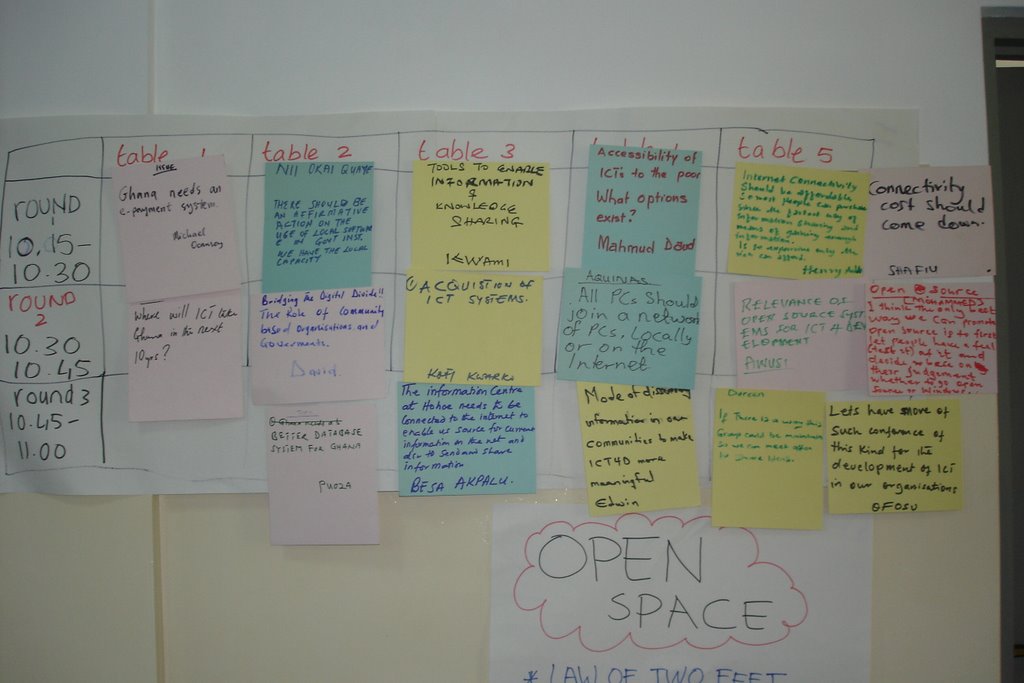
IICD co-facilitated the workshop with a Ghanaian facilitator, in practice IICD's role was to bring in the notion of a community of practice (through a presentation) and (for this group) new methods to get people talking and sharing in a certain way with their practice at the core of the conversation - like tech story telling, open space, and the showcasing sessions. Best appreciated were the story telling and showcasing sessions- open space was considered as too short to get to a meaningfull level of interaction (15 minutes per round). The storytelling worked amazingly well- in groups of 7-8 people, each talked for 10-15 minutes. Even though we had had an introduction session (geek dating), the stories were so telling about the core of the work of the ICT4D technicians, and made it so clear how they worked. It showed some clear connection between people (like all the virus and worm solving stories), but also the variation in jobs- we identified some 6 categories out of it. The methods invoked lively discussions - at some point someone noticed we 'forgot' to do any icebreakers. Some participants mentioned that over the workshop they got some solutions to problems they had been struggling with. The most insightful discussions were generated as a result of the fact of having people from different background- eg. software developers from the private sector and technicians with a development task in an NGO. One of the insights was for instance that NGOs do not have the ideas and purchasing power to commission the development of specific, tailor-made software applications- whereas commercial developers work mainly for the commercial sector- hence the situation where few appropriate applications are generated.

At the end all expressed the interest to continue as a group exhanging both online and face-to-face-and try and enlarge the group. Besides GINKS, who volunteered to take a leaderships role here, 4 people volunteered to place similar roles. GINKS has opened a Dgroup just a week after the event- for online discussion, and it has started up with lots of contributions. This seems to be a group which is very confortable exchanging online and making use of internet groups to get answers to their technical questions.

What I personally learned:
* Though it is hard and complex to organise such an event with 4 institutions, in this case it proved very useful, as all had useful links to offer - for instance the Kofi Annan center brought in the link with the open source community, IICD the link to rural projects, though we could have used more intense communication on the design of the event.
* It seems worthwhile to keep the event short (we had one and a half day) so that the interest is generated but not exhausted.
* It helps to have a common experience during the event like the eclipse :) for bonding.
* It's great to organise this with a group which is not typically workshop-hopping around, but keen on using it to make their work easier.
* For open space to be useful, more time would have to be devoted to it- I have the impression people did not get the chance to find eachother on their passions.
* The chances of success seem higher when you link up with existing initiatives like the Linux groups, the GINKS network- for that it's good to know the field beforehand.
* Finally, I wonder whether we should have identified common projects to work on at this stage. We did not make an effort to pick out a few salient issues or project from all ideas floating around. Let's see what happens.

Practical example: Showcasing your work


During the tech forum in Kumasi participants had the opportunity to showcase some of their work. One example was kasahorow, an open source site which helps translate Akan (Fanti and Twi) and Ewe languages into English. People are invited to help enter data. The example was given that in Ga language there is no direct translation for he word quarter, so the site also works to foster agreement on translations. It reminded me of the sessions with had with our community workers in Mali- translating French into Bambara- they always wanted a lot of time to discuss translations of various terms before going to talk to the people in the communities because they were very unsure of how to translate the french concepts.

Besides being impressed by all that's being developed, it struck me again how communities of practice can provide a space to share and discuss what you're working on and how your working on it, so that others get inspired, and the case owners get some admiration. On top of that, there was really interesting feedback for the developers of the site; people were questioning the need to register first (looks like that is changed already?), and tips like the existence of organisations like the Institute for Languages, which does not know about software, but knows a lot about languages. Though this sounds obvious, it is something which had not yet occurred to the developers. It can improve the quality and usefulness of the work.

I'll refrain from entering my Fanti translations to Kasahorow- I'm still frustrated that my Fanti teacher used to add -oh to an english word and then claim that that was pure Fanti (like office-oh, computer-oh, and bye-bye-oh).

In the next post I'll talk more on my reflection about the meeting. If you want to know the meaning of Kasahorow, you can check it out here

Sunday, April 09, 2006

Communities of practice: Interview with Bill Snyder

At the
Copper website you can find a link to a webcast with Bill Snyder (also called in the same introduction William M. Snyder (?). He talks about what a community of practice is, and how it worked in the case of the Copper group (a CoP in higher education).

A community of practice is a group of practitioners connecting over time to learn and collaborate together. The social component is important as it generates trust and comfort to be able to ask each other questions. He explains the elements of a community of practice: domain, practice and community.

For the Copper group, the domain had been identified during a congress where various campuses could nominate the kind of issues they were interested in, and could rate their interest and expertise to share. Topics were for instance, inclusiveness, service learning and assessment. Various in-campus and inter-campus activities took place like teleconferences, f2f meetings, campus visits and newsletters were produced. The campus visits have an important place because they give a chance to see practice in context.

At the end the interviewer asks how why a community of practice is important, as it takes up time. He answers there are two elements (I heard four):
1. the research component, researching new teaching and learning
2. the practice- translating research into practice, for instance for a new approach to maths, how to apply it in the classroom
3. professional development
4. reputation building

Communities of practice monopoly


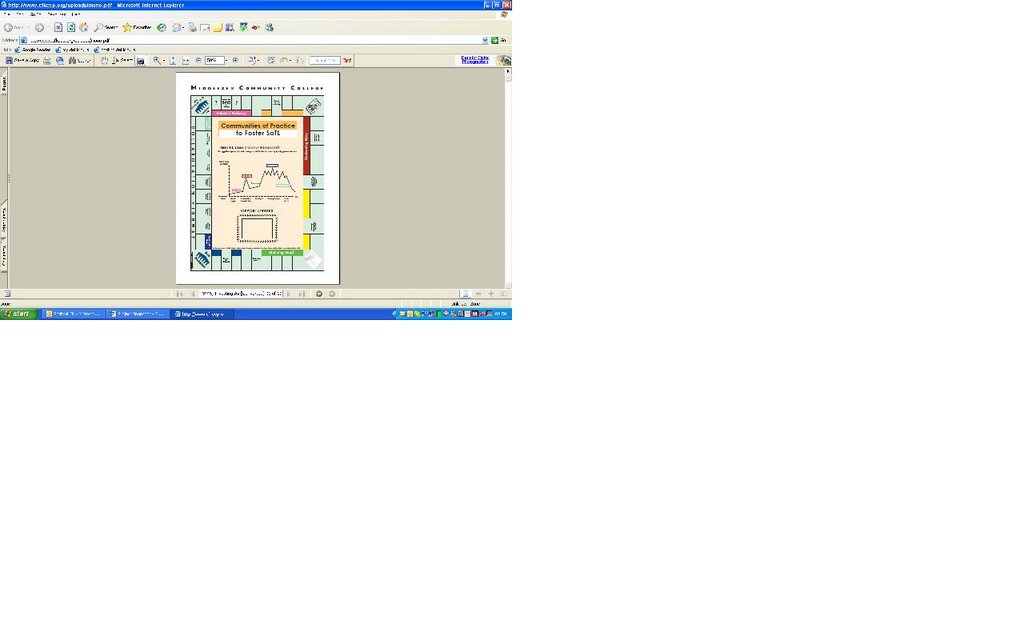
Via Bill Snyder who posted a link on CPsquare I found a CoP monopoly gameboard. If you develop your own cards with questions (didn't see a link to the cards, nor a description of how it was used) it would make for a great self-assessment tool for a community of practice session!

For CRDA I once developed a board game on participation - for two NGOs- the non-participatory one would go fast in the beginning, the participatory one slow in the beginning but much faster in the end. It made discussions on participation so much more practical and was fun to play.

Friday, April 07, 2006

Technology: using mobile phone sms-services to blog


I tried blogging from Ghana (Accra in the picture) using my Ghanaian Areeba sms service from my mobile phone. It worked (though I had to approve it, but that's a setting I can change in blogger). New is also the GPRS service with which you can have internet connectivity via your mobile phone. (but which is said to be costly).

Dorine Ruter asked:
"Technologies to connect mobile phones to email to content management tools (such as Blogger) have been around for some time. It can make us all exiting to see the opportunities for content uploading and downloading. I sure know I am! Still, I never heard of anyone seriously using this in a developing country other than western development workers experimenting with tools. Does that mean that it's nice in theory but never will be more than a gadget?"

From my observations in Ghana; the sms to email service is seriously marketed, and might be an interesting application indeed, for instance sending information to a mailing list. sms is so common: I sms-ed much more in Ghana than in the Netherlands (I must admit this is due to my 'age group' not being active sms-ers :)). Personally I'd not be a serious blogger by sms: the fun part of blogging for me is seeing your post appear, otherwise it is really like throwing some text in the air... but the most amazing thing is that things change so rapidly. So talented people might if there is a rationale for doing so.

And nemik responded on my blog: Speaking of SMS, I made a small site over my spring break from university that allows people to update/post to their blogs via sms. It works from anywhere in the world too. Check it out letmeparty. Apparently this is an attempt to blog by sms. I'm curious where Nemik lives...

Wednesday, April 05, 2006

Technology: energizing communities in Ghana


In this webcast Mrs. Rosemond Kumah, the coordinator of ISODEC in Tamale, Northern Ghana talks about the way a video attracts people in a community in Ghana and influencing their thinking about girl's migration to the south. I made this webcast because I thought it was an interesting story about the way ICTs can support the work of community workers. Just later I thought it could be nice to blog it as well as an example of the way 'new' technologies can influence communication.

I think technologies in general have the potential to be exiting- and get people enthusiastic. At the same time, it is the art of the facilitator to present it in a way that it is energizing. Access to more ICT facilities can hence widen the range of interventions a facilitator can draw upon.
Powered by Castpost

Sunday, April 02, 2006

Technology: a Ghanaian bookmarking site


During the Tech forum in Kumasi, Ghana, people showcased some of their work. Amongst all amazing work, Henry Addo (not in the picture unfortunately) showcased his Webmark site, a free (open source) online bookmark manager.
Henry uses mostly cybercafes to access the web, and used to list his bookmarks on one of the computers in the cybercafe. When he found someone using the computer with his bookmarks, he used to get annoyed. Out of this need, he decided to develop an online bookmark manager.

We compared his bookmark manager to the way I use del.icio.us. Henry felt delicious is too chaotic and takes too long to load. But he likes the public nature of the bookmarks and intends to work on incorporating that feature into Webmark. The intention is to expand the site, but keep the service free by getting advertisements on the site.

I think this is a great example of appropriating technology design for localised solutions. Even though there is an enormous amount of bookmarking solutions readily available, a Ghanaian developed bookmark manager will suit the needs of the cybercafe visitors much better than some of the readily available online bookmarking systems.

Saturday, April 01, 2006

Technology: Young bloggers

This is what Sil (4 years) likes to blog. The dog's name is pluisje and he jumps.

Thursday, March 30, 2006

Technology and the eclipse in Ghana


As part of the tech forum- a meeting to bring some technical ICT4 development practitioners together to talk about their practice- we watched the eclipse in Ghana. It was amazing to see how cold it became and how weird the light was. More reflections about the forum later- but the biggest hits were the tech stories and the tech demos.

Wednesday, March 29, 2006

SMS To Email

this is a test to blog by mobile phone from tamale. No more technical bandwith excuses not to blog in ghana... )

Thursday, March 23, 2006

Technology: the relevance of web2.0 in Ghana

I did a presentation on web2.0 today in Ghana and thought it would be quite web2.0 to blog some parts of the discussion before sharing it with my colleagues... :)

Web2.0 was seen as very interesting, new and mindboggling. It comes with some preconditions: having the equipment, being connected and willing to communicate in an open, transparent way. Lots of ghanaians miss the skills to convert their thought into prose, which is needed to be an active contributor to the conversations on the web. Blogging could be a nice way of practising and nurturing that skill in my opinion or you may think of podcasting/webcasting.

The discussion about the relevance of web2.0 quickly shifted to a discussion about learning how to use technologies. Mostly people learn it via their peers, relatives and other groups they belong to. It was said that men might have an advantage when they tell eachother the new tricks over a beer. Learning has to be linked to a purpose and a personal interest, and then you may be able to be a self-learner via the web; yet most people are not able to do this. Experimenting with the web2.0 tools is most useful if linked to a real, useful purpose (but to know the usefulness of a tool you have to experiment with it, so it's also chicken and egg).

Talking about mobile phones, we ended up learning something very practical about the possibility of sending an email using Areeba's SMS service...(sms the email address space and the message and dial 1313!)

Wednesday, March 22, 2006

Technology: embeddedness and escape in Ghana


Don Slater and Janet Kwami wrote a very interesting paper talking about social use of technology in Ghana: Embeddedness and escape: internet and mobile phone as poverty reduction strategies in Ghana

From the abstract: " The paper argues that Internet and mobile phone use represent two opposed configurations of ICT use, rather than a single movement into an ‘information society’. Moreover each configuration exemplifies quite different poverty reduction strategies deployed by poor urban Ghanaians. Internet use is widespread and is predominantly used to chat with or email foreigners, generally in the North, as part of a strategy of accumulating foreign social, economic and cultural capital; it is part of a poverty reduction strategy of ‘escape’ that is generally conducted in a fantasy modality. Mobile phones, by contrast, are used to manage existing and embedded social networks, the complex family, business or
social connections that constitute both resources and obligations."

The story about the use of internet is amazing, the internet is a chat connection for brief encounters with foreigners. They interviewed a 14 years-old called Asma and describe her use of internet as an example. She uses the internet to get into contact with foreigners like she used to do with penpals. She has 15 MSN windows open at the same time, getting into contact with people abroad and adding them to her contacts list. She feels her experiences are broadened by these connections. By contrast, mobile phone is use very pragmatically. Michael, for instance, flashes the same five people every morning (flashing is phoning without talking). Two of the flashes are to young female relatives boarding at a school in Accra, over whom he has a familial watching brief. The flashing discharges these obligations which would otherwise involve considerable inconvenience and worry. His other flashes are to friends he went to school with and now live in another city.

The conclusion is: if we want to get anywhere, we better start from where we are. An understanding of the use of these media can lead to better strategies for NGOs and government. For instance, internet use now takes place in a vacuum, and is solely used for communication rather than informational use. There are some very practical and small scale suggestions made:

. public information posters listing useful websites and how to access them,
to be displayed in cafes, schools, churches and clinics;
· the enrolment of information intermediaries such as local teachers, religious
figures, health workers, café owners and operators, through local meetings
and training. This will inevitably involve public-private partnerships and
new organizational structures to involve ICT stakeholders;
· connecting informational resources to the actual communicative uses of
Internet and mobile phone, by focusing on chat rooms, listserves and email
rather than websites, or by distributing information through SMS;
· focusing on mediating information through a range of media, rather than
attempting to shift Internet and mobile use: egg, enrolling information
intermediaries (such as local youth groups) to source information online
which can be disseminated through posters, leaflets, loudspeakers, local
meetings and local radio.

Tuesday, March 21, 2006

Culture: inburgeringstest


Ousseini Zongo sent me the link to the nationale inburgeringstest:


In de test komen vragen aan de orde die te maken hebben met kennis van Nederland: de Nederlandse samenleving, geschiedenis, gewoonten, normen en waarden. De vragen zijn opgesteld door dezelfde deskundigen die de echte inburgeringexamens samenstellen. Zo is De Nationale Inburgering Test een realistische afspiegeling van het examen dat nieuwe Nederlanders afleggen, voordat zij echt Nederlander kunnen worden. Er worden ruim 36 vragen gesteld. Wie minder dan 80% van de vragen goed heeft beantwoord, is in feite niet voldoende ‘ingeburgerd’ als Nederlander.

In short: the test contains questions dealing with knowledge about the Netherlands, society, history, habits, norms, values. It is a realistic example of the exam that new Dutch citizens have to pass. There are 36 questions and if you have less than 80% (29 questions out of 36) you are not sufficiently 'ingeburgerd'.

Ousseini scored 6.5 (you need a minimum of 5.5). I tried and got only 4.7 ! So I'm not really 'ingeburgerd'! I had 25 questions right, which is quite something. I correctly said that if your colleague gets married and you are not invited, yet you want to do something, you send a card, instead of giving a present or money. And I knew that you have to collect your driving license at the municipality. I knew travelling from Amsterdam to Enschede by train will take you two hours, not one or three. But if you smell gass in your house I shouldn't close the gass tap but rather open the windows and call the energy company.

The inburgeringstest clearly doesn't do justice to the diversity within the country (otherwise I would have passed :)). It would be an interesting means of making habits discussable, but as an exam with right and wrong answers??

Technology: does 40+ hamper innovation?

On Saturday the newspaper had a great interview about the gap between the internetgeneration (screenagers) and the rest (40+): I didn't want to blog it because it's in Dutch and only for subscribers, but I'm still thinking about so here we go after all: Does 40+ hamper innovation?

It's a double interview with two workers, 44 and 24 years old, Ruud and Liza, working together in an advisory job. It's amazing to read how different their working approaches are: Liza does a lot of multi-tasking, phoning and searching the net for instance, whereas Ruud can only do one thing at the time. Otherwise he feels stressed. He can also be disturbed seeing how other people do many things at the same time, wondering if they are paying sufficient attention. In the client organisation, Liza ran arround fast. After a few weeks, Ruud asked her if she had seen a key contact in the organisation- she hadn't but she had built a good trust relationship by e-mail with him. Ruud was amazed and assumed you have to see each other in the eyes to build a trust relationship. He is often amazed by her speed of thinking and the amount of information she can process. Liza feels her talents are not sufficiently exploited because the older managers don't understand the different way of working of younger people. She has the impression they often see her way of working as a threat. At the same time, she did see value in Ruud's approach because it yielded a lot of quality information -even though she feels it's time inefficient to invest so much time in travel and talk.

I'm currently experiencing linking by internet as a whole new way of building relationships, though I'm sure I'm not as fast as Liza. Last november, I met a group of new people, and with one of them, Dorine, I hardly talking during the day, but we found each other's blogs- mailed- and exchanged intensively on overlapping interests via the web- in a fluid and easy way. I easily know what she's working on and can find linkages and synergy between our work without much time investment.

So it's an additional layer of building relationships- which I've even experienced with people online in Ghana. Therefore, in my opinion the 'digital divide' is much more about people with and without online skills than a north-south divide. Netsquared is collecting cases of NGOs who are early adopters of web2.0 tools and have more cases in Africa than in Europe; see their map with NGO cases....

Saturday, March 18, 2006

Technology: some blogging reflections

I got two comments on my last post: my husband commented verbally that my English is deteriorating and Cindy Hoong said the following:

"Blogging generally speaking is a voluntary job. Most bloggers use blog to achieve whatever they set out to achieve. I have read blogs from PhD students looking for feedback, or blogs looking to promote thier knowledge and eventually hope to get a dream job in the area of their expertise, and other bloggers looking for other goals etc.

I happened to know two persons that fit in these two examples respectively, PhD student and Dream job. AND NOW they both still blog, but occassionally. Recently I learned about two bloggers, I would say well known, decided to give up blogging. One already stopped (some hit I read somewhere that might have conflict-of-interest with his 'real' paying job), the other is slowly phasing out. SO, what are all these tell us? Blogging as a volunteer, generally will not last. Most bloggers drop out like flies in the very beginning, and those that persist generally would still drop out ONCE they achieved their goals. Goal is what keep blogger blogging. Take away their 'goal', there is not much to blog. Simple human behaviour. "

That makes me think about my blogging habit: will I stop when my goal is finished and what's my goal really?

In my six month of blogging, it's really become a habit to process what I read or hear by blogging about it. And so far I like taking that extra step to get my thoughts together because it supports my own learning process, like talking to people helps you to articulate your thoughts. I have never read the full blog since I started, but plan to do that soon. Since I started to tag my posts (a next project would be to get a search button), I also like using my own blog as an archive. For instance: we will have a meeting for the technical champions in ICT4D in Ghana on March 28/29 (during the eclipse!) with the objective of stimulating knowledge sharing between this particular group of practitioners and link the urban and rural expertise. While preparing that meeting, with the help of my delicious I could easily track down practical examples to get some inspiration (for instance this post about CARE's practical experiences), so my blog is first and foremost suiting my own information management. On the other hand, there are many interesting conversation and observations I have which I don't blog because of privacy reasons, which limits the depth of reflections as compared to an offline learning journal (but this is balanced by the positive feedback I get on my blog).

To improve my English, I will try to reread my posts before hitting my 'publish post' :)

Friday, March 17, 2006

Technology: Dutch bloggies

The Dutchbloggies award (honestly: this is NOT translated) is won by sargasso a Dutch group blog. Radio online has an interview with them, as well as with Wim de Bie who won his second Dutchbloggy. Sargasso has won the award amongst other reasons because during the time of the referendum on Europe, they read the whole constitution bit by bit and blogged about it. After winning, their whole site was down because of the high number of visitors. In their experience blogging about your own field of expertise works best.

Wim de Bie (famous Dutch television comedian) is one of the pioneers in experimenting with weblogs in the Netherlands, and now paid by the public broadcasting (publieke omroep) company VPRO and has at times upto 200.000 visitors per day; easily competing in audience with television programs. He is working fulltime on his blog/vlog and what works in his experience is blogging on a daily basis and incorporating personal items.

Soon coming up there will be a weekly newspaper, filled with blogposts.

Thursday, March 16, 2006

Communities of practice: the cock and the jewel

I have added CoP to my delicious inbox and get some new resources through that channel. Like a page with CoP documents including a NAVSEA CoP guide
In the guide I found the following story which is illustrative of the way information has to suit needs of individuals and does not have universal value:

The Cock and the Jewel
A Cock, scratching for food for himself and his hens,
found a precious stone and exclaimed: "If your owner had found thee, and not I,
he would have taken thee up, and have set thee in thy first estate; but I have
found thee for no purpose. I would rather have one barleycorn than all the
jewels in the world."

(Organisational) culture and conversations

David Gurteen has started a series of 50 webcasts under the title 50 lessons, this month with Lynda Gratton, Professor of Management Practice who talks about the power of good conversation.

She argues that it is possible to know, just by witnessing how easily people engage with each other in meaningful conversation, whether or not a company has potential and was energized. Companies which recognise the power of good conversation and communication realise that conversations are not just about facts – they involve people’s emotions too, in some conversations people bring their whole self to the conversation. At the same time we are busy running around and bewitched by our agendas, so we don't give ourselves time to talk about things which are important for the work. The way that senior executives behave sends very strong messages to the people around them about what’s important and valued in that organisation, if senior people engage in good conversations they give others permission to have them too.

We just had a workshop in my organisation and discovered that the women are seen (by both men and women) as bringing a process orientation to the organisation, whereas the men were seen as bringing, among others, output and a results orientation. I'm always worried about over- generalising these differences, but those were the associations people had. Interestingly women's orientation was associated with 'social talk' 'talk' and sometimes even 'gossip'. Having powerful, authentic conversations suddenly sounds much more like work than social talk or gossip!

The webcast is accompanied by a lesson summary, ideas for actions and questions to ask. Two of the lessons which accompany the webcasts ring a bell:
- Do not reprimand people for talking about work. Encourage your staff to have conversations at work, about work, by prompting discussions yourself. Conversations are not idle chatter; they are an essential way for your people to communicate properly.
- Consider banning email for minor internal communications – encouraging people to talk will foster good conversation, as well as get people moving around the office.

Trying to link it to communities of practice: CoPs have the potential to offer the protected space for practitioners to engage in these conversations. Yet- it can be easily be perceived as 'too much talk' and possibly there's a danger that these conversations don't transpire into the rest of the organisation?

Monday, March 13, 2006

Practical examples: The community empowerment network in Central Asia

Erik Caldwell Johnson wrote a Capacity Development Brief on the Community Empowerment Network, a community of practice for local capacity in Central Asia. The World Bank and Europe and Central Asia Region (ECA) launched this network in 2002 as four national networks linked through regional activities that would build the capacity of communities and development partners to implement community-driven development (CDD) projects. CDD describes projects that encourage local communities to control the direction of their own development from project conception through implementation and evaluation. The Network works for Azerbaijan, Kyrgyz, Tajikistan and Uzbekistan.

Note that we get the word community at two level: community-driven development and community of practice- this is sometimes confusing in CoPs for development. And I was actually surprised because about a CoP for community-driven development, as it seems a common development paradigm in the south since the 80s already, maybe not so in Central Asia?

The modalities used are for national-regional interaction: a local NGO from each country manages each national network by facilitating annual action plans, managing funds, reporting, chairing meetings, etc. A steering group, a multistakeholder group designs and approved the action plan and budget at country level. In the first year, national partners undertook a mapping exercise to identify all international and national groups working on CDD activities. To complement the national capacity development with regional networking the World Bank brough national networks together by means of monthly videoconferences, annual conferences, regional websites and e-newsletters.

Under principles it is important to note that apart from the 'regular' principles like multistakeholder participation and partnership there is the principle of informal structure. It means there are no membership criteria, no special bank accounts, nor by-laws for its operation.
(this is different from IICD's experiences where the fact that a network is established which will handle funds, in most countries leads to legal requirements to register the network and draft by-laws etc.)

After 18 months, external consultants performed an evaluation: Community-to-community knowledge sharing, public awareness building, local partnership and CDD institutional capacity building had worked well. Moderately well worked the government involvement, regional exchanges and linkages to the World Bank operations. Face-to-face interaction was most successful in facilitating interactions at a national level, the videoconferencing inspired less exchange and the e-mail list saw only modest use.

Activities that did not work well were the donor coordination, measurement of progress and regular interaction amongst practitioners: most international agencies were not as involved in the network activities as the local community members. (= local NGOs?)

The lessons they want to share are:


* Peer review among countries has great value

* Focus on national or community organisations as international agencies are too busy

* Establish clear indicators of progress (World Bank toolkit offers some ingredients of success as a starting point)

* Promote flexibility in contracts or agreements

* Take a long-term approach to evaluate 'social capital' - impact cannot be measured by the number of people who participate

* Strike a balance between community of practice priority setting and World Bank country strategy (too much involvement of World Bank staff is essential- too much may diminish ownership by community members

Comparing this to my personal experiences in Ghana, I can relate to the flexibility in contract- supporting a network in ICT4D in Ghana, we have just created a 'responsive' budget line with non-earmarked funds so that GINKS can be more flexible in organising activities in reaction to what emerges spontaneously amongst the members or in reaction to policy developments. The last point of striking a balance between the community of practice priority setting and the donor's is very important too- but easier said than done. My yardstick is whether my input is energizing or de-energizing the network- and I'm trying to measure this informally. Something else I try to do is purposely create various options while advising - not just one, which gives room to see in which direction people choose. The lesson to focus on national organisations as international are busy puzzles me- it could be interesting to draw in the international organisations as they may bring a new (fresh?) perspective.


Culture: the power of the Dutch human mind

Cindy Hoong asked whether the power of the human mind to read messed up text would hold in Dutch (and other languages). It is not difficult to do a short test in Dutch:

Dit is een meiojlke tkest oevr het fmeeenon van de kahcrt van het mjelnesik biern. Eglinejk is het mekakjikr om gownee slelnpig te tpeyn doaarm maar een ktroe tkset dzez keer, ik doe heir al vjeitifn meutnin oevr. Bibakraljr weet ik ook neit zveeol lnage woeordn.

I don't know how easy it is to read it in Dutch, but my impression is that turning around of the coupled letters (ei, eu, ij, etc) makes it more difficult to read.

Friday, March 10, 2006

Culture: communication by text and the power of the human mind

Mirjam Kesseler sent me this from Bosnia:

i cdnuolt blveiee taht I cluod aulaclty uesdnatnrd waht I was rdanieg. The
phaonmneal pweor of the hmuan mnid, aoccdrnig to a rscheearch at Cmabrigde
Uinervtisy, it dseno't mtaetr in waht oerdr the ltteres in a wrod are, the olny
iproamtnt tihng is taht the frsit and lsat ltteer be in the rghit pclae. The
rset can be a taotl mses and you can sitll raed it whotuit a pboerlm. Tihs is
bcuseae the huamn mnid deos not raed ervey lteter by istlef, but the wrod as a
wlohe. Azanmig huh? yaeh and I awlyas tghuhot slpeling was ipmorantt! If you can
raed tihs forwrad it.

It's very easy to read! This 'phaonmneal pweor of the hmuan mnid' may also explain why a lot of intercultural communication works very smoothly nevermind all the misunderstandings which should be occurring following theory ...

Thursday, March 09, 2006

Technology: trust in virtual teams

John Gundry wrote a paper on trust in virtual teams trying to 'unpeel the onion about trust'. He states people will have a hard time trusting eachother unless they've met. And further in the article: "it is easier to be suspicious of people when they are out of the line of sight. "

I disagree here: I think that the crux of web2.0 is a change of paradigm- it changes trust and the need to meet face-to-face before you can trust someone (even though it might be true for the past and for lots of people, it is not a general truth). Yet, it is a skill to be learned/a mindset to be taken on to be comfortable with people's reaction (or non-reaction) when they are out of the line of sight.

What I like is that in point 6 he states that the first component of trust is predictability, we use the word 'trust' to mean that we believe people will act in predictably good or positive manner. That's exactly how I unpeel trust: it means you know how a person will react (because you've seen it happening, because the person resembles a previous experiences, etc.). 'We can make judgements that others are predictably good or predictably bad through having communicated enough with them.' A team member is trustworthy if he/she:
- Acts in our and the team's best interest
- Is trustful
- Keeps his/her promises or tells us when they can't keep them
- Respects the citation and/or protection of information we send them
- Shares mutually -valuable information with us

Thinking outloud: in communities of practice and web2.0 trust seems to work differently. Especially bloggers seem to have be ready to exchange ideas/opinions on the basis of reading each other's blogs, processes which could take much longer to build trust face-to-face.

It might be nice to make the link to another article on communication and trust in global virtual teams by Sirkka L. Jarvenpaa and Dorothy E. Leidner which also explores the challenges of creating and maintaining trust a global virtual team whose members transcend time, space and culture, in a study comparing high and low-trust teams and looking at the levels of trust at the beginning and end of a team task. They introduce the notion of swift trust: imported expectations of trust from other settings with which they are familiar. This means that if I've been a participant of 10 online forums, when entering the 11th forum, I bring the trust (again: expectations on predicted behaviour of other people) I have built through participating in the other 10 fora. Which explains that once people get more experiences with working virtually, the 'hard time to trust each other unless they have met' will shift. Swift trust de-emphasizes the interpersonal dimensions and is based initially on broad categorical social structures and later on action. (because high imported trust teams can still end up with low trust at the end, if people did not participate as expected).

On a practical note as tip for facilitators: a nice way of demonstrating the fragility of trust to a group is by metaphore is by taking a paper, crushing it and comparing the effort it takes to crush it to the effort it takes to get the paper straight again.

Tuesday, March 07, 2006

Communities of practice: interview with John Smith

Netsquared had an interview with John Smith. That's the danger of delicious: I had tagged it because I didn't have time to listen to it when I saw it first, but fortunately I remembered to listen to it now.

The audio-interview has excerpts only. Unfortunately I couldn't trace the full interview- though I would have liked to listen to the full one- now it kind of jumps between hugely different subjects.

But John stresses the aspects of relationship building in communities of practice- as social contact is the primary vector for knowledge creation. Tacit knowledge is about sharing standards and perspectives whih needs people to spend time socializing. In the online workshop on cops this translates in the practice of letting outsiders interact with the participants and making use of mentors who have done the workshop before to help out and get people going with the technology.

Interesting is the part about online and face-to-face interaction: he is saying face-to-face is too important not to be preceded by online preparations. Technology should not be seen as a substitute for face-to-face but rather as a way of augmenting the value of face-to-face interactions. The other important remark I got was that most of the discussions about technology are vendor-centric discussions- and it's rather the other way around- ommunities jumping around using technology to communicate. Lastly: talking about practices in a very intimate kind of thing. (I think it would be hence be useful to distinguish levels of talking about practices- mm haven't really found any materials talking about that yet)

Monday, March 06, 2006

Technology: inclusion/exclusion via choice of technology

We had a friend over for dinner and discussed changing use of technologies: we had made the appointment by exchanging 2-3 mails whereas 1 year ago, we would use a phone call to make appointments. So she said that's it is important to keep up with changing technologies not to get sidelined (I was showing her my blog and RSS and she was very happy with the discovery of RSS services). Her -younger- brother was surprised that she was sending sms-messages (she had come back from Indonesia where everyone was sending sms' all the time).

Then she wanted to show something on her mobile phone. And found a an SMS from a friend inviting her for his birthday- which had passed already- . She had missed his call because she did not hear her phone in her bag. She just posted a birthday card, not knowing about the invitation. So I told her that next year he would probably stop inviting her at all, since she did not even reply, a slow entry into a final state of social isolation. She agreed that I could blog this :).

Lesson of the week: when chosing a certain type of technology for communication be aware of the assumptions you make about the use of the medium (frequency of use/access, comfort levels, personal preference: having a phone doesn't mean you check your voicemail daily) or rather try to be aware as I also end up with surprises all the time. For instance I assumed that people in the Netherlands are comfortable with e-mail; for a CoP using a mailing list I learned that at the one end a person was subscribed to 100 mailing lists, on the other hand a person felt overwhelmed by the number of messages which wasn't more than 5 per week.

Saturday, March 04, 2006

Communities of practice: interview with Etienne Wenger

Playing around with delicious (I started using my inbox- by adding people and key words -that's fun!) I found a very interesting interview with Etienne Wenger , discussing identity and situated learning. The webcasting system is great because you can choose to see just parts of the interview if you like.

"In this interview Wenger outlines (in clip 1) the constitutive and fundamental assumptions of social learning theory, he explains (clip 2) how the theory can be applied in organisations, how (clip 3) the industrial model of knowledge is being challenged and revisited by the assumption the learning is happening all the time, (clip 4) that learning is not only situated in physical situations but is culturally and experientially situated in ourselves, (clip 5) how practitioners share and develop competence and knowledge together in practiced communities, (clip 6) that there is a deep relationship between individual identity and the participation in communities in the social world, and (clip 7) how a whole new language or public discourse of learning is mostly welcome."

My favorite is number 5 where he talks about examples of CoPs and the case of the Aid Workers Network, a virtual comunity of practice. He states that it's not important if CoPs meet face-to-face or virtually, the question is: "can practitioners engage with eachother in a way that allows them to bring their practice to bear in a conversation". This helps me to think about my suspicion around virtual communities of practice: my fear is that by bringing practice to bear just by conversations, there is room for crucial distortions from actual practice and the way people talk about their practice. Or important 'tacit' elements might go missing. So, nothing like working jointly in actual practice. (but I realize that it would matter what you practice entails; if it is a practice where interpersonal skills don't matter it might be easier).

Friday, March 03, 2006

Communities of practice and innovation

Dorine Ruter alerted me to the Einstein picture (I'm stalking her through my delicious inbox). I'm very interested in innovation stimulated by CoPs. Unfortunately I did not keep the article in the newspaper (Volkskrant) some time ago about Einstein. It did talk about the fact that he used to talk through his ideas with other practitioners. It's still a question for me in how far people need space for their own creative thinking processes (based on experiences) versus interacting with members in their communities of practice.

Technology: blogging memes

Nancy White refered to me in relation to Paul Currion's meme

So here’s my meme: what five resources - online or otherwise - would you point people to, if you wanted to give them an entry into your field of expertise?

Though I'd been tagged before, I did not realise I had to respond too till I saw the others responded, so that's why I'm a bit slow. Secondly. Oef. Your field of expertise.... I hope this is not going into my field of irrigation engineering as I lost hopelessly touch with irrigation. So let's take communities of pratice (for development). 5 resources.. (now I'm thinking back on the way I learned about communities of practice):

1. Participate in communities of practice and observe! Try to work in different roles, I'm still often thinking back on how I felt and experienced my community of practice when I was an ordinary member of a CoP for advisors in Western Africa. (officially this disqualified as a resource, but what do I care)

2. The basic theory in three offline books: Situated Learning, Communities of Practice and Cultivating communities of practice of which the later is a much more practical book.

3. Participate in the seven-weeks Online Foundations Workshop, there will be one in May and September, it takes you about 1-2 hours per day. In September we will organise a parallel workshop in Dutch. Though the name foundations might suggest that it's only for people who know little about CoPs, I find it is even more useful if you have experiences in/with communities of practice and have clear-cut questions.

4. Join com-prac, a yahoo discussion group, which is public and free and knowledge board which has a SIG on communities of practice. You can also add it to your aggregator.

5. Read blogs which talk about communities of practice. I don't have an overview of all people blogging on this topics but Nancy White provided a good entry point. And yes, we are awaiting the blogroll of CPsquare (a community of practice on communities of practice) to be coming soon.

Culture: adapting the Wold Cafe methodology in Thailand

The World Cafe is a participatory methodology, trying to get people to talk about questions that matter to them. Chaiwat Thirapantu describes how this methodology was used to facilitate a meeting of the People's Assembly in Thailand. He writes:

"In 2002, I came across the World Café when I attended the Authentic Leadership Workshop in Halifax, Canada. The Café was facilitated by David Isaacs and I enjoyed the concept of walking from table to table. At that moment, I realized that World Café would fit in a Thai context smoothly. In southern Thailand where I was born, people visit traditional coffee shops every morning for social and political conversation. This coffee shop assembly is called Sapa Ga fae."

After using the methodology in various situation, he was asked by the end of June 2005, to “People Assembly” with 3,000 participants of the opposition party. Using the world Cafe methodology, people talked in 375 small groups on the following questions:
  • From your heart, tell me why did you come here to join the People Assembly?
  • From your point of view, what are the most challenging issues that our society will encounter? Please name it only three issues, and tell us why they are so important.
  • Please tell me five strategic goals that you and Thai society should achieve in 2009.
  • Tell me from your heart. When you leave the People Assembly and return home, what do you want to do immediately? Why? And do you have any suggestion for Democrat party, what should they do as a political institution to guide Thai society to better future?

I remember I once introduced and facilitated a participatory method for a membership meeting of WERENGO in Takoradi (similar to the world cafe, with people working in small groups on a question and going around to the next table). The normal procedure was that the chairperson would lead the meeting and render accounts and few people would ask questions. Many new issues came up, and many members volunteered for various actions. It was a very new way and innovative way of meeting for this group. Actually, without sustained support, I'm not sure this would basically change the way of working of the network, but I know the network is active and its members contribute fees to cover the costs of a coordinator.