Wednesday, February 15, 2006

Technology: wikis, organisations and efficiency


John Barben posted this excerpt from Business Week on wikis. I thought it's a nice follow-up on our web2.0 discussion in IICD. People questioned the use of some of the web2.0 tools because it is seen at time consuming. Probably in the short run it is (and changing habits is energy-consuming as well). But in the long run it may be about more efficient workprocesses. I'm sure mails and meeting time will go down if people write and read about what's core to share with others, and I think the content of meetings may be more relevant to cater for faster organisational learning. At a small scale we are experimenting with wikis and social bookmarking. Now if I mention that we use pbwiki I get my space doubled (now I'm not sure if I need that but here we go..)

Let's see who reads my blog in IICD...

Communities of practice: a facilitation task taxonomy for communities of practice

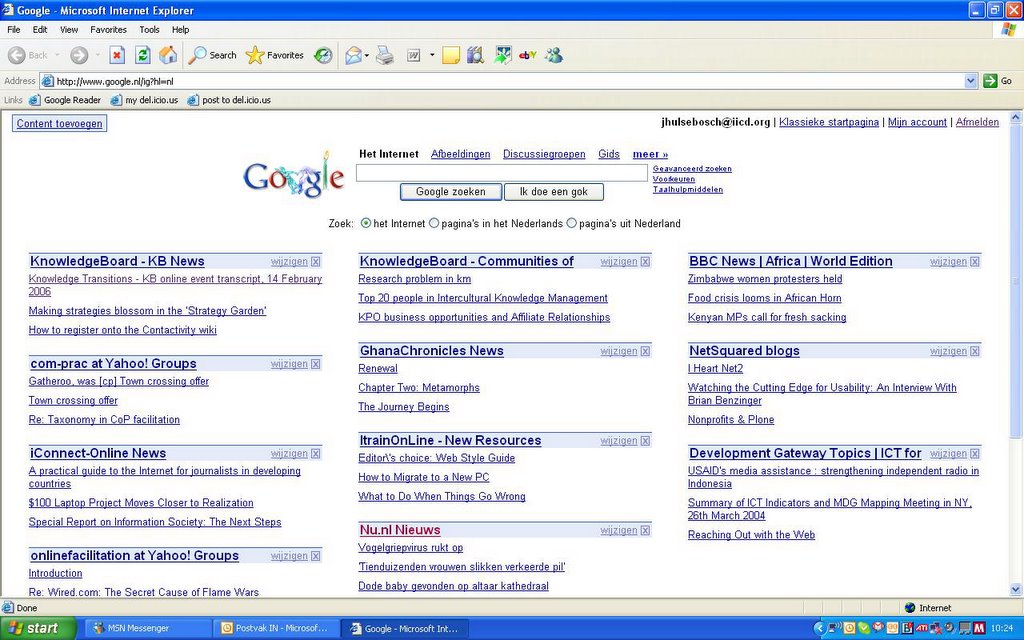
I had unsubscribed from the yahoo group on communities of practice as I was ploughing through my mails rather than happy to read them (not the best mode for learning). But now I have worked out an aggregating system that works for me with google personalised pages as my RSS reader. An interesting alternative for personalised pages (thanks to Chris Addison) is netvibes where you can add more options like flickr photo streams. I have added the yahoo group to my personalised pages, so it pops up and I found Rosanna Tarsiero posting a link to an article on A facilitation task taxonomy for communities of practice by Halbana Tarmizi and Gert-Jan de Vreede (sounds Dutch).

It talks about the role of the facilitator of a CoP which is key to the effective establishment and sustainment of communities of practice. The facilitator role is crucial in making a case for the CoP, finding common topics for members, securing trust of shared information and lowering barriers among members to involve in knowledge sharing activities. Inspired by the facilitator role description work by Group Support Systems (GSS) (is this the same as Group Decision-making Support Systems?) they come up with 33 CoP facilitation tasks. They can be subdivided into two main categories: internal and external.

Internal:
* Information source, providing information to CoP's members
* Inspirator, encouraging members to be active
* Guide, including all tasks that focus on assisting and advising the CoP and its members

External:
* Information source, providing information about the CoP to the outside world
* Public Relations manager, representing the interests of the CoP to the outside world
* Investigator, all tasks concerning searching for and collecting useful information for the CoP and its members.

I think it's good to focus on the facilitator tasks, as it may be underestimated. As a facilitator you may use it as a quick guide to see where you could shift some of the emphasis. Unfortunately the paper does not talk about distributed leadership.

For the first time, I'm now gaining experiences as a facilitator for a CoP on e-collaboration, co-facilitating. I have been a member of a corporate CoP, and external consultant, so it's great to gain practical experiences with this role.

Our recent experience is that we are making a 'phone round' to all participants to find out what occupies them in e-collaboration, what interests them and how they want to continue with the group. It is extremely energizing for us and people we talk to. It's revealing to see some people are gaining valuable experiences and are eager to share/learn together. Some people don't want to participate actively but want to watch to see what's developing so that at some point they may link back to the process. I think it helps to be a practitioner yourself, so that you recognise the issues and are able to relate it to some of your own experiences. I'm convinced that without this facilitator role and the vision to facilitate a more continuous learning process, the process would have stopped at some point in time. So you can't talk about a completely 'organic process', yet you can be conscious about not 'pushing' things too hard. For instance, it was an important indication for us that conversations continued online after the November event, without facilitation. So the art of the facilitator is somehow finding the balance between proposing actions in a inspiring way and providing space to see what emerges (and have an ear/eye for what's happening between members invisible to the online space as there are lots of other links!)

Saturday, February 11, 2006

Communities of practice: domain definition in corporate and inter-organizational communities

Anecdote blogged about Will the community of practice get started? A test and the effect of titles talking about the definition of the knowledge domain of a community of practice.

One pragraphe: I now have a simple test to gauge whether a community of practice might form. When someone says, “I would like to start a community of practice.” I ask, “Can you describe the potential members by completing the following sentence? I am a …..” If they can fill in the blank in a way that people can passionately identify with the descriptor then there is a chance a community might emerge.

I commented that it seems there is a difference between a corporate CoP and large, public, inter-organisational CoP in the sense that their domain definition seems wider.

I would like to share Shawn's answer on my own blog: I think you are right Joitske. The ActKM (a public CoP) was named with a scope covering all of knowledge management. There have been a number of times when we think that the scope should be narrower but such a move would significantly fracture the group. In ActKM's case the scope has emerged from the conversations. For example, you are unlikely to see a deeply technical discussion on ActKM but you will find many theoretical discussions on ways to view the discipline. The discussion act as an attractor for certain people and a repellent for others. It's for this reason why I think you can't be too rigid with defining the scope. It will adapt with the needs and interests of the members.
Another way to look at the scope is to think about the level of abstraction occuring in the discussion. If the discussion is too detailed for the audience the audience will get bored and leave. If the discussion is too high-level and assumes everyone knows the jargon and acroymns the audience is unable to understand and will leave. Like the three bears the level of abstraction in the discussion has to be just right.


Though the knowledge domain of a community may change over time, it seems that the initial name is important for including/excluding people. For instance, the name e-collaboration for the development sector is vast enough to cover a wide range of experiment with collaboration at a distance, but specific enough for certain practitioners to identify with the domain.

Friday, February 10, 2006

Practical examples: Km4dev


Talking to people from MDF, a training and consultancy firm, we had to conclude that there are few practical examples of communities of practice in a development context, so I'll try and search harder (haven't even started the whole km4dev journal for instance). I'm not sure if there are no examples, but there may not be many well-described cases of how communities of practice were intentionally nurtured and leveraged for enhanced knowledge sharing and innovation for development.

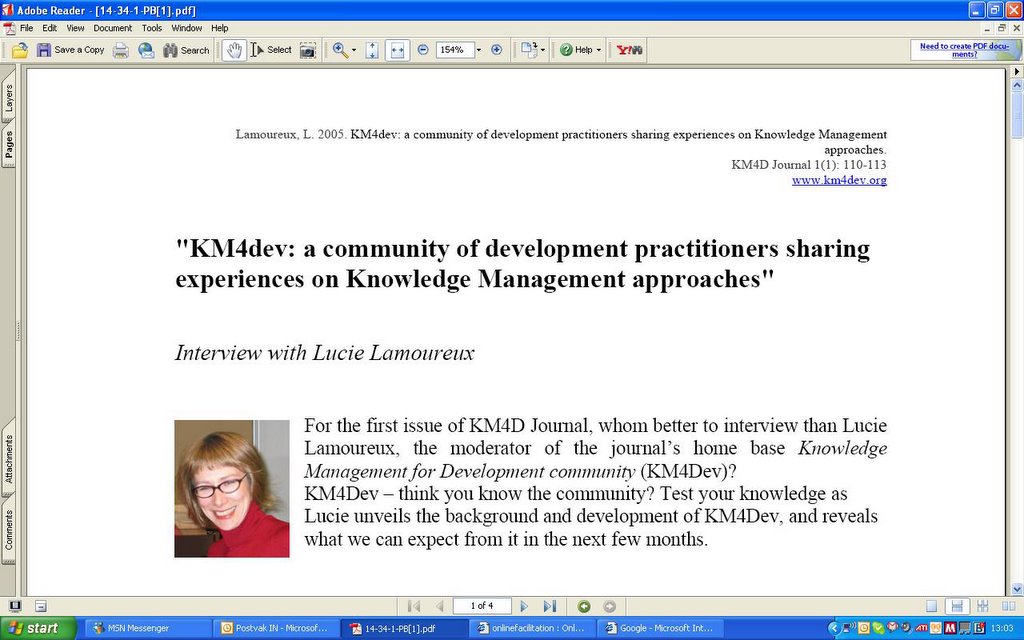
One example of a community of practice is the KM4dev community and I had the honour to to talk to Lucy Lamoureux, the coordinator, somewhere last year, about the same time of the publishment of an official interview with her in the km4dev journal She describes the Km4dev community as a group of development practitioners working in knowledge management and knowledge sharing who ask for advice and receive quick responses from peers. The community grew quite organically after two workshops organised in the year 2000. Now, after 5 years, it has about 385 members, with about 35% of members based in the south. There is a core group of about 60 people who know each other well and have met face-to-face. The process confirms the literature which states that networks need at least 5-7 years before they mature. From the beginning, some gurus in the knowledge domain were involved, as well as the World Bank, an important player in the field of Km4dev. In the beginning there was more sharing of information and resources, lateron people engaged more in asking questions and theories.

The main communication tools are the discussion list, km4dev site (where you can also subscribe to the list), which acts as a repository where members can post profiles, document, etc, and last but not least annual face-to-face workshops. From 2000-2004 Lucy was the sole coordinator for the community, but then a group of 7-8 volunteers was formed who are helping to facilitate, write, interview, etc. A big challenge is to engage the people who can only participate online, versus the group who meets face-to-face. When I asked Lucy about her role, she called it a kind of 'watering', facilitation behind the scene. The watering consisted of asking people to contribute; when hearing a story convincing people to share it and phoning people to find out what's happening.

Communities of practice: the organizational frontier

I think the article by Etienne Wenger and William Snyder called Communities of Practice: the organizational frontier is still a very good basic article, talking about corporate communities of practice. Since it's a Harvard Business Review article I didn't think it would be available on the web, but it is!

It is this article which inspired me and other members of a community of practice of advisor from SNV in West Africa some 5 years ago because it explains the differences between a community of practice and a work group/ project team and informal network so clearly. And it helped us see we wanted a community of practice whereas the management had more a sort work group or task force in mind, so it supported us in clarifying our ideas and understanding the differences. It supported a shift in the membership to include more of the advisory practitioners with similar practices in different countries.

A community of practice is held together by passion, commitment and identification with the group's expertise, and hence membership should be voluntary (at least not appointed). Whereas a work group may be appointed and the task and deadline clearly identified and monitored by a management. This leads to the management paradox: management has less control over a community of practice. A community of practice has to develop measures to show the (often intangible) benefits as compared to the preconceived tangible outputs of a project team ('set up a training and prepare a module' type of instruction). And although communities of practice are informal and self-organizing, they benefit from cultivation by management which can identify them, provide the infrastructure and use nontraditional methods to measure value. This doesn't mean that management can not give any instructions, ideas, or tasks but managers have to be skilled in energizing the community rather de-energizing it.

More and more I'm seeing the parallel of this management paradox for inter-organisational communities of practice: the agency or organisation(s) funding/advising the community of practice will also have to struggle with a similar management paradox.

Thursday, February 09, 2006

Technology: gender and politeness in Computer Mediated Communication

Prof Asha Kaul and Vaibhavi Kulkarni wrote a paper with the name of Coffee, Tea or...? Gender and politeness in Computer Mediated Communication. They studied computer mediated communication (CMC), specifically work related emails in the Indian context (494 mails written by men and women were analysed). By the way: google images on politeness show up as scenes from previous centuries ...

They notice that "CMC provides a link between oral and written communication, producing a categorical change which affects not only the notion of what the conversation is but the speaking-writing dichotomy as well. CMC is not restricted to formal, organizational emails but is also widely used for informal communication. Gramatical markers are used and exclamation point and question marks added as well as emoticons." " CMC can facilitate emotional content and inequalities of status and expertise are reduced in task oriented CMCs."

Though not all researches share a similar view, one research cited in the paper states that rule of politeness governing face-to-face conversations seems to be less binding when there is no physical presence. And in mails there seems to be a sense of anonymity which could encourage people to be impolite and express their hostility or resentment explicitly. One cited research observes that employees communicating with their supervisors through email might lose their supervisor's sense of status and could end up in miscommunication.

Looking at gender, the study cites a lot of researches which found differences in language, with for instance, women using more 'graphical accents' than men. On the other hand more recent research suggests that men and women use interaction patterns which are organizationally fit rather than gender specific. In this study, the examples of adherence of politeness maxim was higher in women than in men. Mails written by women showed hesitancy to openly contradict or disagree. Mails were more appeasing and tentative rather than firm and clear. But looking at 'clusters' of answers, they use of language was more contingent on the needs of the situation or the organization.

They conclude amongst others with the statement that disparity between the intent of the sender and the message transmitted would need further research. I think that this is somehow the point. (and now completely non-supported by any research): The way people write (on similar tasks) is probably influenced by their gender, cultural background but also ease and experience in writing. For instance as an example of the cultural background: in the paper men for instance used flattery more than women in their emails, with contradicts other literature. A possible explaination can be found in the cultural background of India.

So realizing that messages may be misunderstood, you become more conscious about the way you write. That's actually why I try to write my mails always just slightly more positive than I would in talking. And it is of course an important point for online communication in international communities of practice which demands from the facilitators and participants alike not only the skill to write clearly, in a way which will be easily understood by people reading it with different mental models, but also the ability to read between the lines.

The other interesting thing here is the reduction of inequalities of status, because that would mean that people who feel inhibited to express themselves in a certain group due to this factor might find it easier to do so online (in computer mediated communication), which opens up the opportunity to hear voices which may not be heard in a similar face-to-face group.

Monday, February 06, 2006

Technology: my pathway into blogging

Tomorrow we have a seminar in IICD with Chris Addison on blogs and RSS and I'm asked to present my 'pathway into blogging' . So I thought of preparing it in my blog (to get away from powerpoint). A lot of 'how tos' already deal with the technical part- but that's the easiest.

I think there are 4 elements which contributed to the start of my blog
1. When working as an advisor in Ghana I got into the habit of documenting my experiences and I started liking the process of documenting systematically and formulating explicit lessons.
2. I saw a few topical and professional blogs that I liked and inspired me as an example.
3. I read a lot about communities of practice for development and thought there were not many good cases and materials available, so I had a clear topic I was eager to dig into.
4. I discussed with various bloggers who encouraged me to start.

After starting, it is kind of scary and you have to find your own voice, topics and blogging rhythm for instance you have to consider:
- Do I write about myself (lifeblogger) or I refer to materials (linkblogger)?
- Do I blog daily, weekly, monthly or whenever I feel like it?
- Do I only write for myself or do I focus on some kind of audience?
- How do you write about people you met, the job you have (after all it's very public).
- Do I focus on the lay-out and features, add audio, pictures or videos or not?
- Do I stick to my topic or wander off?

In my case, I felt very encouraged (and sometimes embarrassed) when I started to connect to other people by eg.:
1. receiving a comment from people I know on MY blog.
2. getting positive feedback by e-mail.
3. receiving comments from a stranger.
4. sending a link to a book author I blogged and receiving a positive reply.
5. meeting someone who knows your blog but doesn't know you.
6. installing a sitemeter and seeing people from Japan, India, Russian Federation are visiting my blog.
7. being announced/pointed to/quoted in a virtual place.
8. meeting a friend f2f and having a conversation on something you wrote on your blog.

Blogging works for me because:
* I installed a blogreader (bloglines) and starting to read other blogs systematically. Having my own blog made it more sensible to read other's blogs. It is a different way of building a network and learning from others, especially about good resources on the web but also about their lives and thoughts.
* It encourages and supports my own learning process, eg. blogging an article forces me to think through the main points, and I have a good and solid archive of what I read.
* It is a personal, dynamic and easily accessible way of writing/reading. Faster, easier to read and less polished than articles in journals and more personal/deeper than discussion boards or e-mails.

Practical examples: identifying communities of practice throught storytelling


Seth Kahan and Madelyn Blair wrote a short paper on the identification of communities of practice in the World Bank. I blogged it already, but it mysteriously disappeared (I tried haloscan maybe that's the problem). So again:
Kahan worked in information systems in the Bank for 11 years, so he was a real practitioner, when he tried to breath life into a community of practice on Information Solutions. His first step was to identify the existing informal networks and focus efforts on nurturing them. He brought in a consultant, Madelyn Blair, who could speak their 'language' too. They handpicked 20-30 movers and shakers, all inspired veterans.

The veterans were each asked to share a story about a work assignment that was especially exciting. The stories changed to energy in the room noticeable. People were leaning in and listening closely to each other. Over the next days, they worked to identify common themes and began to identify 9 groups.

The paper gives a sample story as well as 7 guidelines on how to use storytelling to identify communities of practice.

Technology: the potential role of blogs in changing development


ODI has started a blog with commentary from leading development experts.
Enrique Mendizabal blogged about blog development, blogs. He sees the value of blogs and other social technologies to bridge the IT gap between resource rich civil society organisations (CSOs) in developed countries and those in developing countries. It awards small CSOs in developing countries access to information and participatory spaces otherwise closed to them. He mentioned www.civiblogs.org as a platform specifically designed for CSOs, but when I clicked on it, it was not available.

Blogs may well he on track to overthrow the traditional 'thinking spaces' of the development sector, he continues. Blog links can foster debates and aggregate scattered knowledge. Blogs can be monitoring and evaluation tools that when used systematically can replace tedious, long and expensive traditional methods. (mmm, a lot of expectations for blogs!)

Friday, February 03, 2006

Technology: mashups


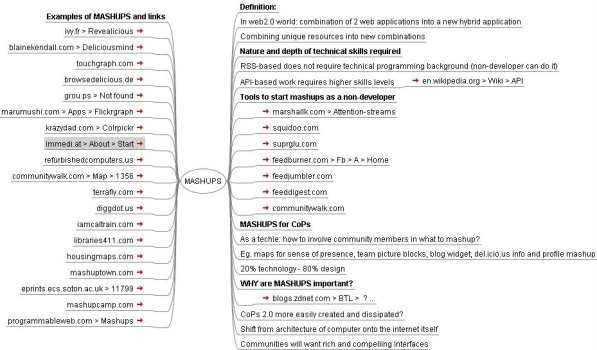
I summarized the discussion on mashups in CPsquare (see picture, if you want to read it you may have to save it and enlarge it). I feel like I summarised something I don't fully understand, but maybe that's also a function of a CoP to learn about completely unknown waters. When I feel I just start to grasp blogging, talks move to mashups.

It's hard to decide if this is important when talking about communities of practice for development. But I guess the concept in itself is useful: making a hybrid of two applications, and that it's within the reach of non-developers. So ample scope for more appropriate and tailor-made applications I would say. Since a lot of mashups do a combination with maps, this leads to more visual representations and that may be very useful in development (eg. in PRA drawing and negotiating maps with farmers is such a powerful communication tool). Just don't know if you can do what is done in the US for countries in Africa. I have found the place in Mali where we lived in google earth, but it is quite at a distance .

Thursday, February 02, 2006

Technology: blogging game 4x4


I was tagged by Beverly Trayner for a 4x4 game. (My association with 4x4 is a four-wheel drive but this is about answering 4x6 questions). Usually I'm not really a fan of chain-letters (kettingbrieven), but when I clicked on the tagged by.. tagged by.. tagged by.. tagged by..I got to the source and I liked the way you can trace the chain. It wasn't really explained that being tagged means that you have to answer all the questions, but that's what everyone did, so I will answer the same questions (I noticed some questions changed along the line):

4 jobs I had:
- Secretary at the gender department in Wageningen (fired after 1 day)
- Researcher on 'vasijas de ardecilla' for El canelo de Nos in Chile
- Organisational advisor for CRDA, an NGO umbrella in Ethiopia, based in the containers before they moved to the new building
- Knowledge sharing program officer at IICD (started in November recently, but so far a great job)
(I this way I skipped the Johnson and Johnson factory where I had to count the number of hygienic pads in each package and which did not really contribute to my career :))

4 places I lived:
I my case that's almost the same question as the first, during a job interview someone said my CV looks like a countries CV:
- Heteren (lived in the 'woonwagen', a house on wheels, road flooded by the river in winter, so that we had to go to the main road by boat, no gas connection, was where my ear got frozen)
- San Bernardo, Chile
- Addis Abeba, Ethiopia
- Takoradi, Ghana
(you see, my toughest environment by far was in the Netherlands)

4 places I've liked (amongst many more):
- Djenne in Mali (gets more beautiful when you arrive by bicycle from Macina with the Harmatan winds blowing in the opposite direction)
- Gem Rae in Kenya
- Lalibela in Ethiopia
- Bolgatanga in Ghana
(Beverly mentioned the Seychelles- the Seychelles couldn't make it to this list because I still get nausea when I see the pictures- was there when I was pregnant)

4 sites I visit daily (well, not really daily, but more often than other sites):
- my bloglines (I have gone beyond my 25 deadline to 36 feeds)
- CPsquare (like Beverly, when there are online discussions)
- IICD's Intranet (my blogs was announced there, so I can't gossip about colleagues anymore)
- Dgroups (my Dgroups have grown to the number of 7)

4 favorite movies:
- Lars von Trier's movies
- Festen
- The mysterie of the sardines
- Pluk van de Petteflet

4 people I tag (which means I invite them to answer the same questions, trying to reach some other continents):
Beth Kanter (my blog inspiration, hope she has not done the 4x4 already 5 times)
Guido Sohne (as punishment)
Sarah Cummings (because we just discovered eachother's blogs)
Nick Noakes (to try and invade Asia with 4x4 from Hongkong)

Tuesday, January 31, 2006

Communities of practice: Want to manage tacit knowledge?

Shawn Callahan from Anecdote wrote a very good white paper on communities of practice called:
Want to manage tacit knowledge? As the title indicates he focuses on the strength of communities of practice to manage tacit knowledge in a rapidly changing business environment. He writes: A common (but misinformed) strategy is to extract and record what people know-and then store it in a database. The problem is that much of this know-how is not amenable to this treatment. It cannot be captured or converted easily. Much of it is unspoken and unrecorded.

There are 3 types of knowledge to consider:
* Things that are not said because everyone understands them and takes them for granted
* Things that are not said because nobody fully understands them
* Things that are not said because, although some people understand them, they cannot costlessly articulate them

Communities of practice help manage tacit knowledge because they enhance the artefacts like documents and tools, which may take on new meaning for the group. Interaction among members of the group enables members to respond quickly to requests because the community of practice has been in the habit of posing and exploring novel questions. And there is the pool of expertise in the community of practice and through the interaction, tacit knowledge is shared.

Yesterday I met Reni, who has studied online interactions and is fascinated by it. She said that tacit knowledge may surface through interactions with other people, because each person touches different 'buttons'. I fully agree with her. That's why I like and am in favour of working together in teams on complex issues, so that knowledge gets surfaced and blended.

Technology: the difference between generations

Please see this wonderful drawing by my youngest daughter (4-years old). In case you can't see her talent like I do: she drew herself in from of the computer and the black/brown thing on the right is the mouse. She can manage the tweenies on the computer by herself, including closing down etc. I started in University still typing my first report with a typewriter (the advantage was that you did not have to REDO anything because that meant typing the whole report again). And with the first computerised datasets lots of data got lost because the lecturers till had to figure it out. My mother has just started her first computer course and is proud that she can do a game of 'patience'. I think my children will come out with a whole different set of skills, but till then people with hugely different skills and perceptions will have to work and live together.

Communities of practice for development: Culture: Cross-Cultural Communication (C3)

Communities of practice for development: Culture: Cross-Cultural Communication (C3)

Culture: Cross-Cultural Communication (C3)

The paper on cross-cultural communication I talked about a few posts ago is downloadable from the CPsquare newsblog. We wrote the paper as part of the seven-weeks online Foundations of communities of practice workshop, highly recommended if you want to learn more about communities of practice or want to have a crazy online experience (or both). So if you are interested to read the full paper you can download it there.

On communication: I remember we had a chatsession with a guest speaker in that workshop, who talked about for the first time about C3. Nobody really asked about the term, and I assumed it was the C of community (after all that was the C word most often dropped in the workshop) till someone checked and he explained that C3= cross-cultural communication. So you checking for correct understanding is very important (but hard in blogs). Let's try if I can trackback to their trackback.

Sunday, January 29, 2006

Technology: I'm a blog mentor for the young Caucasus women project

This week I'm a blogmentor for the Young Caucasus women project and posted a blog entry on the topic: who in the world would you like to send an email/letter and why?. The women will have to post a blog entry on the same topic and I will try to comment; and they will also be encouraged to comment on the other blogs. If I'm correct, all women are from Azerbaijan, Armenia and Georgia. I hope the other mentors will also jump in.

Details about the project copied from their site:
'Recruited from current FLEX students, the young women will be trained in personal citizen journalism to be published on a weblog (a WWW publishing tool, available for public consumption.) The students will post a minimum of once a week on an assigned topic. They may post on other topics throughout the week as well. After the students return home, they will receive a monthly assignment, but may post as often as they like. Each week a blog “mentor” with post early in the week to help inspire the young women. The mentor will be an adult blogger from around the world, with a particular focus on bloggers from developing countries who are having an impact on the dissemination of news from their countries.'

The purpose of the blog project:
  • To highlight the similarities and learn about the differences between young women in these neighboring countries.
  • To promote citizen journalism in developing countries as an alternative to mainstream media.
  • To promote weblogs as a method of democratic expression.
  • To expose young women to journalism and technology.

I decided to participate because I'm curious whether and how you can stimulate people to blog. I'd like to see whether other people can become as enthusiastic about blogging as I am. (and if not, why not?)

Saturday, January 28, 2006

Culture: persistent practices in the Netherlands

On the way to the museum we passed a circus, so we decided to take the kids there instead. Uhm, quite a solid institution the circus! (to say there all acts were extremely cliche). Despite all changes, coming back to the Netherlnads after 10 years out of the country, I observed that there are some practices that, surprisingly, do not seem to have changed in the Netherlands:
* The practice of sending eachother snailmail christmas cards
* The practice of mothers taking their children home from school to have lunch (though now there are some occasional fathers)
* The practice of school pictures: a photographer taking a yearly picture of your child in school. Of course he/she looks so cute that all parents buy them despite all 1860 digital pictures they already possess...

(Any Dutch people reading this who want to add?)

Why does this persist and other practices change?

Practical examples: FAO mentions CoPs on ICD


On the FAO site on ICD (Information and Communication for Development) there is a list of online communities on ICD. Unfortunately I haven't found any methodological background on how they function, are supported, etc. (and why they are perceived as communities of practice rather than interest groups for instance).

Friday, January 27, 2006

Technology: haloscan with blogger

Britt Bravo tipped me on haloscan to use for trackback on blogger. I'm going to try it when I feel like I have more time for this, thanks!

Communities of practice and core qualities

I read the book by Daniel Ofman called Bezieling en kwaliteit in organisaties
(don't know how to translate 'bezieling', the rest means quality in organisations). I worked a couple of times with the core quality quadrants or kernkwadranten in teams. It is very powerful, because it goes one step beyond competences and styles, looking at core qualities a person posesses as really someone's capacity which is so natural to the person that he/she thinks everybody can do it. But it also helps you to look at the shadow side of your core quality by looking at the pitfall (if you are overdoing your core quality); your challenge and allergy. In that sense it is very respectful of the fact that everyone has something to bring and that too much of a good thing becomes a negative quality and that you have to find your personal balance. Sometimes a very revealing exercise! What has been particularly revealing to me is that you have something to learn from the people who match your allergies (usually not your best friends :)). He describes why it's hard to change yourself, and that the best step to take is towards an increased balance is to be aware of and accept your core qualities and pitfalls.

In this book, part two talks about organisational development and states that managers tends to be allergic to chaos, because they don't realise that chaos is the presence of energy without direction. He thinks management of energy will be a huge management theme. I think this links strongly to the power of communities of practice, if they achieve in connecting people who are passionate about their practice (which probably has a connection to their own core qualities) it combines and directs their energy. I see communities of practice as a potential entry point to change the wider organisation and bring it in closer touch with its core quality.

We can also talk about the core quadrant of an organisation (this is new to me). Drawing a core quadrant of an organisation, in a participatory manner, could help to see where communities of practice would fit in or meet with resistance. Including subcultures in an organisation (coupling their core quandrant can make it more visible where they bite eachother!)

I liked the way he revisits project management and 'projectmatig werken', because I'm very tired of projects, after 10 years in Mali, Ethiopia and Ghana. If a project turns into a controlmechanisms which leaves out anything coincidental and spontaneous developments, the result will be forced and will not be sustainable. Nevertheless, this is not a fault of project management in itself, if the essence is co-creation it can be a very powerful intervention. A creative proces can be facilitated as a technique (by formulating objections to an idea as challenges) , but it is also a competence in itself and reflects a philosophy which starts from the premises that everyone's work and ideas have value. Advice at the end of the book: try to be creative and not reactive (something I find easier in CoPs than in organisations or projects ...).

PS in this post I'm not really doing justice to the whole book, I just picked out a few things which resonated with my own ideas.

Thursday, January 26, 2006

Technology: trackback

I knew there is something called trackback but never had the courage to dig into it till today. Nynke Kruiderink kindly sent me this trackback explanation which even links to a beginners guide for trackback. Since I slowly start feeling like blogging is going to stay with me, I try to understand it. It is explained:
1) The purpose of TrackBack is to let a site know that you are referencing them on your on site.
2) The TrackBack URL is different than the regular permanent link URL.
3) TrackBacks are fun. You should use them.

Ok, since they are fun: I go ahead. But it appears blogger doesn't have it. So I installed links to this post instead. I hope it is the same thing? I'm not convinced that this is something that works and is useful to me actually. When I pointed to Nancy's video, I could have used links her post.. oh, then she would know how many people have linked.... I think I get it. (this will replace the part where I normally send an email, and though that might be as fast actually it may not be as visible).

Communities of practice versus individual learning

I read about linkbaiting as a way to increase the number of visitors and comments on your blog. Though I don't think that's really my style it made me think about a discovery I had over the weekend that may be controversial in relation to communities of practice. I talked to an artist (painter) who is sharing a workspace with other artists. So I asked her about her interactions with the other painters and whether that is stimulating/influencing her in her work. But she said she doesn't like to interact with them and discuss her work, she intuitively knows what to work on and how to improve it. And it's hard work. They don't know her struggles and she's happy that she doesn't have to explain it others like in art school.

Since then I'm thinking about the space for individual learning versus group learning and group pressure to go in a certain direction. Maybe some people thrive when they are not (or not so much) connected to and influenced by others? Maybe individualistic journeys are more authentic? Do blogs create that space for online communities? Is this a linkbait?

Culture: Speaking Dutch on the street?

There has been some turmoil about languages spoken in the Netherlands on the street: In the paper Minister Verdonk was reported to be an advocate for a code of conduct for citizens which would include speaking Dutch on the streets. On monday I read though, that she had never intended to make this some kind of law. And lots of people ridiculised the idea fortunately.

I did not intend to blog it, till I saw the great reaction from Wim de Bie on his bieslog (weblog). He writes down a dialogue between a policeman and someone talking dialect. When the person speaking dialect gets arrested for not speaking Dutch, the policeman starts calling the assistance of his colleague using English terms. (Emurtjensie koll!!). What a great way of making the whole idea of blending cultures and languages clear.

Culture: Cross-cultural communication and emotions


With Meena Wilson and Ancella Livers from the Center for Creative Leadership, we collected short stories describing cross-cultural encounters, to look at crosscultural issues in communities of practice. The term cross-cultural was not restrictricted to national cultures, but included professional subcultures. From the stories 10 important themes surfaced, but the theme on emotions has stuck with me, more than the other themes. I thought about it again because I received two angry e-mails, or rather, I perceived the sender to be angry. Thinking about our stories made it much easier not to get upset and to realize that you don't know what's behind it.


The stories revealed that cross-cultural encounters can induce strong emotional reactions. Behaviour of a person can easily be misinterpreted and emotions are diplayed in cultures in different ways. (this reminds me that my colleague from Ivory Coast yesterday told me the story of a Dutch person reacting very undercooled to winning a huge sum of money, saying, 'oh, that's nice'!). Hence, acknowledging the importance of emotions is an important intercultural competency. The emotions are not only negative, but also positive, excitement and laughter also played a big role in the stories.

The other themes which emerged were:


  • * It helps to have, find or stress common goals and commitment - common practices and passions like in communities of practice can go a long way


  • * Attention for communication protocols is important for facilitators of the process (language, translations, explanation of meanings, non-verbal clues)

    * Being open and willing to learn about yourself and the others is important personal characteristic which facilitates working through any differences

    * It helps to have cultural brokers, people who understand different sides of the story

    * Asking for, providing and receiving feedback is important yet perilous. Perilous because also practices of asking and giving feedback may vary.

    * Resolving conflicts and misunderstandings is important as they can not be prevented. Hence the ability to work through conflicts is more important than trying to prevent them at all costs.

    * Respect and openess for other people and other practices is almost the basis, but goes with developing the ability to suspend (quick) judgment.

    * Trust is critical to maintaining intercultural relationships. Trust is difficult to earn but can be easily squandered by incidents that seem insignificant to some, but hugely important to others. Though there is also the concept of 'imported trust', trust people bring along from their previous experiences.

Friday, January 20, 2006

Technology: Nancy White on blogs and development

Nancy White was interviewed on blogs and development (if you click on her name you'll get to the video). I asked her I could point to it, but never got a reply so I'll just do it!! She points out the fact that blogs can cross boundaries, so it's a voice which can reach out beyond the 'regular' and physical boundaries of a community of practice. (This is at least what I remember about the webcase one week after watching it, if you want to know what she really said you have to check it out :))

Practical examples: Power relations in negotiating a shared object in NGO-development cooperation

Tiina Kontinen wrote a paper on Producing a 'project' -power relations in negotiating a shared object in NGO development cooperation. I read it sometime ago, but blogging and summarizing it will help me to draw my own lessons.

The paper is informed by postcolonial theory on continuous asymmetric relationships between North, South, East and West analyses a practical micro-level process within development cooperation. The micro-level process is a project formulation as a joint effort of Finnish and Tanzanian NGOs for improving the difficult economic siutation of retired professionals in Morogoro, Tanzania. She (is Tiina a she?) takes Foucault's methodological notion of intertwining of the relations of production, communication and power as a starting point.

Since 1980s NGOs in development cooperation have been regarded as representatives of partnerships that include more equal relationships, refering to a relationship of 2 parties that collaborate to meet each others' needs and that includes trust, respect and equality. Another key word in development cooperation has been 'participation'. Projects should be planned and implemented in a participatory manner to ensure 'local ownership' of the project. She argues that authentic and more ethical encountres presuppose the acknowledgement of these historical asymmetries. The whole debate calls for analysis of power and specifically how systemic power is produced and reproduced in the local practices of development cooperation. Hoes does this 'inherent contradiction' in aid (to aim at equality and partnerships in conditions of unequal distribution of resources) emerge in actual development encounters? A constuctive combination of the analysis of constructing a project and power relations will give new insights in the encounters which are both places of dialogue and sites of struggle in project definition.

The project described was an effort to improve the economic situation of retired professionals in Morogoro in Tanzania. A Finnish NGO with over 50 years experience in welfare of aged people in Finland (but not in development cooperation!) worked with a Tanzanian NGO established by a small group of retired professionals, organising group counselling sessions amongst other activities. In 1999, both organisations came together to discuss the planning of a project, through 7 planning meetings with 2 representatives from the Finnish NGO and 5 from the Tanzanian NGO. A draft agreement was produced, and some kind of consensus reached, but interviews raised the question how authentic the consensus was. Both parties had different planning agendas, with the main tension arising between the concept of the project as a training-only project versus a training project with micro-credit facility. Rather than solving the tension, the Finish representatives added a used computer to the project. The question was transformed into : "should we stop the project if a training-only project is not sufficient"?

Even small and trivial acts like discussions on advancing cash or not held importance in constructing the power relationship. The projet budget was not shared and Northern representatives controlled the use of the project money. Furthermore, the processes of divisions, exclusion and inclusion were also going on between the southern actors who might use the project to serve interests in local power struggles.

The conclusion is that the Northern agenda became shared and that the sharedness of the project was contested by continuous manifestations of tensions in the project - even though the project may be beneficial to the retired professionals. The practical difficulty of NGO partnership and participation calls for more macro and structural interpretation of emergent asymmetry. Acknowledgement of historically emerged features might help practitioners in understanding the problems in development cooperation.

Pff. (I'm now budgetholder for a small budget, which makes me feel like a donor for the first time in my life ;)). So what may help is to be clear on roles- and limits like budgets. And don't go for participation where the donor's mind is already set, only go for participation with open ears where you honestly want to listen. And maybe being clear on decision-making procedures, who decides on what? What are the joint decisions? Like in the described case, in fact the Tanzanian NGO's participation was restricted to defining the content of the training and the eligible training participants.

Thursday, January 19, 2006

Communities of practice: a place to share what you are passionate about

I attended a meeting of a community of practice in the Netherlands, for teachers. I was again struck by the fact that a community of practice is a place where you can share with peers what you are passionate about in your work; peers who will listen (because they recognise it from a deep understanding) and appreciate it.

One of the teacher had worked for two weeks on a database system to keep track of competence development of pupils. When asked if he had so much time at hand to work on it, he answered that he did it partly in his own time, as a hobby. This community meeting was a place where he could share that- partly voluntary- work.

Tuesday, January 17, 2006

Communities of practice and goose

I read a story about a goose (with my children). The goose wants to fill a pond and puts up a bucket. Because the bucket fills up slowly, he starts to run around which doesn't help. Then he starts to tun around even faster and faster. But it doesn't fill the bucket. He finally succeeds when it starts raining much faster and with bigger drops.

The analogy with organisations supporting communities of practice struck me. I've seen organisations who continue organising another training and another training in the hope to build capacity, but it may not be within the real learning interests of the participants. The art of cultivating communities of practice is in linking up with natural processes and that sometimes means waiting to see what emerges rather than running around faster and faster.

Sunday, January 15, 2006

Technology: blogging and audience


In the blogging discussion that I mentioned before, someone talked about obsession with audience and statistics. I think I am a bit obsessed (or thrilled?) by the location statistics you can get from the sitemeter. Amazing how you can follow who visited your blog, from which countries, from which URL (web address) they were referred and how long they stayed on .... 33% from the US, a country I have never been to. (and what is an unknown country? Bush trying to read my blog anonymously?). Though I still blog in the first place to digest what I read and observe, and enjoy the photo and video part, which is more creative, I start to become more conscious of audience. I might review some of the old articles I read on communities of practice as they are still relevant, and would keep my blog on track with its title. Without comments it's hard to know which posts are most appreciated and which direction my blog should take. (the posts I consider my best posts get the least comments).

And.. I discovered my brother-in-law follows my blog so I have to be careful as well what I write about the family :)

Technology: learning new ways to express yourself

This morning I found these notes on the laptop (saying sweet mama, sweet louka, stupid sil, stupid papa). Since my daughter learned how to write; I sometimes come home to find a note on the door saying 'forbidden to enter'. Or she helps her sister to write a letter for her teacher. It's great to see how it offers her new ways of expressing herself and how she is experimenting with it. Quite similarly I think, to how blogs (or other forms of expression!) can function in communities of practice. If it is taken up as an exiting new means of expression, it can energise a community of practice, if it is seen as an obligation, a weird idea or something which is time-consuming it won't work.

Personally, I cling very much to my painting class (and my blog recently). Even though I rarely show my painting works to anyone, it is a very creative, different way of expressing myself. Just recently I started to see the parallels in the way I paint and the way I work (so guess how my paintings look like :)).

Saturday, January 14, 2006

Technology: CoPs and Blogs (&RSS)

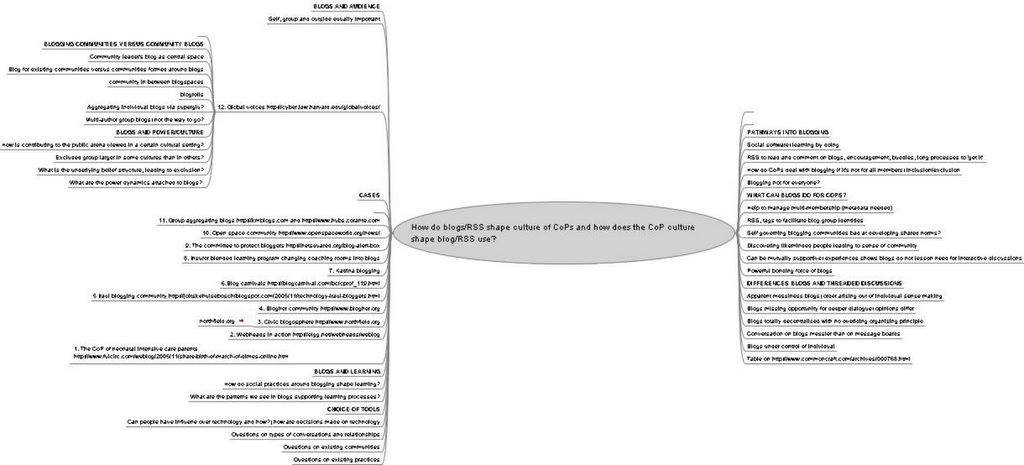
I was so busy talking about blogs that I didn't have time to blog :), nor did I read blogs. I volunteered to summarize a discussion in CPsquare about communities of practice and blogs/RSS. Here's the summary, but based on the summary you can start a whole new discussion (if you want to read it, you may copy this JPEG image and print it).

Interesting and practical were the 12 cases shared and discussed and I will probably discuss a few in separate posts. Personally I see the distinction between existing communities of practice who incorporate blogs as a means of conversation, which will shift the dynamics and content of that conversation, as learning logs did during the online facilitation course I participated in. Blogs are more personal, quiet and safer spaces which are open to a slower pace and more reflection. On the other hand, people reported that blogs can create communities of practice because it is a way of finding likeminded people; which can subsequently lead to dialogue en even meeting face-to-face.

A friend, Maaike Smit, commented that she enjoyed reading my blog because it is so much easier to read a personal account than a long, dry article. I thought that's such an important point about the power of blogs in the overload of information on the web that I like to share it.

Sunday, January 08, 2006

Technology: subscribe to my blog by e-mail!!

I actually thought it was already pretty technical of myself to add a 'subscribe to bloglines' button to my blog. Through copying from Britt Bravo, I have now added a subscription button so that you can subscribe by e-mail. I think this widens people's options to be able to follow my blog, not everyone will know bloglines or be happy with a web-based aggregator, especially people with low bandwith access to the web. It was very simple and easy to do (5 minutes or so), compared to times when you are busy for an hour because you overlooked something small. Some of these things look more complicated than they are which can keep me from trying. When it works, it really stimulates to continue!!

I went to the site of feedblitz and the rest is quite self-explanatory (you subscribe and have to copy a html code into your blog's template).

Technology: How to choose an aggregator

Denham Grey in a discussion on CPsquare about web 2.0 and communities of practice pointed to a podcast on aggregators. It rightly supported my own learning process on RSS. I heard about RSS about a year ago and was really lazy in finding out how and what (and life kind of continues happily without it :)). Then my colleague showed me google reader and I copied all her feeds as well (lazy again) and I used it together with bloglines for reading blogs. Now I'm very happy with bloglines and not too happy with google reader. Bloglines links with my interest in following some blogs and forget to check google reader at times. At times there are so many things you can dig into!

The podcast talks about aggregators a a means of subscribing to RSS feeds. She explains why 2006 can be the year of the aggregator because for instance, it is possible to be informed when a colleague has added something on a project you're working on. There is a basic choice to be made between:
* webbased readers, eg. bloglines, myyahoo, newaggregators
* desktop client readers- to quickly scan what's going on eg. blogbridge is mentioned as a good one because it is java-based, open soure and designed by someone who understands collaboration and can be integrated with delicious.

It's interested that your learning process is very individual, but it can be supported by your community of practice if it coincides with others at the right time. And it can stimulate action and change, my uneasy feeling about google reader will now be transformed into action by trying blogbridge (combined with uploading my own feeds more consciously).

Saturday, January 07, 2006

Culture: the case for contamination

The Ashanti king (asantehene) on the picture. Beverly Trayner sent me the link to an article by Kwame Anthony Appiah called The case for contamination (note that you have to subscribe to the New York Times for free before the article opens). He describes a scene where he is seated on a palace veranda, for a ceremony which involves the Ashanti King called the Wednesday festival day, in Kumasi. But before the king arrived, people were taking calls on cellphones, and discussing contemporary issues like the teaching of science and technology at the local university. The king will be meeting the head of the World Bank next week in the states.

He argues strongly for cultural contamination as the opposite of cultural protection as defined by agencies like Unesco. Though contamination has a bit of a negative connotation I like his emphasis on the dynamics of culture and the fact that people drink Coca-cola everywhere does not means there is a case of cultural imperialism: 'cultures are made of continuities and change and the identity of a society can survive through these changes. Societies without changes aren't authentic; they're just dead.

And: ' change is more a gradual transformation from one mixture to a new mixture, a process that usually takes place at some distance from rules and rulers, in the conversations that occur across cultural boundaries. Such conversations are not so much about arguments and values as about the exchange of perspectives. ' ...' How much of the shift away from these assumptions is a result of arguments? Isn't a significant part of it just the consequence of our getting used to new ways of doing things?'

I recognise the depicted scene very much, last time when we went to the Ethiopian restaurant, we laughed with the son of the owner because he asked how long we all had lived in Ethiopia and his was the shortest of all (two years). Another Ethiopian friend lives in Ireland and is married to a French woman adopted from Brasil when she was eight. So she was asking us lots of things about Ethiopia because she had never been there. They talked to us about how Irish people interact. At the same time, I realize we are more likely to meet those 'cosmopolitans', as Kwame Appiah calls it in his article, through our work and travels.

It also reminds me of the day I travelled with my Ghanaian colleague to a visit the work of one NGO and we met a female chief in one of the villages in Western Region in Ghana. As I was surprised, I asked her several questions. She explained that she was of the family illegible for chieftancy and had been involved in several community tasks when the former chief passed away. She was then asked to take up the chieftancy by virtue of her contributions to the village, even though this is traditionally a men's role. A strong example of the fact that all cultural practices are dynamic.

To try and relates this to communities of practice: the conversations across boundaries, whether professional boundaries or other 'cultural' differences can contribute to gradual change and transformation. So fostering conversations across boundaries is important to innovation (this is my own interpretation).

Tuesday, January 03, 2006

Technology: ICT4D grey literature

Via ictlogy I found an archive of the Department of Communication of the University of Washington with grey literature on ICT4D. You can search the archive by country. When I was studying, more grey literature on development could be found in Western Universities rather than in countries in Africa, but through these online archives it's available for all with access tot the web! (left with being able to find it but for quickly passing on interesting links we have our communities of practice, isn't it)

Sunday, January 01, 2006

Culture: Ananse and the pot of wisdom


Through global voices I found this story from Ghana told by Reverend Peter E. Adotey Addo:

ANANSE AND THE POT OF WISDOM..or NO ONE PERSON CAN HAVE ALL THE WISDOM IN THE WORLD

This is a very old story told when the world was young . It is about how Mr.. Ananse the Sly and greedy one among all the animals in the forest outsmarted himself.
As the story goes Ananse, that is still his name , but did you know that his first name was Kweku because he was born on a Wednesday ? One day Ananse collected all the wisdom in the world and decided to keep it all in a large pot for himself. Now he said “I have all the wisdom of the world for myself. At least that was what he thought being such a greedy person.
Kweku Ananse then tied the pot of wisdom around his neck with a strong vine rope and let the pot hang in front of him. But then he was afraid that someone would find the pot of wisdom and steal it.” What shall I do with my pot of wisdom” He thought and thought and at last he said,” I shall hide the pot on top of the the tallest tree in the forest.” So he searched the forest until he found the tallest tree which happened to be the thorny silk cotton tree and brought the pot of wisdom to the tree. While Ananse was trying to climb the thorny silk cotton tree his son was watching him.” Father,” he said,” “What are you doing” “Well” said Ananse , I have in this clay pot all the wisdom of the world and I am going to hang it on the top of the tallest tree away from everybody , then I will be the wisest in the whole wide world.” “I have an idea.” said his son ” Why not hang the pot behind you instead of in front of you. Then you will be able to climb the tree”. Well the sly one Ananse hung the pot behind him and to his surprise; he was able to climb to the top of the tree with his pot.
Finally Ananse sat on a branch of the tree holding the pot of wisdom. “I thought I had all the wisdom in the world” He thought to himself.
“I thought I had it all in my pot but my own son has wisdom not in my pot.” Then he made a statement that we still use today.” No one-person can have all the wisdom in the world.”On his way down he dropped the pot and it smashed into many pieces and scatted all the wisdom all over the world.


Wednesday, December 28, 2005

Pratical example: Obstacles to knowledge sharing experienced by a network in Ghana

I vlogged Edward Addo-Dankwa (working for the Ministry of Food and Agriculture in Ghana and a board member of GINKS, a network on ICT for development in Ghana) about cultural obstacles to knowledge sharing for networks in Ghana. Unfortunately the video is very, very dark and I thought editing would help, but it didn't. I'm so sorry, but thought it would be a pity not to post it. To compensate I will add Eddy's picture here and my advice is to look at his picture while listening to his voice and what he has to explain, which is very interesting.

I actually had various talks on the topic of how knowledge sharing works in the network and while designing the question for Eddy I thought asking about obstacles would make a negative question and almost choose the alternative of asking about succesful learning processes within the network. Nevertheless, I decided that you can't go around understanding some of the obstacles as well. I asked Eddy because we had discussed the same topic in July as well. He talks about 3 important elements: the fact that people are brought up with information flows from older to younger generations rather than lateral flows, the assumption that knowledge and wisdom comes with age and the perception that people will make money out of knowledge which inhibits free sharing of information.

He actually suggests that education is needed to change people's perceptions to realize that young people may have useful knowledge to contribute and complement. With regard to the fact that people can make money with their knowledge, you may think about ways of rewarding experts, in non-monetary ways. Which is exactly the art of a community of practice to draw in experts and keep them interested by rewarding them with recognition and interesting contacts.

Powered by Castpost

Tuesday, December 27, 2005

Technology: how to start blogging

Britt Bravo has a great post on how to start blogging. It's basically the process I went through, plus I tried to get some help and feedback from people before I started. And I'm terribly lazy with adding new things like a subscription feature, trackback, tagging, so I still have a lot to do. These things are so horribly time consuming. At some point I started listing the blogs I was reading haphazardly in bloglines (now I have 22). Somehow when you are blogging, it gives you more of an interest (or excuse) to read other blogs systematically, I only started reading these blogs systematically when I started blogging myself. And it's amazing what you pick up, things which are completely different from what you blog about at times. It's very tempting to allow your bloglines to grow, but I think I'd like to stop at around 25, to avoid the feeling of having to 'keep up' with your own bloglines (and creating your own information overload).

Saturday, December 24, 2005

same video with 1,4 MB instead of 18 MB (should be faster to open)

Powered by Castpost

Technology: building relationships through online and f2f interactions

I met Manju Chatani in Accra, Manju lives in Accra, is an online facilitator and interested in ICT4D. I interviewed Manju in July for my work with GINKS. Then we were together in the online facilitation workshop of Nancy White which was a great experience and we learned and interacted a lot online for 5 weeks. My work in Accra permitted us to meet again, and deepen our discussions about our online work. I had actually forgotten how fast she talks through all the online -mostly text- interactions :). The great experience for me was that we actually just continued talking where we left off online. For instance, we discussed blogging a lot during the workshop and she asked me straight: 'So, tell me why I should start blogging'; which is really the point where we left off online. I noticed f2f it is easier to fill in some details which seem kind of trivial, yet the lack thereof online may lead to plenty assumptions. (I realize how quickly I pick up accents; plenty is very Ghanaian english and it's the word running in my brains now).

I vlogged Manju about this experience: she has a great explanation of how online interactions can contribute to deepening (learning) relationships, reflecting on our relationship as an example. I knew it would be hard to get her on video, but I succeeded (I think the topic did a lot there)!!

Powered by Castpost

Monday, December 19, 2005

Saturday, December 17, 2005

Changing cultures: men, women and carrying babies

Unfortunately, I didn't dare to take pictures while waiting for my plane.. otherwise there would have been two great pictures. The words probably won't do half of the work but let's try.

My plane was full of Ghanaians living abroad, going home for X-mas, many from the US. And there was one lady, carrying her baby on her back, tying it the Ghanaian way (when I did that some time, I felt like the baby could fall every moment, but Ghanaian women are quite comfortable doing so). And there was also one man, carrying his baby on his belly, with a 'western' carrier. It would have been great to post the two pictures on my blog if only I had dared.

Technology: live blogging from Accra...

Just for fun: blogging from my hotel room in Accra with a wifi connection (and no, this is not the Hilton, nor Golden Tulip, but a 'middle range' hotel...). 20,000 cedis per hour (2 euros). So connectivity is improving in Accra, if you have money. But you can also buy a sim card at every corner for 75,000 cedis. And there is an innovative system whereby you can a card like a phone card, but its for a dial-up connection.

In the plane, I got upgraded to business class (for the second time in my life :). While swimming in my seat, I watched all the movies there were to see and found out you can also send sms/emails if you want. (I resisted this).

We did some brainstorming with GINKS board members (in the picture: Agnes Adjiabeng from EPA; clearly happy with the results). I was very impressed with everything going on. And did I hear the word blogging during the brainstorm??

Thursday, December 15, 2005

Technology: blogging by mail

Hi, this is a test to blog by e-mail. If it works, it would be easier for people with low-bandwith problems. (you can type offline and send all your mails at once, when you are connected). Test, test, test.

Wednesday, December 14, 2005

Technologies: online versus f2f


Yesterday I met the first person who knew my blog without knowing me!! Weird experience. Since I had few comments, you have the impression that nobody is reading your blog. (which is OK because it is also a way of organising and documenting your own thoughts, but getting comments is very stimulating). It was at an informal gathering of people working in development organisations. I also met a person who talked about oyster as important for searches for content on the web (I'll try it). Since we met f2f I forgot his name & it took me some time to find oyster on the web (didn't know how you write it). Beth Kanter mentioned live blogging at Global Voices Summit in London with pictures of people meeting f2f and still hooked up to their computer, which seemed (and still seems) utterly weird to me, but OK there are some disadvantages not putting something immediately in your computer...

I also heard about interesting work by my own colleagues from people from other organisations, which was funny, and shows how hard it is for organisations to develop systems for good internal knowledge sharing, without ending up in boring meetings all the time. I think blogging would be great to keep eachother informed of the basics, but it goes with the habit of blogging and reading. Just wonder if there are private blogformats (suppose there are). It shouldn't be public. But the habits and discipline to blog?. I'll talk about my experiences with documenting in Ghana some other time.

Culture: sinterklaas jokes


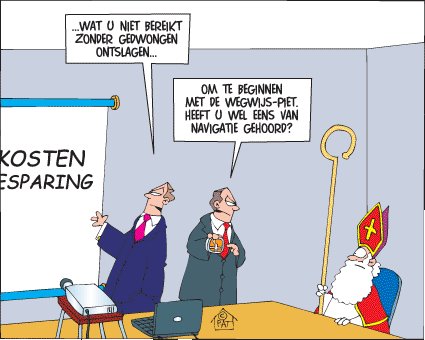
For the last time: sinterklaas by Pathuis from Intermediair

Cost reduction; 'what you can't achieve without firing staff'' 'to start with the show-around Piet, did you ever hear about navigation?'

Probably the joke will be hard to understand without knowing the context (so it's for the 33% of my blogreaders who log in from the Netherlands, amazing what statistics you can get from a free sitemeter..).

Monday, December 12, 2005

Communities of practice


There is a webcast with a presentation by
Verna Allee on value creating network. The good thing is that it takes an hour, but you can click on subparts, and the whole webcast is on transcript as well (I ended up reading rather than listening). There are some really interesting parts related to communities of practice.

First she makes important distinctions between different social networks like information networks, affiliation networks, and purpose networks like knowledge networks and communities of practice; whereas social network analysis has not really made this distinction. She recalls an organisation where everyone was so excited about communities of practice that they started calling everything a CoP (hm very recognisable!). She distinguishes CoPs from knowledge networks since CoPs have a shared domain, a joint enterprise flowing from a joint understanding of the practice, which comes from within. So there is a whole educational process needed to make people understand the difference. She mentions that CoPs are very popular because it seems to build people's skills to survive in a networked society. A different set of skills than needed for survival in a hierarchical organisation.

I like the stricter definition, but if you apply it strictly, I wonder if multistakeholder networks would qualify for CoPs (because of a wide variety of practices and maybe very uneven practices) or are more often knowledge networks (and then what are the different implications for supporting or structuring it?). So far I tried to avoid looking at the name but rather whether CoP theory could help in any way to understand what's going on in a network or CoP. (??)

Practical examples: 5 examples from Latin America

In Intrac Praxis Note 16 (available in English and Spanish), Brenda Bucheli and Gabriela Romo describe some of the outcomes of a workshop on communities of practice held in Mexico at the beginning of this year. The participants were from SNV, PACT and IMAC. The workshop defined a community of practice as a group with a 'common learning interest, aimed at establishing long-term learning processes, innovation, the improvement of practice and the strengthening of relationships between members. It analyses success factors in 5 areas from getting started to incentives. It stresses the building upon existing relationships, knowing who the members and their strengths are and that focussing on the themes of interest does not necessarily commit members to joint action or a formal constitution. Motivation to participate can be strengthened by concrete products like cases or guides, as well as trainings or workshops.

In the appendices, the five cases are summarised: they vary from corporate CoPs (SNV), to a inter-organisational CoP of civil society organisations (IMAC), to a CoP of M&E professionals. At SNV a team works to promote the CoP, which is key to the success, and work programmes can become very ambitious. IMAC and PACT found that the existence of a webpage that recorded the history of the CoP made it easier to integrate new members. EVALperu concludes that it is not indispensable to have external funding. (here members pay a subscription for running costs). IMAC concludes that it's indispensable to contract someone specifically to promote exchange and learning between members, connect and follow-up. Also that organisations with sufficient resources to cover their own operations are more able to participate in the CoP.

Overall, most seem to be relatively formalised with mention of constitutions, internal rules and operational plans. Unfortunately, there are no reflections on the cultural adaptation of the concept, but the conclusion is that CoP provide interesting ways of promoting learning within and between organisations on a larger scale.

Sunday, December 11, 2005

Communities of practice: learning about lice & taboos

Friday I helped with the X-mas decorations in school. One of the mothers talked to me about her wish to know who is having lice (louse-lice?) in the class of her children. Lice is a huge problem in all Dutch schools. Since my daughters are schooling, after each holiday there is an inspection. With the exception of one holiday, on all occassions, we received a letter announcing there is lice in class, please check your children with some short explanation about treatment. Apart from that there is no talking about the topic, out of fear of stigmatization of children. My daughters had it once and even though I checked I saw nothing, you really need experience to recognise it. I have learned a lot about the practice of combatting lice from practice, chemicals don't really work and give the illusion it's been treated. So when I shared my lessons, the mother was surprised. We also discussed whether you would allow a child with lice to play with your children. The ideas were wide apart! Even though there is a lot of informal sharing and collective learning around eating habits etc. in the community of school parents, collective learning on lice is limited. Lesson: opportunities for informal contacts (X-mas decoratings) may help get some conversations on difficult but important topics going. (more difficult in virtual communities?)

Thursday, December 08, 2005

Communities of practice: site map


There is a site map with a very visual overview of CoP theory (like the picture for hierarchy). Though it doesn't go much in-depth and doesn't offer links to articles, it gives a quick overview and some short definitions of terms (though it doesn't state where the definitions are originating).

Culture: Guanxi and social network theory

Pete Bond posted some articles in the yahoo com-prac discussion group, amongst others one by Hammond and Glenn called The ancient practice of Chinese social networking: Guanxi and social network theory. The chinese concept of Guanxi refers to a social network that contextualizes individuals within a highly collectivist society. It is defined as a mechanism by which individuals are able to achieve personal, family or business objectives. The essay argues it overlaps with Social Network Theory and that Western theorists could gain significant isights from Eastern thoughts. The three overlapping areas are:
1. Information and sustainability. Both imply that information is crucial for sustaining a social system.
2. Change and emergence. Relationships are characterized by constancy or change.
3. Order and chaos. (I only understood the overlapping areas when reading the full explanation)

I found the differences as interesting as the overlaps: the essay argues that Guanxi defines insider and outsider relationships, which may be compared to strong and weak ties in social network theory. Yet, whereas in the Chinese tradition of Guanxi the outsider is treated with mistrust and the insiders with trust and sharing of information, in social network theory, weak ties are seen as critical because they are a source of new information. Within Guanxi the collective identity is important and relationships are seen as permanent (as in other collectivist cultures).

The articles conclused that social network theory claims to be a new idea set, yet, the practices of social networking are much older (and more universal?). There will always be emergent rules to create coherence in social interaction. (I would add that the rules may vary in each cultural context).

To link this story to communities of practice; I'm still trying to think through possible differences of CoPs in various cultural settings. I guess it would be too easy to think that in collectivist cultures people are used to be in communities and hence it would be easier to nurture CoPs, as these social networks (like Guanxi) are not around practices. From the above explained differences in the essay I gather that outsiders might be regarded with much suspicion compared to insiders. Even though it is a risk in any CoP, the risk of CoPs becoming clique-ish in collectivist societies may be higher. These kind of clique-ish communities tend to stagnate and the close ties may prevent members from critiquing each other or from seeking to deepen their understanding of the domain. (p. 145 cultivating communities of practice, Wenger, McDermott and Snyder).

Communities of practice: Nancy Dixon on knowledge transfer


I went to the local library because they had purchased their first book on weblogs (apparently Rosmalen is about to enter blogosphere). But someone had borrowed it already and I bumped into Nancy Dixon's book on 'Kennisoverdracht in organisaties'. In english: Common knowledge: how companies thrive by sharing what they know. I had read her book on the organizational learning cycle, but this one was quite different.

Personally I had abandoned the term 'knowledge transfer' because I thought it's impossible to transfer knowledge. Rather people should take their own learning trajectories in hand. But after reading this book, I see it can be possible under some conditions. (still I feel the term knowledge transfer implies an easiness in handing over knowledge which is misleading)

She first does away with three mythes about knowledge transfer:
1. Build the system, people will come
2. Technology can replace human contact
3. First you have to create a learning culture

(must admit I was not sure that the third one is a myth, but I'm happy it is..). It's easier to build on what exists rather than changing the culture by introducing something new. She distinguishes 5 categories of transfer (very useful to make a distinction, I have the feeling often all kinds of knowledge are heaped in a single discussion on knowledge management):

1. Serial transfer (the same team executing a task in a new context)
2. Near transfer (transfer from a source team to a receiving team with a similiar task in a similar context)
3. Far transfer (transfer from a source team to a receiver team with a non-routine task, implicit knowledge)
4. Strategic transfer (transfer of complex knowledge from one team to the other, separated in place and time, the task is of strategic interest to the organisation)
5. Specialist transfer (transfer of explicit knowledge about a task not performed on a regular basis) This is a typical case where a listserve may work.

(just realize I don't know which english terms she uses as I read the Dutch translation, near and far transfer sounds weird). Other things which were striking:

* The fact that elements of a new situation can trigger people's implicit memory, so that old experiences bubble up.
* The reason to name a certain scattered, existing knowledge practice is to make is a legitimate activity, which makes a request for support no longer a favour from your colleague but a recognised part of your professional practice.

* Putting all implicit knowledge on paper on in text is very hard. Because implicit knowledge does not only exist by facts but also of the linkages between facts and how people link facts to deal with a certain situation. So gains from implicit knowledge can be found in situations where new things have to be designed or thought through. (this last one helps me to specify my question on virtual communities of practice, I still wonder how they will deal with transferring some of the deeper levels of implicit knowledge of the members, which can only be observed through reacting to certain situations).

Culture: on changing mobile phone cultures

Yesterday in the train, a girl was talking loudly to a friend using her mobile. Two men sitting opposite her told her to lower her voice. (I sympathised with her because I seem to do the same thing according to my husband; talking too loud in a phone). And someone added that this was a 'silent' part of the train. But after some time, the phones of the two men also started ringing and they engaged in a -longish- conversation as well :). Someone next to me said: "it's OK if you just inform people of where you are, but you shouldn't throw your whole life in....". I have the impression 7-8 years ago with the introduction using mobile in public was considered inappropriate. Personaly I like it a lot when people throw their whole lives into the train!
A difference between Ghana and the Netherlands is that here you are supposed to put your mobile off in meetings. In Ghana, in 2003, important people used to leave their mobiles on and answer the phone during the meeting (whispering though). Will see if that changed.

The 7-8 years suddenly remind me of the fact that in the UNDP case (see previous post) it took from 1999-2003 before numbers of members of CoPs really went up. Would be interesting to know more about that process and if there was a specific reason for it to go up at that point in time.

Tuesday, December 06, 2005

Practical examples: the knowledge sharing approach of the United Nations Development Programme

In the km4dev journal there was an article by Kim Henderson on the knowledge sharing approach of UNDP based on CoPs or knowledge networks. The first CoPs were established in 1999 in some of the priority thematic areas of UNDP, currently there are 20 knowledge networks with between 300-2300 members each, corresponding to the strategic goals. Members are primarily UNDP staff, though some are open to external participants. The networks serve for sharing experiences and good practices, and for discussion of substantive issues. The networks are linked by electronic networks, but also supported by regular face-to-face meetings. One of the unique features is the use of a standardised product called the 'consolidated reply'. This reply entails supplementing each discussion with information about what is already known and published on the topic.

Subscription is voluntarily and rose slowly from 1999-2003, but sharply between 2003-2005. CoPs have improved connections between the headquarters and the field, between country offices, leveling the hierarchy and enabling inputs from bottom up into policy and practice. It is reported to be a huge shift from 1998, where staff were required to clear message content with senior managers before sending out e-mails. (I recall this too, in 1998 in Ethiopia, our secretaries were printing, stamping and filing all e-mail messages :)) to direct communication between national programme staff. The consolidated reply is reported to be a real time saver by CoP members.
Key ingredient for healthy CoPs are reported to be:
* Moderation or facilitation
* Maintaining quality
* Balancing participation with quality of contributions
* Getting to know community members
* Sequencing and managing the flow on the electronic network

You should not presume CoPs can do everything and take the place of organised project mapping or knowledge gathering. A key issue was to maintain the quality, yet if the bar is set too high, members were too intimidated to provide contributions.

Further efforts will go into ongoing translations (over five official languages), systematic collection of knowledge to complement the connecting by the CoPs, and mainstreaming knowledge management into human resource approaches such as performance assessement and career tracks. The article concludes by saying CoPs can be an excellent entry point for knowledge management initiatives within development organisation. Yet, CoPs can only take an organisation so far, and efficient systems for collecting information are required as well.

Communities of practice: HIV/AIDS prevention practices

Yesterday, a colleague had organised an interesting meeting with Achieng Renish Ngube, a Kenyan HIV/AIDS activist, who figures in a book called Mijn status is positief by Annemie Struyf and Lieve Blancquaert. Two things struck me in relation to communities of practice/learning.

The first thing is that she mentioned that all the information my colleague forwarded to her about HIV/AIDS contributed to her change from patient/victim to activist. So knowing more about HIV/AIDS changed her attitude.

The second thing is about being at the cutting-edge of practice. We asked her to comment on the HIV/AIDS educational materials that IICD partners in Ghana produced (a comic depicting HIV/AIDS by monsters). She felt the content would probably be very appropriate for youth, but that the second part of the message is missing, being the message about the availability of antiretroviral drugs. And this could be important to stimulate people to go for testing. It clicked with the story of a friend who went back to Ethiopia. While we were there till 2000, testing was very uncommon, but now lots of people in his area (Ambo) had gone for tests, since they had free access to antoretroviral drugs, in case they would test positive.

It seems that being linked to a community of practice is very important to be at the cutting edge of practice, since the scenery is changing rapidly. It would be a pity if all these NGOs and agencies continue with the famous ABC (abstain, be faithful and condoms) message while there is an important opportunity to change people attitude towards testing. (apparently there are more drugs available in Kenya than people who have tested positive and qualify for it). Huge needs to speed up collective learning.